Table of Contents
- Why Branded Corporate Workwear Matters for Your Business
- Building Brand Identity and Recognition Through Workwear
- The Benefits of Corporate Uniforms for Employee Morale
- Creating Professional Appearance and Customer Trust
- Embroidered Company Apparel: Durability and Visual Impact
- Choosing Durable Corporate Workwear for Long-Term Value
- Measuring Return on Investment and Cost Efficiency
- Frequently Asked Questions
Last Updated: October 10, 2026
Why Branded Corporate Workwear Matters for Your Business
Branded corporate workwear creates a unified visual identity that customers and employees instantly recognize. When your team wears consistent, professionally designed apparel with your logo, it sends a clear message about who you are and what you stand for.
Employees feel part of a larger team. Customers perceive professionalism and trustworthiness.
Building Brand Identity and Recognition Through Workwear
Your brand identity lives on your employees’ chests, sleeves, and shoulders every single day.
When employees wear branded apparel consistently, your company becomes visually recognizable. A customer sees your logo repeated across your team and begins to associate that visual identity with your service quality. This consistency matters. According to research on brand recognition from the American Psychological Association, visual consistency increases brand recall by strengthening neural pathways in how people remember organizations.
Employees wearing branded uniforms become moving advertisements, extending your reach beyond your physical location.
Your brand identity becomes tangible, customers see professionalism, attention to detail, and a team that takes itself seriously.
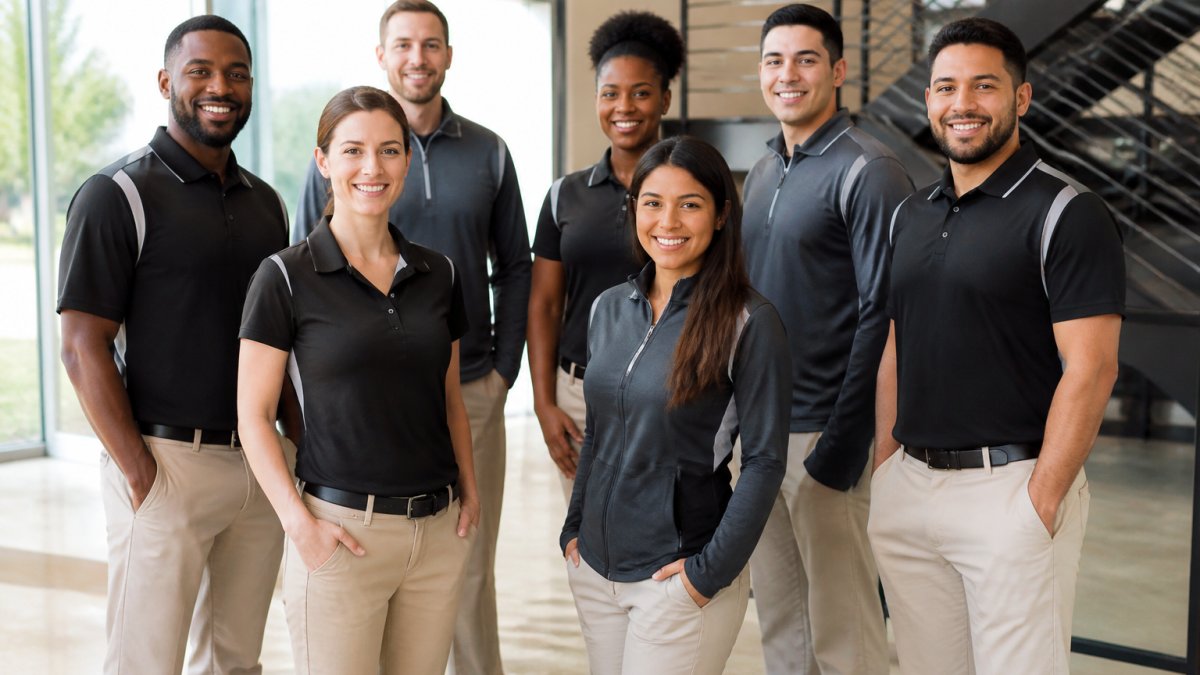
Custom uniforms compress years of marketing effort into a single, visible statement that builds familiarity and trust.
The Benefits of Corporate Uniforms for Employee Morale
When employees put on a uniform bearing their company’s name and logo, they shift psychologically from individual to team member. This sense of belonging drives engagement.
A uniform program signals that your company values unity and has invested in team identity. Employees who feel valued perform better, stay longer, and recommend the company to others.
Morale gains only materialize if employees want to wear the uniforms. Poorly fitting garments, inadequate sizing, or designs that exclude different body types create resentment rather than pride.
Practical adoption factors that drive morale:
-
Fit and sizing: Offer a genuine range of sizes (XS through 4XL minimum) and multiple fit styles. Petite and tall options prevent the frustration of garments that don’t fit properly. When employees feel comfortable in their uniforms, they wear them willingly and feel confident.
-
Gender-inclusive design: Cut options matter. Some employees prefer traditional fits; others need different proportions. Offering both unisex and tailored cuts signals that the program was designed with everyone in mind, not as an afterthought.
-
Fabric and climate suitability: A heavy cotton uniform in a warm warehouse creates resentment. A lightweight, moisture-wicking blend in the same environment builds buy-in. Seasonal options (short-sleeve and long-sleeve) show that you’ve considered the actual working conditions.
-
Employee input on design: Involve your team in choosing colors, styles, and fit options before rollout. Employees who had a voice in the decision are more likely to embrace the result. A simple survey asking for preferences costs nothing and dramatically improves adoption.
-
Accessibility considerations: For employees with mobility challenges, sensory sensitivities, or other needs, standard uniforms may not work. Building flexibility into your policy (modified fits, alternative fabrics, exemptions where necessary) ensures inclusion rather than exclusion.
Uniforms eliminate daily dress decisions, reducing cognitive load. For customer-facing roles, they remove appearance-based anxiety and boost confidence.
Uniforms create a psychological boundary between work and personal life, supporting better work-life balance.
Research from the Society for Human Resource Management on workplace culture shows that teams with visible symbols of unity report higher engagement scores. Branded corporate workwear serves as exactly that symbol, constant, visible, and reinforcing, but only when the program is designed with employee comfort and inclusion as core priorities.
Creating Professional Appearance and Customer Trust
Your employees’ appearance shapes first impressions in seconds.
Customers notice what your team is wearing before hearing a word. Professional, branded apparel sends an immediate message: this is a serious, organized business.
Professional branded uniforms build customer trust quickly. Customers associate cohesive dress with competence and reliability.
This trust translates to business outcomes: customers are more likely to purchase, book services, return, and recommend you to others.
Branded uniforms create accountability. Employees take more care with interactions when visibly representing their employer.
Durability matters, faded logos and worn seams undermine professionalism. Customers notice quality.
Embroidered Company Apparel: Durability and Visual Impact
The difference between printed and embroidered logos is immediately visible and lasts.
Embroidered company apparel creates a premium visual impression. The logo becomes part of the garment, making the design feel more permanent and professional.
Embroidered logos withstand repeated washing and wear far better than many printed designs.
Quality embroidery pays for itself through longevity.
For customer-facing roles, durability matters more. Customers interpret worn uniforms as poor management. Embroidered designs signal maintained standards.
Piercy Sports and Apparel specializes in premium embroidery that preserves color vibrancy and stitch integrity through extended use.
Choosing Durable Corporate Workwear for Long-Term Value
Durability isn’t just about the embroidery. It’s about every component of the garment.
When you’re choosing durable corporate workwear, evaluate the base fabric first. High-quality cotton blends and performance fabrics hold their shape, color, and integrity far longer than budget alternatives.
Thread quality matters. Cheap thread breaks, unravels, and creates loose seams. Quality thread maintains structural integrity through repeated washing and wear. The difference is invisible until the garment fails.
Seam construction determines how long a garment survives daily use. Double-stitched seams in high-stress areas (armholes, shoulder seams, side seams) prevent the blowouts that plague cheaper alternatives. Reinforced hems and collar bands add months to a garment’s usable life.
Consider the specific demands of your roles. A warehouse worker needs different durability features than an office receptionist. Work in harsh environments requires heavier fabrics and reinforced stress points. Customer-facing roles need garments that maintain their appearance through frequent washing.
The total cost of ownership matters more than the unit price. A durable uniform worn regularly for two years costs less per wear than a cheap uniform replaced every six months. This calculation changes how you should evaluate pricing.
| Consideration | Budget Option | Quality Option | Impact |
|---|---|---|---|
| Fabric durability | Standard cotton | Performance blend | Lasts 6-12 months vs. 24+ months |
| Thread quality | Standard | Premium polyester | Seams hold vs. fray after months |
| Seam construction | Single-stitched | Double-stitched reinforced | Blowouts vs. structural integrity |
| Color retention | Fades noticeably | Maintains vibrancy | Professional appearance maintained |
| Cost per wear | Higher (frequent replacement) | Lower (extended use) | Budget efficiency improves with quality |
Measuring Return on Investment and Cost Efficiency
Numbers matter when you’re making a business decision about branded workwear.
The ROI calculation starts with direct costs: the price of the garments, embroidery or printing, and any customization. Then add indirect costs: time to manage orders, logistics, inventory, and replacement cycles. Against those costs, measure the benefits through specific, trackable metrics.
Calculate total cost of ownership (TCO):
Don’t compare unit price alone. Over a five-year period with 50 employees, a quality option can lead to significant savings in replacement costs.
Include all costs in your TCO model:
- Initial garment purchase and embroidery/printing
- Replacement cycles (estimate 25-50% of inventory annually)
- Laundering and maintenance (if company-provided)
- Inventory management and logistics
- Administrative time for ordering, sizing, distribution, and tracking
- Alterations or custom fitting for specific roles
A realistic TCO for a team in branded polos, t-shirts, and jackets depends on quality and replacement frequency. This becomes your baseline for measuring ROI.
Measure brand visibility and cost per impression:
An employee wearing branded apparel generates brand impressions throughout their day. A customer-facing team of 10 people, each interacting with 20 customers daily, creates 200 brand impressions per day, or 52,000 annually (assuming 260 working days). Maintaining this consistent visual presence requires durable fabrics, which is why many organizations prioritize polyester blends for apparel to ensure their staff remains polished throughout these thousands of daily interactions.
Compare this to paid advertising. A local digital ad campaign might cost a certain amount monthly for equivalent reach. Your uniform program can deliver similar visibility at a fraction of the cost. This calculation alone often justifies the investment.
To track this:
- Survey new customers: “Where did you first hear about us?” Include “saw your team’s uniforms” as an option.
- Monitor brand mentions on social media and review sites that reference your team’s appearance.
- Measure foot traffic or inquiries on days when your team is visibly wearing branded apparel versus days they are not (if applicable).
Track employee retention and turnover savings:
Replacing a skilled employee costs 50-200% of their annual salary when you factor in recruitment, training, and lost productivity, according to Society for Human Resource Management turnover cost research.
If your uniform program reduces annual turnover by even one employee in a team, you can save significantly depending on role and salary. Measure this by comparing your turnover rate before and after implementing uniforms, controlling for industry and economic factors.
Example: Reducing turnover can lead to substantial annual savings. A uniform investment can pay for itself quickly.
Measure customer perception and conversion impact:
For retail and service businesses, track:
- Conversion rate: Percentage of customers who make a purchase or book a service. Compare conversion rates before and after uniform rollout.
- Average transaction value: Do customers spend more when interacting with uniformed staff? Track this metric monthly.
- Customer satisfaction scores: Use post-transaction surveys to measure perceived professionalism and trustworthiness.
- Repeat business rate: What percentage of customers return? Uniforms that build trust often increase repeat rates by 5-15%.
Even a small increase in conversion rate on annual revenue can generate significant additional revenue.
Measure employee productivity and engagement:
Employees in cohesive teams (signaled by uniforms) report higher engagement. Track:
- Employee engagement scores (via anonymous surveys)
- Absenteeism rates (uniforms correlate with higher attendance)
- Customer service metrics (call handling time, complaint resolution, customer satisfaction scores)
- Internal promotion rates (engaged employees stay and advance)
A reduction in absenteeism across a team can save significantly annually in lost productivity.
Build a simple ROI dashboard:
| Metric | Baseline | Year 1 | Year 2 | Impact |
|---|---|---|---|---|
| Annual turnover cost | $500,000 | $450,000 | $425,000 | $75,000 saved |
| Brand impression reach | 0 (paid only) | 52,000 | 52,000 | $3,000-$5,000 ad equivalent |
| Customer conversion rate | 8% | 8.5% | 9% | $7,500-$15,000 revenue lift |
| Employee engagement score | 6.2/10 | 6.8/10 | 7.2/10 | Higher retention, lower turnover |
| Uniform program cost | , | $5,000 | $3,500 | , |
| Net ROI | , | $77,500 | $76,000 | 1,550% return |
The key is tracking metrics that matter to your specific business. For retail, prioritize conversion and repeat rate. For service businesses, emphasize customer satisfaction and retention. For all businesses, measure employee tenure changes and calculate the turnover savings. When you measure the full picture, reduced turnover, improved customer perception, extended marketing reach, and productivity gains, branded workwear consistently delivers ROI that exceeds the investment.
Frequently Asked Questions
How does branded corporate workwear help a business stand out?
Branded corporate workwear creates immediate visual recognition and strengthens your company’s professional image. When employees wear consistent branded apparel with your logo and colors, customers instantly associate them with your business, reinforcing brand identity every time they interact with your team. This visibility extends beyond your location, employees become mobile brand ambassadors in their community, increasing awareness and credibility.
Can company uniforms actually improve employee morale?
Yes. When employees wear branded company apparel, they feel part of a unified team with shared purpose and identity. This sense of belonging boosts confidence, encourages engagement, and strengthens company pride. Uniforms eliminate dress-code anxiety, reduce social comparison, and signal that employees represent something larger than themselves, which measurably improves job satisfaction and retention.
What makes embroidered company apparel better than printed alternatives?
Embroidered company apparel offers superior durability and a more professional finish. Embroidery threads are stitched directly into the fabric, meaning logos withstand repeated washing, stretching, and daily wear without cracking or peeling. Embroidery also creates a tactile, premium appearance that conveys quality and attention to detail, signaling to customers that your business values excellence.
What should I look for when choosing durable corporate workwear?
Prioritize fabric weight, seam construction, and finishing technique. Look for medium to heavyweight fabrics that resist wear, double-stitched seams for longevity, and embroidery or high-quality screen printing that won’t fade. Consider the role, customer-facing staff need premium appearance, while warehouse teams need functional durability. Partner with providers who specialize in corporate apparel and can guarantee their craftsmanship will hold up to your specific work environment.