Table of Contents
- Why Custom Team Uniforms With No Minimum Order Matter
- What to Expect From Custom Jersey Design
- Sublimation Printing vs. Screen Printing and Embroidery
- Custom Hockey Jerseys and Sport-Specific Options
- Custom Team Shirts for Youth, Adult, and Mixed-Gender Teams
- Handling Roster Changes and Reorders
- Design Quality, Durability, and Approval Process
- Production Time and Getting Uniforms Before Your Season
- Frequently Asked Questions
Last Updated: October 9, 2026
Why Custom Team Uniforms With No Minimum Order Matter
Custom team uniforms with no minimum order have transformed how small teams, youth leagues, and growing organizations build their identity.
Custom team uniforms signal identity and build cohesion, but only if they fit the team’s size, timeline, and budget.
The challenge is knowing which suppliers deliver on the no-minimum promise without hidden fees, quality compromises, or unrealistic turnaround times. Here’s how to evaluate options and get uniforms before your season starts.
What to Expect From Custom Jersey Design
Designing custom team uniforms starts with clarity.
When you submit artwork to a provider like Piercy Sports and Apparel, we check file quality and resolution.
The proof approval stage is critical. You’ll receive a digital mockup showing exactly how your design will appear, so you can catch issues with color accuracy, placement, and sizing.
Design approval typically takes 3-5 business days; expedited review or multiple revision rounds take longer. The total design-to-production window is commonly 7-10 days.
Sublimation Printing vs. Screen Printing and Embroidery
Three methods produce custom team uniforms: sublimation printing, screen printing, and embroidery. The right choice depends on design, budget, and durability expectations.
Screen printing applies ink through a mesh screen, one color at a time, and suits simple 2-4 color designs.
Embroidery stitches thread directly into fabric for a textured, premium look, ideal for logos, names, and numbers.
Many teams combine methods to balance visual impact, durability, and cost.
Custom Hockey Jerseys and Sport-Specific Options
Sport-specific construction is where a no-minimum order either works or falls apart. A supplier that can print one soccer jersey may not produce one hockey jersey, because decoration, fabric, and trim requirements differ by sport.
Hockey
Hockey jerseys are the heaviest construction in team apparel. Quality shells use a polyester-and-nylon blend (often around 200 GSM) with reinforced shoulders and a fight strap on pro-style cuts.
Tackle twill (stitched fabric layers) is a premium alternative for crests and numbers, common at high school and junior levels. The catch: tackle twill requires cutting and sewing each number, so many suppliers set a per-design minimum on twill even when they advertise no minimum on other jersey types.
Baseball and Softball
Button-front jerseys, raglan or set-in sleeves, and matching pants define the category. Fabric weight matters more here than in any other sport because the uniform is worn in heat for nine innings. Look for moisture-wicking polyester in the 150-180 GSM range for jerseys and a heavier twill or polyester blend for pants. Pants are most likely to carry a minimum since they’re cut and hemmed to length, if you need one replacement pair, confirm the supplier will cut a single pair to a specific inseam.
Football
Football jerseys must fit over shoulder pads, so the sizing chart differs from a T-shirt chart, a jersey sized to a player’s street size won’t fit over pads. Most suppliers publish a separate “padded” chart running one to two sizes larger, with numbers typically 8-10 inches front and back. Because rosters are large and jerseys expensive, no-minimum ordering is most valuable here for mid-season replacements.
Lacrosse
Lacrosse uniforms use mesh panels for ventilation and often a reversible or two-piece short-and-jersey set. Confirm whether the supplier prints both sides of a reversible or only one.
Soccer
Soccer jerseys prioritize fit and moisture management over durability. Lightweight polyester (130-150 GSM) with flatlock seams reduces chafing, and names and numbers are usually heat-applied or sublimated. Because rosters are small and youth turnover is high, single-unit reorders are most common here, and a supplier’s reorder policy matters most.
Volleyball
Volleyball uniforms are typically sleeveless or short-sleeve jerseys with spandex-blend shorts. Fit is close to the body, and women’s and men’s cuts differ significantly in shoulder and torso proportions. A supplier offering only one cut will leave half a mixed-gender roster in the wrong fit.
Before you assume “no minimum” applies to your sport, ask three questions: (1) Which decoration methods carry a minimum? (2) Can you cut a single unit in my size? (3) Is the size chart sport-specific or generic? The answers vary more by sport than by supplier.
A practical test: request a single sample unit in your sport before committing to the full roster. Most no-minimum suppliers will produce one, and the sample confirms fabric weight, fit, and decoration quality in a way a digital proof cannot. Budget for it, a single decorated jersey costs more per unit than a bulk order, and that premium is the price of verifying fit before you buy 15.
National Federation of State High School Associations uniform rules
Custom Team Shirts for Youth, Adult, and Mixed-Gender Teams
Sizing is where many teams encounter problems. Youth, adult, and mixed-gender rosters require different size ranges and fit profiles.
Youth Sizing and Fit
Youth uniforms typically run XS through XL, scaled down from adult standards.
When ordering custom team uniforms for youth, request a manufacturer-specific size chart.
Growth matters too: a youth team spanning ages 10-13 creates a 3-4 inch height range, so slightly oversizing for growth and layering is common. Discuss this with your supplier when finalizing sizes.
Adult and Custom Sizing
Adult uniforms offer standard sizing (S, M, L, XL, XXL) plus custom options. Some teams need extended sizes or unusual proportions.
Piercy Sports and Apparel accommodates custom sizing for teams with specific needs, tall sizes, wide sizes, or modified proportions, so every player feels comfortable and confident.
Mixed-gender teams present a real challenge: men’s and women’s cuts differ in shoulder width, torso length, and chest fit. Some suppliers offer both cuts; others don’t.
Handling Roster Changes and Reorders
Rosters change constantly: a player gets injured, a new kid joins mid-season, a jersey is lost, or a sizing error surfaces after the first game. The ability to reorder a single matching item, without restarting the design process or paying a new setup fee, is the real test of a no-minimum supplier. Here’s what determines whether a reorder goes smoothly.
What a clean reorder requires
A reorder is only as good as the records behind it. Before placing the original order, confirm the supplier will retain:
- The approved artwork file and color values (Pantone or hex)
- The exact fabric and garment style number
- The decoration method and placement coordinates
- The size breakdown and any custom measurements
If the supplier can’t reproduce the original spec, your “matching” reorder may arrive in a different shade, fabric weight, or logo placement. Ask upfront how long they keep order records, a common pattern is 12-24 months, though some archive indefinitely.
The cost variables on a single-item reorder
A reorder isn’t always priced the same as the original order. Expect these line items:
- Per-unit price. Small quantities cost more per unit because setup and handling spread across fewer pieces. A single jersey may cost noticeably more than the same jersey in a 15-piece order.
- Setup or screen fees. Screen printing requires a new screen per color per design. If the supplier didn’t archive the screens, a one-off reorder can trigger a full setup charge. Embroidery usually avoids this because there’s no physical screen.
- Artwork or digitizing fees. Embroidery requires a digitized file. If the supplier keeps it, reorders are cheap; if not, you pay to digitize again.
- Shipping. A single item ships at parcel rates, which can approach the cost of the item itself. Ask whether the supplier will hold a reorder and ship it with a later batch to reduce freight.
Ask about reorder pricing before you place the original order, not after. A supplier that charges the same per-unit rate on a single reorder is offering real value. A supplier that applies a large small-order markup is telling you something about how they treat existing customers.
Turnaround on reorders
Standard reorder production runs roughly 5-10 business days once the spec is confirmed, plus shipping. Rush reorders (3-5 days) are sometimes possible at a premium. If you’re replacing a jersey three weeks before playoffs, confirm the timeline in writing before you commit.
Roster changes that are not reorders
Some changes aren’t a simple reorder:
- Adding a player mid-season. You need a new name and number on an existing design. Confirm the supplier will add both to a single unit without a new art fee.
- Replacing a damaged uniform. If it’s a manufacturing defect, check the remake or return policy. If it’s wear-and-tear, it’s a standard reorder.
- Changing a number. Some suppliers treat a number change as a new decoration setup; others treat it as a modification. Ask which.
- Switching a size. A size swap on an existing design is usually the simplest reorder, but confirm the size is still in stock in the original fabric.
Buyer protections to confirm
Before relying on a supplier for mid-season reorders, verify:
- Proof approval process. You should approve a digital proof before any reorder goes to production, even a single unit.
- Remake policy. What happens if the reorder doesn’t match the original? A written remake or refund policy is the difference between a supplier and a gamble.
- Payment security. Use a payment method with dispute rights. Avoid suppliers requiring wire transfer or untraceable payment for small orders.
- Review evidence. Look for reviews mentioning reorders specifically, not just first orders. Strong first-order reviews with no reorder feedback leave the supplier an unknown.
Treat the original order as the setup for every future reorder. Document the artwork, fabric, style number, and size breakdown yourself, and confirm the supplier archives the same information. The team that keeps its own records never has to restart the design process.
Federal Trade Commission guidance on online shopping and refund policies
Design Quality, Durability, and Approval Process
Whether uniforms last or deteriorate after a season comes down to execution: fabric quality, printing or embroidery technique, and care instructions.
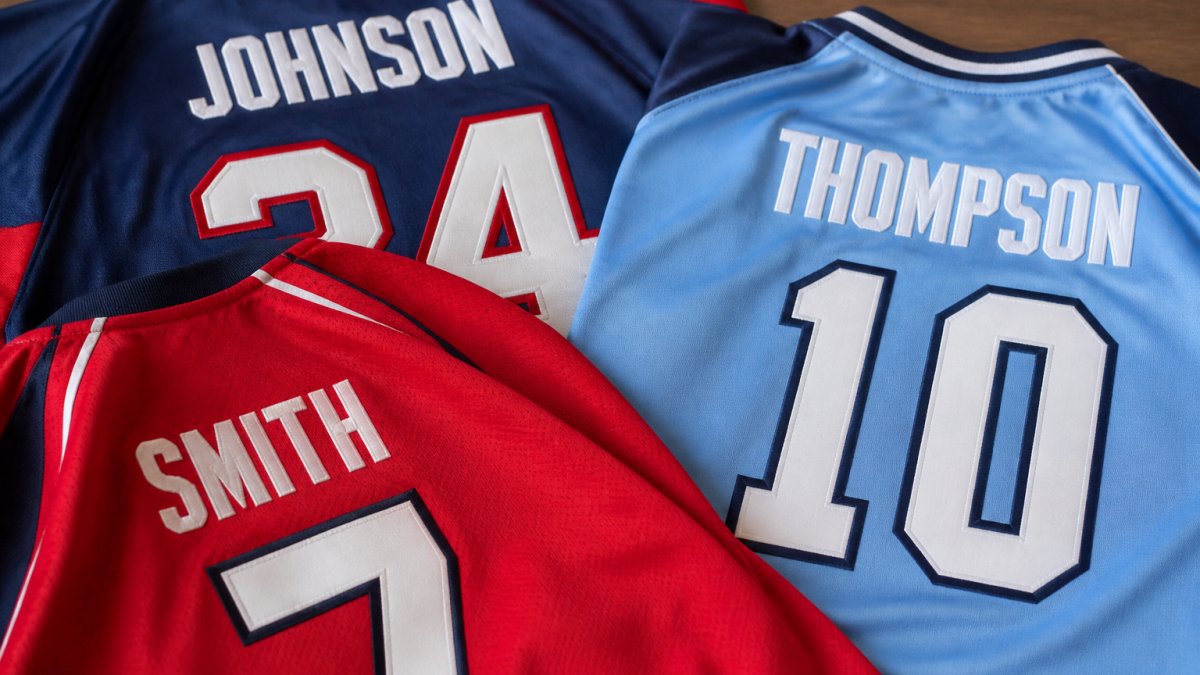
Quality fabric is non-negotiable. Polyester blends rated for athletic use resist pilling, fading, and shrinkage. Heavy-weight polyester (around 200 GSM) outlasts lightweight versions.
Screen printing durability depends on ink quality and application technique. Poor-quality screen printing cracks within a few washes.
The approval process protects you.
Ask about wash testing.
Production Time and Getting Uniforms Before Your Season
Production time is the final critical variable. Custom team uniforms with no minimum order are only valuable if they arrive when you need them.
Standard production typically takes 10-15 business days from proof approval, assuming no design revisions and standard fabric availability.
Shipping adds 2-5 business days depending on distance and method.
Piercy Sports and Apparel prioritizes fast, reliable turnaround because a delayed uniform order disrupts team preparation.
Plan backward from your season start date. If you need uniforms by a specific date, communicate that clearly when ordering.
Weather and material availability can affect timelines.
Frequently Asked Questions
Can you really order custom team uniforms with no minimum order?
Yes. Many providers now offer no-minimum policies, allowing you to order a single custom team uniform or small quantities without bulk requirements. This works well for small youth leagues, individual replacement orders, or testing a design before committing to full team quantities. Confirm the no-minimum policy directly with your provider when requesting a quote, as some may apply small fees for single-item orders.
What’s the difference between custom sublimated uniforms and screen-printed designs?
Sublimation printing transfers dye directly into polyester fabric, creating vibrant, all-over designs that won’t crack or peel. Screen printing applies ink to the surface, ideal for logos and text on any fabric. Embroidery uses thread for a raised, three-dimensional effect. Sublimated uniforms offer durability and full-color graphics; screen printing and embroidery are better for team logos and player names.
How long does it take to produce custom team uniforms?
Standard production typically takes 2-3 weeks after design approval. Rush orders may be available for an additional fee, reducing turnaround to 1-2 weeks. Factors affecting timeline include design complexity, customization method (e.g., screen printing), quantity, and current order volume. Confirm production schedules with your provider early, especially if your season starts soon.
What information do I need to provide to order custom team uniforms?
You’ll need team name, logo artwork (high-resolution file), team colors, player names and numbers, desired uniform style (jersey, shorts, full set), sizing details for your roster, and quantity. Provide a size chart if ordering for youth and adult sizes. Your provider will request design mockups for approval before production begins. Have roster details ready in case you need mid-season updates.
Custom team uniforms with no minimum order have eliminated the biggest barrier to team identity and professionalism. The challenge now is finding a supplier who delivers on quality, speed, and flexibility. At Piercy Sports and Apparel, we specialize in exactly this: high-resolution digital printing, premium embroidery, and tailored solutions that match your team’s vision and timeline. Get started with a quote today and experience the difference superior craftsmanship makes.