Quick Summary
To remove grass stains from sports jerseys, rinse the stain from the back under cold water, work in a few drops of liquid enzyme detergent or dish soap, and let it sit 15 to 30 minutes before washing gently in cold water. Acting within a few hours gives the best chance of success.
- Rinse from the back with cold water so pigment is pushed out rather than deeper in.
- Let the detergent sit on the stain for 15 to 30 minutes so enzymes can break down the pigment.
- Use cold water only, since hot water can set the stain permanently.
- Never use chlorine bleach on polyester blends or printed designs.
- Check the stain in good light and avoid the dryer until it is fully gone.
Table of Contents
- Why Grass Stains Set Faster on Sports Jerseys
- What You Need Before You Start Treating the Stain
- Best Stain Remover for Polyester Sports Jerseys
- Step-by-Step: Pre-Treating and Washing the Stain
- Removing Set-In Grass Stains From White Football Jerseys
- How to Wash Sports Jerseys to Preserve Screen Printing
- Drying Safely and Checking the Stain Before Heat
- Get Matching Jerseys From Piercy Sports and Apparel
- Frequently Asked Questions
Why Grass Stains Set Faster on Sports Jerseys
Last Updated: November 4, 2026
Grass stains are among the hardest marks to remove from sports jerseys. The green pigment comes from chlorophyll, which bonds tightly to polyester and other synthetic fibers. If you learn how to remove grass stains from sports jerseys quickly, you can save the garment before the color sets.
Grass stains are stubborn for a simple reason. Chlorophyll is an oil-based pigment, so it clings to the fibers of a jersey and does not rinse away with plain water. Sweat and dirt make it worse, binding the stain deeper into the fabric. Because chlorophyll binds to fibers much like grime can cling to synthetic turf, the same attention to gentle, natural methods is useful when cleaning artificial grass.
Here is what speeds up the setting process:
- Heat: Hot water and high dryer temperatures lock pigment into the fibers.
- Time: A stain left overnight becomes much harder to lift.
- Drying: A stain that dries before you treat it bonds permanently.
- Friction: Rubbing a stain without pre-treating pushes pigment deeper.
Acting within a few hours gives you the best chance.
What You Need Before You Start Treating the Stain
Gather a few basic supplies before you begin. Having everything ready keeps the stain from drying while you search for tools.
- A clean white towel or old cloth
- A soft-bristled brush or an old toothbrush
- Liquid laundry detergent with enzymes
- Dish soap, which cuts through oil-based pigment
- White vinegar or hydrogen peroxide (test first on colored jerseys)
- Cold water and a clean basin or sink
- The garment’s care label, so you know the fabric and wash limits
Check the care label before using any product. Some printed designs and numbers react badly to peroxide or strong bleach, so a spot test on a hidden seam is a smart step.
Best Stain Remover for Polyester Sports Jerseys
Polyester is not one fabric. The constructions you are most likely to encounter react differently to heat, solvents, and agitation, so match the remover to the construction before you start.
- Polyester mesh (the open-weave body of most jerseys): The loose knit lets detergent penetrate quickly, but the same openness means pigment can wick deep into the yarn. A liquid enzyme detergent worked in with fingers, followed by a 15- to 30-minute dwell, is usually enough. Avoid stiff brushes on mesh, the loops snag and pull. Compare how screen printing and embroidery hold up to washing and stain treatment before choosing a decoration method.
- Spandex and elastane blends (side panels, compression layers, fitted sleeves): These fibers degrade with heat and with chlorine bleach. Keep water cold, skip the dryer entirely, and use a mild enzyme detergent rather than a solvent-heavy spot remover. Solvent cleaners can swell the elastane and leave the panel baggy.
- Moisture-wicking synthetic blends (often polyester plus a small percentage of spandex or nylon): The wicking finish is a surface treatment, and harsh degreasers or high-heat drying strip it. A pH-neutral liquid detergent plus a short cold soak preserves the finish better than a heavy powder or a bleach-based whitener.
Compare labels for fabric safety before buying any stain remover.
Watch out: avoid chlorine bleach on polyester blends and printed designs, since it can yellow fabric and fade or crack the print. Oxygen-based color-safe bleach is the safer brightener for white polyester, but spot-test it on a hidden seam first because even oxygen bleach can dull some dyed trims.
Step-by-Step: Pre-Treating and Washing the Stain
Follow these steps in order for the best result.
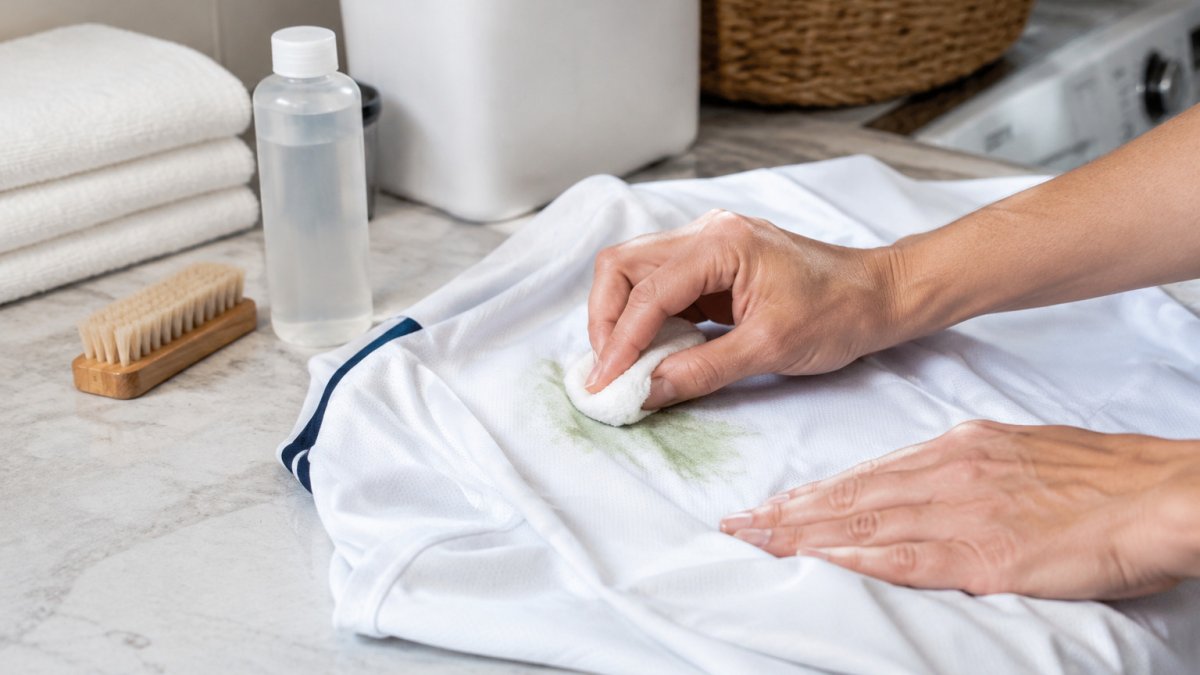
- Rinse from the back. Hold the jersey under cold water, with the stained side facing down. This pushes the pigment out instead of deeper in.
- Apply a small amount of detergent. Work a few drops of liquid detergent or dish soap into the stain with your fingers.
- Gently brush the area. Use a soft brush in small circles. Avoid scrubbing hard enough to damage the print.
- Let it sit for 15 to 30 minutes. Longer soaking helps enzymes break down the pigment.
- Rinse again in cold water. Check whether the stain is fading before moving on.
- Wash on a cold, gentle cycle. Turn the jersey inside out and use a mesh laundry bag to protect the print.
Cold water is key. Hot water can set the stain, so keep the temperature low until the mark is completely gone.
Handling Dried-In and Set-In Stains
A stain that has dried is harder but not impossible. Soak the area in a mix of cold water and enzyme detergent for several hours or overnight. Then brush gently and rewash.
Many people try to scrub harder when a stain will not budge. That usually damages the print and does little for the stain. Patience and repeated soaking work better than force.
The steps below summarise the pre-treatment and washing process, with the timing or frequency for each.
| Step | What to do | Time or frequency |
|---|---|---|
| 1. Rinse from the back | Hold under cold water, stained side down | Before any treatment |
| 2. Apply detergent | Work a few drops of liquid detergent or dish soap into the stain | Before brushing |
| 3. Brush gently | Use a soft brush in small circles | Avoid hard scrubbing |
| 4. Let it sit | Allow enzymes to break down the pigment | 15 to 30 minutes |
| 5. Rinse again | Rinse in cold water and check if the stain is fading | Before moving on |
| 6. Wash gently | Cold, gentle cycle, inside out in a mesh bag | Per wash |
Removing Set-In Grass Stains From White Football Jerseys
White jerseys show grass stains clearly, so getting them out matters even more. Pre-soak the stain in cold water with a little dish soap and enzyme detergent for at least an hour.
For white polyester, hydrogen peroxide can brighten the fabric. Apply a small amount to a hidden spot first and wait five minutes to check for color change. If the fabric holds up, dab the stain with peroxide, let it sit briefly, then rinse.
Avoid putting white jerseys in the dryer until the stain is gone. Heat can make a faint mark permanent, so check carefully before drying.
How to Wash Sports Jerseys to Preserve Screen Printing
Screen printing is durable, but it can crack if you wash it roughly. Protecting the print is just as important as removing the stain.
- Turn the jersey inside out before washing.
- Use a mesh laundry bag to reduce friction.
- Wash on cold with a gentle cycle.
- Use a mild detergent and skip fabric softener, which can coat the print.
- Never use chlorine bleach on printed areas. See how to prevent jersey logo cracking to keep logos intact through washing and stain removal.
Repeated hot washing and high dryer heat are the main causes of cracking. Read how to prevent screen print cracking for more guidance on protecting the print. Keeping the process cool and gentle helps the design last.
Drying Safely and Checking the Stain Before Heat
Air drying is the safest choice. Lay the jersey flat or hang it away from direct sunlight, which can fade colors over time.
Before you use a dryer, check the stain closely in good light. Learn why custom team uniforms fade and how to prevent it so the print stays intact after drying. If any trace remains, repeat the pre-treatment and wash again. Heat can lock in a stain that looked almost gone. Only use low heat when you are certain the mark is removed.
If you have a jersey that has faded or cracked beyond repair, replacing it may be the better option. Piercy Sports and Apparel offers custom team uniforms and high-resolution printing and embroidery built for repeated washing. For current prices and a quote for matching jerseys, visit the Piercy Sports and Apparel website. Pricing depends on quantity, design, and delivery timing. You can also explore professional logo embroidery services to see how embroidered designs hold up over time.
Get Matching Jerseys From Piercy Sports and Apparel
Lasting grass stain removal starts with the right garment. Piercy Sports and Apparel, based in Whiteland, Indiana, produces custom team uniforms, business apparel, and sports gear using premium embroidery, screen printing, and high-resolution digital printing. Visit the Piercy Sports and Apparel website to request a quote for your next order.
Frequently Asked Questions
How do you get grass stains out of jerseys?
Rinse the jersey in cold water from the back so the stain moves out of the fabric rather than deeper in. Apply a small amount of liquid laundry detergent or an enzyme-based stain remover directly to the stain and work it in with a soft brush or your fingers. Let it sit for 10 to 15 minutes, then wash the jersey in cold water on a gentle cycle. Check the stain before drying, because heat from a dryer can set any remaining grass pigment permanently.
Will Dawn dish soap remove grass stains from synthetic fabrics?
Dish soap is a common option for lifting grass stains from synthetic fabrics. Apply a small amount directly to the stain, let it sit for several minutes, then rinse with cold water and wash as usual. Test a hidden area first, since some dyed or printed areas can react to strong degreasers. Dish soap is a reasonable first pre-treatment but may need a second application for older stains.
Is it safe to use bleach on sports jerseys to remove stains?
Chlorine bleach is risky on sports jerseys. It can weaken elastic and synthetic fibers, and it can fade or discolor colored fabric and dull screen-printed or heat-transfer graphics. Oxygen-based bleach is a gentler option for white jerseys, and you should always check the garment care label before using any bleach product. Spot test on an inside seam first.
How can I remove dried grass stains from a sports jersey?
Dried grass stains need more time to soften before washing. Soak the jersey in cold water mixed with a laundry detergent or enzyme-based cleaner for 30 minutes to a few hours, then gently scrub the stain. Repeat the pre-treatment if the stain is still visible. Avoid hot water and the dryer until the stain is completely gone.