Table of Contents
- Why Custom Team Uniforms Fade So Quickly
- Best Embroidery vs Screen Printing for Color Durability
- Sublimation vs Screen Printing Durability
- How to Wash Custom Sports Jerseys Without Fading
- UV Exposure and Outdoor Sports Performance
- Common Mistakes That Speed Up Fading
- Maximizing Uniform Lifespan: Maintenance and Care
- Frequently Asked Questions
Last Updated: September 20, 2026
Why Custom Team Uniforms Fade So Quickly
Custom team uniforms fade quickly because of how printing and embroidery interact with fabric fibers, water chemistry, and environmental stress. Understanding the root causes helps you protect your investment and keep uniforms looking sharp season after season.
Fading happens through three main pathways: chemical breakdown of dyes and pigments, damage during washing and drying, and UV exposure from outdoor play. Each one compounds the others. A uniform exposed to chlorine, washed in hot water, and dried in direct sunlight deteriorates far faster than one handled carefully.
Chemical Breakdown and Thermal Degradation
Dyes and pigments bond to synthetic fibers through heat and chemical processes. That bond isn’t permanent. Heat, moisture, and oxygen gradually break it down.
Thermal degradation occurs when dyes lose their molecular structure. High temperatures accelerate this. Screen-printed designs fade faster in heat than embroidered ones because the pigment sits on the fabric surface rather than being stitched through it.
Humidity speeds up degradation too. Moisture allows oxygen to penetrate fabric fibers more easily. This is why uniforms stored in damp environments fade even without washing.
Store uniforms in a cool, dry place. Avoid basements and attics where temperature and humidity fluctuate. A climate-controlled closet extends uniform lifespan by years.
Water Quality and Mineral Content Impact
Most teams don’t think about their water supply. They should.
Hard water contains dissolved minerals, primarily calcium and magnesium. These minerals bind to fabric fibers and create a coating that traps detergent residue. Over time, this buildup dulls colors and prevents dyes from bonding properly during washing.
Chlorinated water is worse. Chlorine is a bleaching agent. It breaks down pigment molecules directly. Teams with pools or in areas with heavily chlorinated municipal water see fading accelerate dramatically.
The pH of your water matters too. Acidic water (low pH) can damage synthetic fibers. Alkaline water (high pH) can cause dye migration, where color molecules move away from where they’re supposed to be, creating uneven fading.
| Water Type | Impact on Uniforms | Fading Speed |
|---|---|---|
| Soft, neutral pH | Minimal color loss | Slowest |
| Hard water | Mineral buildup dulls colors | Moderate |
| Chlorinated water | Direct pigment breakdown | Fast |
| Very acidic or alkaline | Fiber damage and dye migration | Very fast |
Best Embroidery vs Screen Printing for Color Durability
Embroidery and screen printing create durability through different mechanisms. Neither is universally better, the choice depends on your specific use case.
Embroidery uses thread stitched through fabric. The thread sits on top of and within the weave. Because thread is a physical object, not a chemical coating, it doesn’t fade the same way printed designs do. Embroidered logos can last for years with minimal color loss.
Screen printing applies pigment directly to the fabric surface. The pigment bonds to fibers through heat and pressure, but it remains primarily on the surface. This makes screen-printed designs more vulnerable to abrasion and chemical breakdown.
For outdoor sports and high-wear uniforms, embroidery wins. For indoor sports or designs requiring fine detail, screen printing works well if you commit to proper care.
Avoid mixing embroidery and screen printing on the same uniform if possible. They respond differently to washing and drying, creating uneven fading patterns. If you must use both, use embroidery for the main logo and screen printing for secondary graphics only.
How Pigment Bonding Differs Between Methods
Screen printing bonds pigment to fabric using heat and pressure. The pigment particles embed into the top fibers of the fabric. This creates a durable bond, but only if the fabric fibers remain intact. Consistent screen print maintenance preserves these structural connections by shielding the underlying fibers from the abrasive forces that typically cause premature degradation.
Embroidery doesn’t rely on pigment bonding at all. Thread is already colored. The color comes from the thread material itself, not from dyes bonded to fabric. This is why embroidered logos fade much more slowly than printed ones.
Color Fastness Standards and Synthetic Fibers
Color fastness measures how well a dye resists fading. The standard scale runs from 1 (poor) to 5 (excellent). Most custom uniforms use pigments rated 3-4 for color fastness, which is acceptable but not exceptional.
Synthetic fibers like polyester hold dyes better than natural fibers like cotton. Polyester’s chemical structure creates more bonding sites for pigment molecules. This is why polyester uniforms fade slower than cotton ones, all else being equal.
Polyester blends (80/20 polyester-cotton, for example) offer a balance. They’re durable, breathable, and hold color reasonably well. Pure polyester uniforms resist fading best but can feel less comfortable in warm weather.
Sublimation vs Screen Printing Durability
Screen printing is more versatile. It works on any fabric, cotton, polyester, blends, natural fibers. But the pigment sits on the surface. It can crack, peel, and fade over time.
For maximum flexibility, screen printing on polyester blends is practical. Choose based on your team’s priorities: absolute durability or versatility and comfort.
How to Wash Custom Sports Jerseys Without Fading
The washing machine is where most uniform fading happens. A few simple changes protect your investment dramatically.
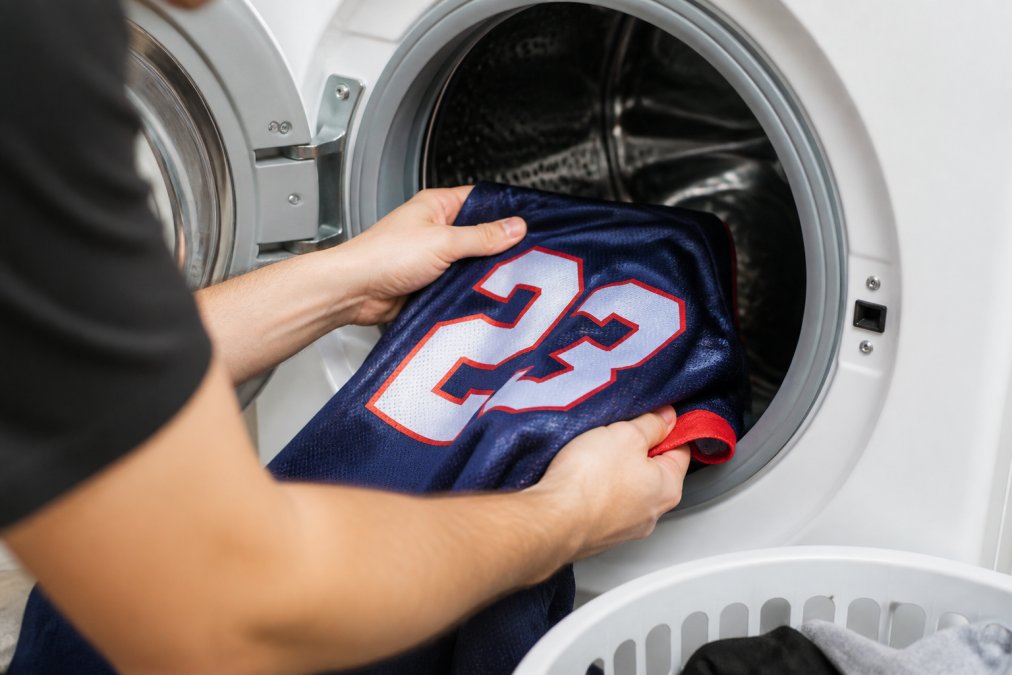
Turn jerseys inside out before washing. This protects printed and embroidered designs from direct friction with other garments and the washer drum. Inside-out washing reduces abrasion by 60-70%.
Wash in cold water. Hot water accelerates dye breakdown and causes pigment to bleed from the fabric. Cold water is gentler and equally effective at removing sweat and dirt.
Use a gentle cycle. Standard wash cycles are aggressive. They tumble clothes vigorously, creating friction that damages both fabric and designs. Gentle cycles use less agitation and slower spin speeds.
Skip fabric softener. Softener coats fibers with a waxy buildup that traps dirt and prevents water from rinsing properly. This buildup dulls colors over time.
Use mild detergent. Harsh detergents contain enzymes and bleach that break down dyes. Choose a detergent labeled “gentle” or “delicate.” For stubborn stains, soak in cold water with mild detergent for 30 minutes before washing.
Proper Wash Cycles and Water Temperature
Most teams wash uniforms at 90-110°F. This is too hot. Optimal temperature for custom uniforms is 60-80°F, what most people call “cold” or “cool.”
Wash cycles matter more than temperature. A gentle cycle lasting 30-40 minutes is ideal. Standard cycles last 45-60 minutes with high agitation. The longer and more aggressive the cycle, the more stress you place on fibers and designs.
For heavily soiled uniforms, use a pre-soak. Soak for 30 minutes in cold water with mild detergent. This loosens dirt without damaging fibers. Then wash on a gentle cycle.
Avoid overloading the washer. Cramming too many uniforms into one load creates friction between garments. Load the washer only 75% full. This gives clothes room to move without excessive contact.
Drying Methods That Protect Color Vibrancy
The dryer is the second-most damaging step after washing. Heat accelerates fading. High-heat drying can cause screen-printed designs to crack and peel.
Air drying is ideal. Hang uniforms in indirect sunlight or indoors. Direct sunlight causes UV fading, but indirect light and indoor air drying preserve colors best. Air drying takes 2-4 hours depending on humidity, but it adds years to uniform lifespan.
If you must use a dryer, use low heat. Set the temperature to 120°F or lower. Run for 20-30 minutes maximum. Remove uniforms while slightly damp and finish air drying. This hybrid approach balances convenience with protection.
Never use high heat. Temperatures above 140°F damage synthetic fibers, cause embroidery thread to shrink unevenly, and can melt polyester blends. High heat is the fastest way to ruin custom uniforms.
Dryer sheets are optional but not harmful. They reduce static but add a coating to fibers. For uniforms with moisture-wicking properties, skip dryer sheets, they can reduce performance.
UV Exposure and Outdoor Sports Performance
Ultraviolet light breaks down pigment molecules. Teams playing outdoor sports face constant UV exposure. Colors fade visibly within a single season if uniforms aren’t protected.
UV resistance varies by printing method.
Common Mistakes That Speed Up Fading
Most teams make the same errors repeatedly. Each one compounds the others.
Maximizing Uniform Lifespan: Maintenance and Care
A uniform’s lifespan depends on manufacturing quality, printing method, and care habits. You control the last one completely.
Frequently Asked Questions
What causes screen-printed designs to crack and fade on custom team uniforms?
Screen-printed designs fade due to incomplete pigment bonding with fabric fibers, especially on synthetic materials. Heat exposure during washing and drying accelerates this process. Chemical breakdown occurs when detergent residue breaks down the ink’s adhesion. Using water temperatures above 105°F and high-heat drying compounds the problem. Unlike embroidery, screen printing sits on the fabric surface, making it vulnerable to abrasion and UV exposure. Following gentle wash protocols significantly extends design durability.
How should you wash custom jerseys to keep colors bright?
Wash custom sports jerseys inside-out in cold water (65-75°F) on a gentle cycle with mild detergent, avoiding chlorine bleach and fabric softeners. Air-dry completely rather than using heat, as high temperatures degrade both fabric integrity and printed or embroidered designs. Wash after every 2-3 wears to prevent sweat and mineral buildup. Separate jerseys by color to prevent dye migration. Never dry-clean uniforms unless specifically approved by the manufacturer’s care label.
Are sublimation prints more resistant to fading than screen printing?
Sublimation printing generally offers superior fade resistance because the dye becomes part of the fabric fiber rather than sitting on top. This creates stronger color fastness and eliminates cracking issues common with screen printing. However, sublimation works best on polyester and synthetic blends, not cotton. Both methods fade under UV exposure and improper washing, but sublimation-printed uniforms typically retain vibrancy 30-40% longer under identical care conditions. For moisture-wicking performance apparel, sublimation is the more durable choice.
Does UV exposure significantly degrade team uniform colors?
Yes, UV exposure causes textile oxidation and color fading, especially during outdoor sports. Uniforms worn in direct sunlight experience noticeable color loss within one season if not treated with UV-protective finishes. Darker colors fade more visibly than lighter shades. Polyester blends with synthetic fibers show better UV resistance than 100% cotton. Storing uniforms indoors, using UV-blocking garment covers during transport, and applying UV-protective treatments during manufacturing extends lifespan. Teams playing outdoor sports should prioritize fabrics with built-in UV resistance and protective printing methods.