Last Updated: October 24, 2026
Quick Summary
Embroidered logo apparel is worth the cost for branded corporate uniforms, team apparel worn frequently, and business gear expected to last multiple seasons, as embroidery delivers superior durability and professional appearance. For small orders, one-time events, or complex designs, screen printing often proves more economical.
- Embroidered logos resist fading and wear better than screen printing through repeated washing and maintain design integrity through significantly more wash cycles.
- Polo shirts, sweatshirts, hoodies, jackets, and caps are excellent candidates for embroidery; t-shirts and delicate fabrics are poor choices due to puckering and fiber damage.
Table of Contents
- When Embroidered Logo Apparel Delivers Real Value
- Embroidery vs Screen Printing for Business Apparel
- Logo Embroidery Pricing Factors That Drive Your Cost
- Disadvantages of Embroidered Logos You Should Know
- Best Apparel for Embroidered Logos
- Cost Per Wear: The Real Measure of Value
- Getting Your Custom Embroidered Apparel Started
- Frequently Asked Questions
When Embroidered Logo Apparel Delivers Real Value
Is embroidered logo apparel worth the cost? It depends on your goals and how long the apparel must last.
Embroidered logos create a polished, professional look most decoration methods struggle to match. For branded corporate apparel, team uniforms, and promotional items meant to last multiple seasons, embroidered logo apparel often delivers genuine value, though setup costs can be steep for small orders.
Embroidery vs Screen Printing for Business Apparel
Embroidered logos and screen-printed logos serve different purposes, and choosing between them requires understanding the trade-offs.
Embroidery creates a raised, three-dimensional design with visible stitch detail; screen printing produces a flat, smooth finish.
Screen printing costs less upfront and handles complex, multi-color designs with fine detail.
For durability, embroidery outperforms screen printing in most scenarios. The stitching won’t crack or peel the way screen-printed ink can after heavy washing or physical stress.
See our detailed comparison of screen printing versus embroidery methods to match the approach to your garment and design.
Logo Embroidery Pricing Factors That Drive Your Cost
Understanding what drives embroidery costs helps you estimate a complete order before requesting a quote.
Stitch count is the primary driver. A simple two-color logo might use 5,000 stitches; a detailed multi-color design could reach 15,000 or more.
Setup and digitizing costs are fixed expenses spread across your order.
Order quantity directly affects final price.
Garment type and blank apparel cost matter too, embroidery on a high-end polo costs more than on a basic t-shirt. Explore cost-effective custom team uniform solutions to see how garment selection impacts your total investment.
Logo size and placement affect stitch count and production time.
Thread colors and specialty applications add cost.
Turnaround and rush fees are a real line item.
A Transparent Cost Build-Up You Can Copy
Use this worksheet to estimate a complete order. Ranges are typical U.S. market figures; your quote will vary by shop, region, and garment.
| Line item | Typical range | How it scales |
|---|---|---|
| Blank garment | 8-60 dollars depending on style | Per piece |
| Digitizing (one-time) | 50-150 dollars per design | Fixed per design |
| Embroidery run charge | 3-12 dollars per piece depending on stitch count and placement | Per piece |
| Additional thread colors | 0.25-1.00 dollar per piece per extra color | Per piece |
| Specialty application (3D puff, appliqué) | 1-4 dollars per piece | Per piece |
| Rush surcharge | Often 10-25% of order | Percentage |
Worked example, 24 polos, left-chest logo, 6,000 stitches, two colors:
- Blank polos: 24 × 30 dollars = 720 dollars
- Digitizing: 100 dollars (one-time)
- Run charge: 24 × 6 dollars = 144 dollars
- Extra color: 24 × 0.50 dollar = 12 dollars
- Estimated total: 976 dollars, or about 40.67 dollars per polo
Worked example, 250 polos, same logo:
- Blank polos: 250 × 30 dollars = 7,500 dollars
- Digitizing: 100 dollars (one-time)
- Run charge: 250 × 6 dollars = 1,500 dollars
- Extra color: 250 × 0.50 dollar = 125 dollars
- Estimated total: 9,225 dollars, or about 36.90 dollars per polo
The per-piece difference between 24 and 250 pieces is roughly 3.77 dollars, almost entirely the digitizing fee spread across more units. Setup cost shrinks fast as quantity rises.
Ask your embroiderer for a quote broken out by line item, garment, digitizing, run charge, and any specialty fees. A shop that will itemize is easier to compare against competitors and easier to budget around.
Break-Even by Order Size
To see when setup cost is offset, compare the all-in per-piece price at different quantities. The 24-piece order pays about 4.17 dollars per piece in digitizing; the 250-piece order pays about 0.40 dollar. If you expect to reorder the same design, ask whether the digitizing fee is waived on reorders, that single question can change the economics of a small first order.
Disadvantages of Embroidered Logos You Should Know
Embroidery isn’t perfect for every situation. Know the limitations before you commit.
Stitch density creates bulk. Heavily embroidered designs add weight and stiffness, especially on lighter fabrics; dense embroidery on a t-shirt can feel plasticky compared to screen printing.
Repair and replacement costs exist. Embroidered logos can snag, tear, or fray with heavy use, and damage often requires professional repair or replacement. Learn how to prevent jersey logo cracking through proper care, but treat maintenance as an ongoing cost.
Thread color matching can be imperfect. Thread palettes are limited compared to screen printing inks, so close approximations of brand colors are sometimes necessary.
Production time is longer. Embroidery machines work stitch by stitch, so a 50-piece order takes longer than a screen-printed one; if you need apparel quickly, screen printing often delivers faster.
Best Apparel for Embroidered Logos
Matching your decoration method to the right apparel type maximizes both visual impact and value.
| Garment | Embroidery fit | Watch-outs |
|---|---|---|
| Polo shirts | Excellent, structured fabric holds stitches cleanly | Heavier logos can feel stiff on lightweight polos |
| Sweatshirts and hoodies | Excellent, large surface, stable base | Dense back designs add weight and cost |
| Hats and caps | Excellent, structured panels suit small logos | Curved placement limits logo width |
| Jackets and vests | Excellent, durable shells suit chest and back placement | Nylon and coated fabrics need appropriate backing |
| T-shirts | Fair, best for small, simple left-chest logos | Light fabric can pucker under dense stitching |
| Delicate fabrics (silk, thin performance knits) | Poor, needle punctures can weaken fibers | Consider printing instead |
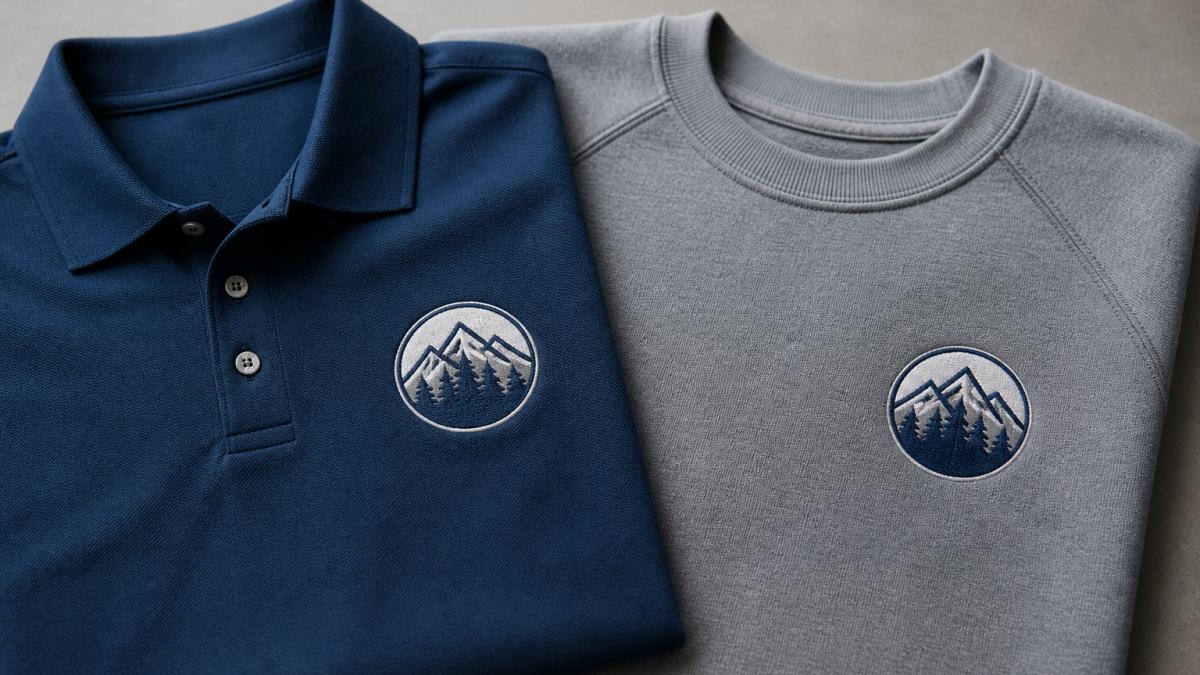
Polo shirts are the gold standard for embroidered logos.
Sweatshirts and hoodies work well for team identity and branded apparel.
Hats and caps are excellent candidates.
Jackets and vests support embroidery well on chest or back placement.
T-shirts are less ideal unless the design is small and simple.
Delicate fabrics like silk or thin performance materials are poor choices, needle punctures can weaken fibers and thread weight can distort the garment.
Logo Suitability and Stitch-Count Trade-Offs
Before choosing a garment, check whether your logo will survive the translation to thread:
- Minimum line weight. Very thin lines (roughly under 1 mm at final size) tend to disappear or break up in thread. Ask your digitizer to thicken hairlines slightly.
- Minimum text height. Small lettering is the most common failure point. Keep letters at least about 0.25 inch tall for legibility; below that, expect simplification or dropped detail.
- Gradients and photorealism. Thread cannot blend like ink. Gradients are usually converted to stepped color blocks, and photorealistic art is simplified. If brand accuracy depends on a gradient, printing may be the better method.
- Stitch density and comfort. Dense designs on lightweight fabric feel stiff and can pucker. On performance wear, high stitch counts can also reduce stretch and breathability.
- Placement and size. A left-chest logo is the most economical and most legible placement. Full-back designs multiply stitch count and cost, and curved placements on caps limit logo width.
If your logo has fine text, gradients, or photographic elements, request a digitized preview before you commit to a full order. A preview lets you see how the design simplifies in thread and whether the stitch count, and price, matches your expectation.
Recommendations by Buyer and Budget
- Uniform programs (restaurants, retail, field teams): Choose embroidered polos or button-downs in a durable poly-cotton blend. These are worn frequently, laundered often, and represent the brand in public, embroidery’s durability and polish pay off. Standardize on one left-chest logo to keep reorders simple and setup costs low.
- Sports teams and booster clubs: Embroidered hats, hoodies, and jackets build identity and survive a season of heavy use. Order in a single batch to spread digitizing across more pieces, and keep a consistent logo file on hand for mid-season reorders.
- Corporate gifting and client apparel: Embroidered outerwear and premium polos signal investment. If budget is tight, embroider a smaller left-chest logo on a better garment rather than a large logo on a cheap one.
- One-time events and giveaways: If the apparel will be worn a handful of times, printing is usually the better economic choice. Reserve embroidery for pieces recipients will keep and wear.
- Lightweight t-shirts and performance wear: Use embroidery only for small, simple logos, or choose printing to avoid puckering and stiffness.
Care, Repair, and Replacement Costs
Embroidery is durable, but not maintenance-free. Build these costs into your decision:
- Laundering. Turn garments inside out and avoid high heat, which can shrink backing and distort stitching. Heat is the most common cause of premature wear.
- Snags and pulls. A snagged thread can be worked back with a blunt needle rather than cut. Cutting a pulled thread can unravel a section of the design.
- Fading and pilling. Thread color can fade over many washes, and pilling on the garment surface can dull the logo’s appearance. Dark garments show pilling most.
- Replacement vs. repair. Small thread damage is often repairable by a local embroiderer; large tears or backing failure usually mean replacing the garment. Keep spare pieces on hand for uniform programs so a damaged item doesn’t take an employee out of compliance.
Find guidance on professional logo embroidery services and which apparel works best to match your project needs.
Cost Per Wear: The Real Measure of Value
The most honest way to evaluate embroidered logo apparel is cost per wear, value delivered over the garment’s life, not sticker price.
Divide the total cost of the garment by the number of times it will realistically be worn before it’s retired or replaced.
Team uniforms and branded business apparel worn throughout a season or year benefit from embroidery’s durability, frequent use makes cost per wear attractive.
Seasonal apparel like winter team jackets often justifies embroidery because the concentrated wear period means heavy use.
Getting Your Custom Embroidered Apparel Started
Once you’ve decided embroidered logo apparel makes sense, the process is straightforward. Preparation and clear communication prevent delays and costly mistakes.
Step 1: Prepare your artwork. Your logo file needs to be high-resolution and suitable for embroidery; vector files work best because they scale without losing quality. Learn how to prepare artwork for custom uniforms to ensure your design is production-ready.
Step 2: Choose your garments and placement. Chest placement is standard and most affordable; back, sleeve, and specialty placements may cost more.
Step 3: Request a quote and digitizing sample. Provide your artwork, garment choices, and quantity.
Step 5: Place your order. Confirm quantities, delivery timeline, and final pricing.
Step 6: Receive and inspect. Inspect pieces for stitch quality, color accuracy, and placement consistency, and report any issues immediately.
Embroidered logo apparel delivers real value when matched to the right situation.
Frequently Asked Questions
What are the main disadvantages of embroidered logos?
Embroidered logos have higher upfront setup costs due to digitizing and needle work. They work best with simpler designs, highly detailed artwork may lose clarity when stitched. Embroidery also takes longer to produce than screen printing, and repairs to damaged stitching can be costly. For very small orders, per-item costs stay high because setup fees don’t spread across many units.
How does embroidery compare with screen printing for business apparel?
Embroidery creates a three-dimensional, tactile appearance that feels premium and professional, making it ideal for corporate uniforms and upscale branded apparel. Screen printing costs less per item on large orders and handles complex, multicolor designs better. Embroidery typically lasts longer through repeated washing and wear, while screen printing can crack or fade faster. Choose embroidery for durability and perceived quality; choose screen printing for detailed graphics and lower costs on bulk orders.
Does embroidered clothing last longer than printed clothing?
Yes, embroidered logos generally outlast screen-printed designs. Needle and thread bond directly to fabric fibers, resisting cracking, peeling, and fading through many wash cycles. Screen-printed ink sits on the surface and can deteriorate, especially after repeated washing in hot water or heavy use. For apparel that will be worn frequently or laundered often, like employee uniforms or team gear, embroidery offers superior longevity and maintains its appearance over years of use.
What types of logos work best for embroidery?
Simple, bold logos with clear outlines and limited stitch count work best for embroidery. Solid shapes, text, and two- to three-color designs translate well to thread. Highly detailed artwork, fine lines, and gradients lose clarity when stitched and should be simplified first. Logos with large areas of solid color are ideal; intricate patterns may require too many stitches, increasing cost and production time. Discuss your design with your apparel provider, they can advise on simplification without losing brand recognition.