Table of Contents
- What Makes Fast Turnaround Custom Apparel Printing Possible
- Printing Methods That Deliver Speed Without Sacrificing Quality
- No Minimum Custom Apparel Printing: Flexibility for Any Order Size
- Custom Business Apparel for Staff with Accelerated Timelines
- Rush Custom T-Shirt Printing: Preparation Steps That Speed Up Production
- Realistic Timelines: Same-Day and Next-Day Delivery Guarantees
- Sustainability Meets Speed: Eco-Friendly Ink Options for Fast Production
- Last-Minute Event Planning Checklist for Custom Apparel
- Frequently Asked Questions
Last Updated: September 21, 2026
What Makes Fast Turnaround Custom Apparel Printing Possible
Fast turnaround custom apparel printing relies on a combination of modern technology, simplified workflows, and strategic planning. The key is matching your design complexity to the right printing method and having a provider who understands your timeline constraints from the start.
The difference between a 20-day turnaround and a 3-day turnaround often comes down to three factors: your file preparation, the printing technology selected, and whether you’re ordering during peak season or a slower period.
Same-day and next-day delivery guarantees exist because providers have invested in equipment that can handle high-volume production without bottlenecks. However, “same-day” typically means same-day production start, not same-day delivery to your door. Understanding this distinction matters when you’re planning an event.
The reality is that most delays happen before production even starts. A poorly formatted design file, unclear specifications, or miscommunication about quantities can add days to your timeline. Get those details right upfront, and you unlock the speed that modern printing technology actually offers.
Printing Methods That Deliver Speed Without Sacrificing Quality
Not all printing methods are created equal when speed matters. Direct-to-garment and screen printing each have distinct advantages depending on your order size, design complexity, and timeline requirements.
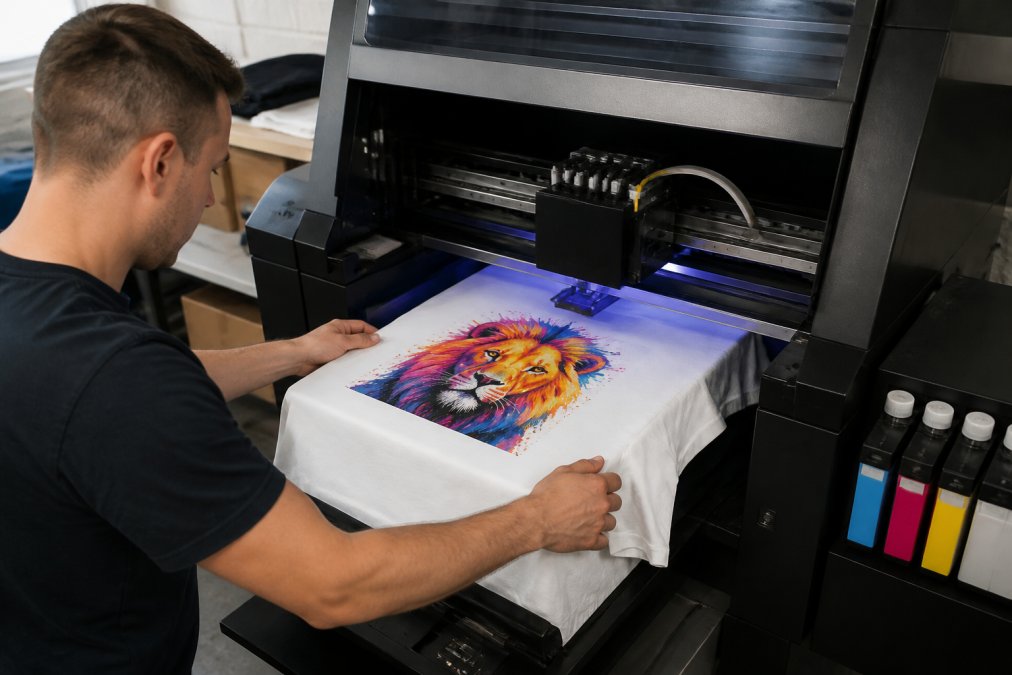
Direct-to-Garment (DTG) Printing for Rush Orders
Direct-to-garment printing is the fastest option for small to medium orders with complex, photorealistic designs. The technology works like an oversized inkjet printer, spraying ink directly onto the garment. Setup time is minimal compared to screen printing, which makes it ideal for rush custom apparel production.
DTG excels when you need high-resolution artwork with multiple colors or photographic elements. There’s no screen setup required, no color separations needed. You upload your design file and start printing.
The trade-off is cost per unit. DTG pricing doesn’t decrease significantly with volume the way screen printing does. If you’re ordering 500 identical shirts, screen printing becomes more economical. But for rush orders where time is the priority and quantities are modest, DTG delivers.
Screen Printing for High-Volume Rush Production
Screen printing is the workhorse for bulk orders and remains the fastest method when you need high-volume production with durable results. The process involves creating a mesh screen for each color in your design, then pressing ink through the screen onto each garment.
Setup takes longer than DTG, but once screens are ready, production moves fast. A shop with multiple presses can print hundreds of shirts per hour. For orders of 100 units or more, screen printing often matches or beats DTG timelines because the per-unit production speed is unmatched.
Screen printing also produces exceptional durability. The ink bonds directly to the fabric fibers, creating prints that withstand hundreds of washes without cracking or peeling. This matters for uniforms and team apparel that need to last an entire season or longer.
No Minimum Custom Apparel Printing: Flexibility for Any Order Size
The “no minimums” model has transformed custom apparel from a bulk-only business into something accessible for small teams, single events, and individual orders. This flexibility is essential when you need fast turnaround custom apparel but don’t have a large budget or inventory need.
Providers offering no-minimum orders typically use DTG or print-on-demand technology. The economics work because there’s no setup cost per design. Your design file is uploaded, queued, and printed when it reaches the production line. Whether you order 5 shirts or 500, the process is fundamentally the same.
This model matters for youth leagues with 15-20 members, small businesses ordering staff apparel for the first time, and event organizers who can’t predict final attendance. You order exactly what you need, not what a minimum order forces you to buy.
The catch: no-minimum orders typically have longer timelines than bulk orders. A provider can’t guarantee same-day production on a 5-shirt order during peak season. But many providers do offer expedited no-minimum options at a premium price, which still beats ordering excess inventory.
Custom Business Apparel for Staff with Accelerated Timelines
Businesses often face unexpected needs for branded staff apparel: a trade show in three weeks, a rebranding that requires new uniforms, or a sudden expansion that means hiring more employees than anticipated. Fast turnaround custom apparel becomes a business necessity, not a preference.
The solution is working with a provider who understands your business timeline and can prioritize your order.
For businesses, the best approach is building a relationship with your provider before you need rush service. Discuss your typical order patterns, preferred apparel styles, and color preferences. When you need accelerated timelines, your provider can move quickly because they already understand your specifications.
Bulk pricing discounts apply at different thresholds depending on the provider and printing method. Generally, orders of 50-100 units see meaningful discounts. Orders of 200+ units unlock wholesale pricing. If you’re ordering regularly for staff, ask about annual volume discounts or standing orders that lock in pricing.
Rush Custom T-Shirt Printing: Preparation Steps That Speed Up Production
The fastest route to fast turnaround custom apparel printing starts before you contact a provider. Proper file preparation and clear specifications eliminate the delays that derail timelines.
File Format and Resolution Requirements
Your design file format matters enormously. Vector graphics (Adobe Illustrator .ai files.eps, or .pdf) are preferred for screen printing because they scale infinitely without quality loss. Raster files (JPG, PNG) work for DTG printing but must be at least 300 DPI (dots per inch) at the final print size.
A common mistake is submitting a logo pulled from your website. Website logos are typically 72 DPI, which looks fine on a screen but prints pixelated on fabric. If your logo file is only available at low resolution, tell your provider immediately. They can sometimes enlarge and trace it to create a vector version, but this adds 2-3 business days to your timeline.
For DTG printing, high-resolution artwork (300 DPI minimum) is non-negotiable if you want crisp, detailed prints. For screen printing, vector files are ideal, but high-resolution raster files work if vector versions aren’t available.
Color specifications matter too. If your design includes specific brand colors, provide the Pantone color codes. Don’t rely on “it looks right on my monitor.” Screen colors and printed colors differ significantly. Pantone codes ensure your brand colors print accurately every time.
Troubleshooting Common Design File Errors Before You Order
Submitting a flawed design file to your printer creates a bottleneck. They’ll contact you for corrections, you’ll need to revise and resubmit, and suddenly your rush order has lost 1-2 business days. Catch these issues yourself first.
Check your file for these common problems: text that’s too small to print clearly (anything under 0.5 inches tall becomes illegible), thin lines that may not render properly (use lines at least 0.05 inches thick), and colors that are too similar to the garment color (printing white ink on a white shirt requires special consideration).
Verify that all fonts are embedded or converted to outlines. If your printer opens your file and sees missing fonts, they’ll substitute fonts, changing your design.
Realistic Timelines: Same-Day and Next-Day Delivery Guarantees
Same-day and next-day delivery guarantees need context. “Same-day” typically means same-day production start after design approval, not same-day delivery to your location. Shipping still takes time depending on your distance from the provider.
Sustainability Meets Speed: Eco-Friendly Ink Options for Fast Production
Eco-friendly ink options for fast turnaround custom apparel printing have improved dramatically. Water-based and soy-based inks now match the durability and color vibrancy of petroleum-based inks while reducing environmental impact.
Last-Minute Event Planning Checklist for Custom Apparel
When you’re planning an event and need custom apparel fast, a checklist prevents costly mistakes and delays.
Two weeks before event:
- Finalize your design and order quantity
- Confirm apparel color and size mix
- Submit design file for preview approval
- Confirm delivery address and preferred shipping method
One week before event:
- Receive and approve production sample (if time allows)
- Confirm final quantities with your provider
- Arrange payment and confirm order status
- Verify shipping timeline matches your event date
Three days before event:
- Confirm order has shipped (request tracking number)
- Plan for delivery window and have someone available to receive shipment
- Inspect garments upon arrival for quality and correct sizing
- Flag any issues immediately for resolution
Frequently Asked Questions
How fast can you actually get custom apparel printed with rush production?
Fast turnaround custom apparel printing depends on your chosen method and order complexity. Direct-to-garment printing can produce custom designs within hours for small orders, while screen printing typically requires 2-5 business days for setup and production. Production speed also depends on design complexity, garment selection, and current order volume. Contact Piercy Sports and Apparel for a specific timeline based on your exact needs.
Does fast turnaround printing affect the quality of custom apparel?
No. Modern printing technology allows high-quality results even on tight timelines. Direct-to-garment printing delivers vibrant, durable prints instantly, while screen printing produces ink saturation and fabric durability that rivals standard timelines. Quality depends more on file preparation, garment selection, and printing method than on production speed. Properly prepared high-resolution artwork ensures your custom design looks professional regardless of turnaround time. Poor file quality, not rush production, causes issues like pixelation or color inconsistency.
Can you handle no minimum custom apparel printing for small orders?
Yes. No minimum custom apparel printing is standard for fast turnaround providers. Whether you need 5 t-shirts for a small team or 100 for a corporate event, you won’t be forced to order excess inventory. This flexibility is especially valuable for youth leagues, small businesses, and organizations testing designs before larger orders. Bulk pricing discounts apply at higher quantities, but single-unit and small-batch orders are fully supported. This approach eliminates waste and lets you order exactly what you need.
What file format and resolution do I need for rush custom t-shirt printing?
For fast turnaround custom t-shirt printing, provide high-resolution artwork at 300 DPI (dots per inch) in vector graphics format (AI, EPS, or PDF) when possible. If you only have raster files (JPG, PNG), ensure they’re at least 1200 pixels wide for standard apparel sizes. Avoid low-quality logo files or screenshots, pixelation becomes visible at print size. Submit files as print-ready files to avoid delays; include color specifications and confirm the final design before production begins.