Table of Contents
- What Low Minimum Custom Apparel Orders Actually Mean
- Best Platforms and Vendors for Low Minimum Orders
- Digital Printing vs Screen Printing for Small Orders
- Custom Business Apparel for Staff: Design and Ordering
- Turnaround Time for Custom Apparel: What to Expect
- How to Prepare Your Design Files for Small-Batch Orders
- Cost Per Unit and Pricing Factors for Low-Quantity Orders
- Durability and Quality Assurance for Low-Minimum Apparel
- Frequently Asked Questions
Last Updated: September 4, 2026
What Low Minimum Custom Apparel Orders Actually Mean
A low minimum custom apparel order is a production run that requires far fewer units than the traditional 50- to 100-piece minimums that dominated the industry for decades. For a youth league with 15 kids or a business that needs just a dozen branded polos, this shifts the economics of custom merchandise entirely. Instead of paying for 40 extra shirts you don’t need, you order exactly what your roster or staff requires.
The practical effect matters more than the definition. Small-batch production lets teams and businesses test designs, equip new hires, and create merchandise without tying up cash in inventory. At Piercy Sports and Apparel, youth leagues and local companies avoid the trap of over-ordering by working with vendors who understand that a 12-piece order deserves the same care as a 500-piece one. The key distinction is between print-on-demand, where items are made after purchase, and small-batch printing, where a vendor runs a short production cycle just for you. Both give you access to custom apparel resources and industry standards without the burden of a warehouse full of extras.
Best Platforms and Vendors for Low Minimum Orders
Finding the right partner for low minimum custom apparel orders comes down to two main routes: print-on-demand services and local or regional shops. Each fits a different need, and the choice shapes your pricing, turnaround, and quality.
Print-on-Demand Services
Print-on-demand platforms connect your design to a network of production facilities that print and ship individual items as orders arrive. This model works well for merchandise you sell continuously, like fan gear or fundraising items, because there is zero inventory risk. The tradeoff is that you pay a higher per-unit cost and have less control over print quality and shipping speed. For a one-off team order, the per-item markup and variable shipping can make this route pricier than it looks.
Local and Regional Custom Apparel Shops
A local shop that runs its own production offers a different value proposition: direct oversight of print quality, consistent garment sourcing, and a single point of contact for questions. When you order 15 jerseys from a shop that prints in-house, you can approve a physical sample, adjust logo placement, and get a firm delivery date before production starts. The per-unit cost is often lower than print-on-demand for batch orders, and the quality control is tighter.
| Order Type | Best For | Key Advantage | Watch Out For |
|---|---|---|---|
| Print-on-Demand | Ongoing sales, no inventory | No minimums, no stock | Higher per-unit cost |
| Local Shop | Team sets, staff uniforms | Quality control, fixed dates | Lead time planning needed |
| Hybrid | Fundraisers + team gear | Flexibility | Managing two workflows |
For teams and businesses that need a consistent look and a reliable date, a local provider that handles the entire process is usually the stronger choice. Piercy Sports and Apparel operates as a one-stop shop for custom team uniforms and business apparel, handling design, printing, and delivery so you are not coordinating between three different vendors.
Digital Printing vs Screen Printing for Small Orders
Digital printing and screen printing serve different purposes, and the right choice for a small order depends on your design and fabric. Digital printing works like a high-end inkjet printer, applying the design directly to the garment. It handles full-color, photo-quality artwork with no setup fees, which makes it the default for small batches. Screen printing pushes ink through a mesh stencil, one color at a time. It produces vibrant, durable results that survive years of washing, but the setup cost per color makes it economical only once your quantity justifies the preparation work.
For a typical low-minimum order of 10 to 30 pieces, digital printing usually wins on cost and flexibility. The print quality is high, and there are no screens to burn or clean. Screen printing becomes the better value when you are ordering the same design in the same colors for a larger group, where the setup cost spreads across more units. A common mistake is assuming screen printing is always higher quality. In practice, modern digital printing on the right fabric is durable and vibrant, and it allows for details that screen printing cannot reproduce.
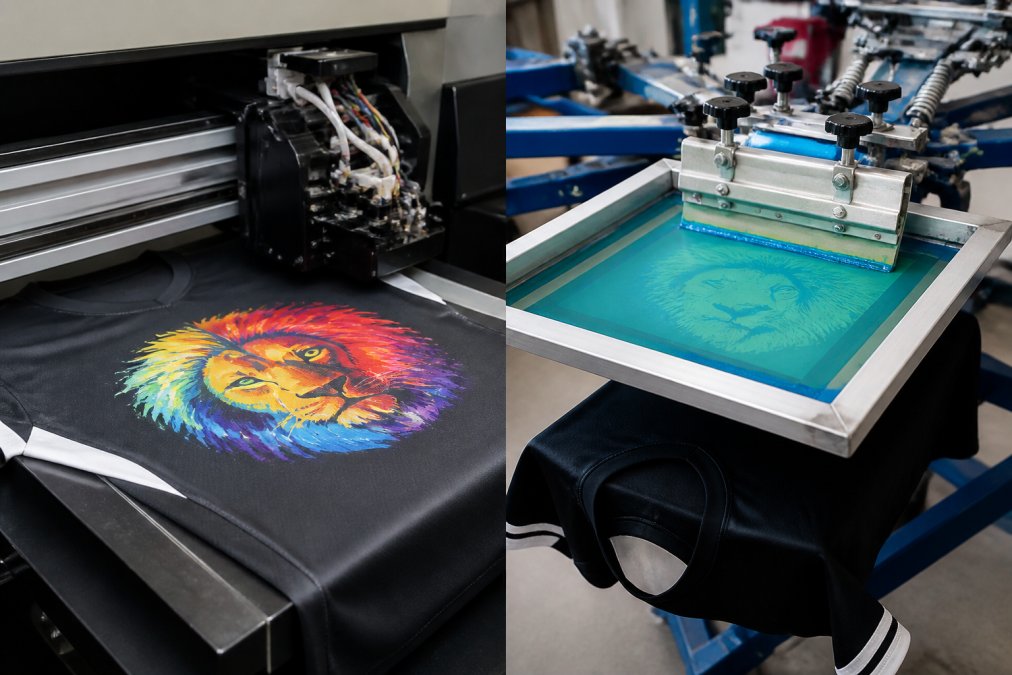
The durability question is where vendors differ. High-resolution digital printing uses inks that bond with the fabric, resisting the cracking and peeling that plague low-quality transfers. If your logo has gradients or many colors, digital printing is the only practical option for a short run. If you need a simple two-color design for 50 or more shirts, ask about screen printing, since the per-unit price drops meaningfully at that volume.
Custom Business Apparel for Staff: Design and Ordering
Custom business apparel for staff serves a dual purpose: it projects a professional image to customers and builds internal cohesion among employees. Ordering for a small team follows the same logic as a youth league, but the stakes involve your brand. A consistent, well-made polo or jacket tells clients you are established, and it gives employees a uniform they are proud to wear.
The ordering process starts with a clear brief. Decide which garments you need, from polos and button-downs to jackets and hats, then confirm the sizes across your team. A size chart is essential, since apparel sizing varies by brand and cut. Next, prepare your logo in the highest resolution available. Vector files, like AI or EPS formats, are ideal because they scale without losing sharpness. If you only have a JPEG or PNG, a good vendor can often rebuild it, but the result depends on the original quality.
When you send your order, specify the logo placement, size, and thread or ink colors. For embroidery, confirm whether the design needs a patch backing or can be stitched directly. For printed apparel, clarify whether the design wraps around the sleeve or sits on the chest. Piercy Sports and Apparel specializes in turning a rough logo file into professional craftsmanship, using premium embroidery and high-resolution digital printing to ensure the final product looks sharp on the rack and after dozens of washes. The goal is an elevated brand identity that customers notice and employees appreciate.
Turnaround Time for Custom Apparel: What to Expect
Turnaround time for custom apparel is the gap between order approval and delivery, and it is the most common source of friction in the industry. A realistic expectation for a low-minimum order from a shop that produces in-house is 10 to 15 business days for production, plus shipping time (sba.gov). Large national vendors often quote 20 to 25 days because they batch orders and outsource production. If a provider promises a faster turnaround, ask whether they print in-house or route through a third party, since that affects both speed and accountability.
The timeline breaks down into distinct phases: design approval, production, and delivery. Design approval can take a few days if your artwork needs cleanup or a mockup requires revision. Production itself is the longest phase, and it depends on the decoration method. Embroidery takes longer than digital printing because each item is hooped and stitched individually. Screen printing requires setup time for the screens before the first shirt runs.
Your best tool is a firm deadline. If your season starts in six weeks, tell the vendor your “in-hand” date up front and work backward. A reputable shop will tell you honestly whether the timeline is feasible before taking your money. For teams with mid-season roster changes, ask about reorder policies. A vendor that keeps your digital files on hand can reprint a few additional jerseys without charging you for a new setup, which saves both time and money when a new player joins.
How to Prepare Your Design Files for Small-Batch Orders
Preparing your artwork correctly is the difference between a crisp, professional logo and a pixelated mess on a jersey. The single most important rule is to send the largest, highest-quality file you have. Vector formats, including AI, EPS, and PDF, store graphics as mathematical lines, so they scale to any size without losing detail. Raster formats like PNG and JPEG store graphics as a grid of pixels, and enlarging them blurs the edges.
If you only have a raster file, check its resolution. A good rule is that the image should be at least 150 dots per inch at the final print size (aiga.org). A logo that looks sharp on a website at 200 pixels wide will look rough when stretched across a chest at 12 inches. If your file is low-resolution, a professional production house can often redraw it as a vector, but the result depends on the complexity of the design and the skill of the artist.
Transparent backgrounds are another common stumbling block. A logo with a white box around it cannot be printed cleanly on a dark shirt. Send a PNG with a transparent background or a vector file with no background fill. Clearly state the ink or thread colors you want, using standard color codes if you have them, and specify the exact placement on the garment. A little preparation on your end prevents the most frequent production errors and keeps your order moving without delays.
Cost Per Unit and Pricing Factors for Low-Quantity Orders
Pricing for low minimum custom apparel orders is driven by three factors: the garment, the decoration, and the quantity. The garment cost is fixed by the brand and style you choose, with performance fabrics and name-brand blanks costing more than generic options. The decoration cost depends on the method. Digital printing has no setup fee, so the per-unit price stays relatively flat. Embroidery and screen printing carry setup costs for digitizing or screen creation, which makes the first few units more expensive but lowers the cost per unit as quantity rises.
Because pricing depends on quantity, dates, and delivery, the only reliable way to get an accurate number is to request a quote for your specific order. A local vendor can often match or beat national platforms once you factor in shipping and the cost of a rejected batch. For a youth league, the math changes when a vendor can produce exactly 15 jerseys instead of forcing a 40-piece minimum. You save on the unneeded units, and the per-piece price reflects a short, efficient production run.
Bulk pricing tiers still exist for low-minimum orders, but the thresholds are lower. You might see a price break at 12, 24, or 48 pieces rather than at 100. Ask your vendor where the tiers fall. Ordering a few extra pieces for spares or future roster moves often pushes you into a better price bracket, which is a smarter use of funds than being forced into a large minimum you do not need.
Durability and Quality Assurance for Low-Minimum Apparel
The fear that small orders get lower quality is understandable but outdated. A reputable vendor applies the same production standards to a 12-piece order as a 1,200-piece order, because the equipment and inks are identical. The difference lies in the vendor’s commitment to quality assurance, not the order size.
Durability starts with the garment itself. A heavier fabric with a tight weave holds prints and embroidery better than a thin, loose shirt. For sports uniforms, look for moisture-wicking polyester blends that resist fading and shrinking. For business apparel, a cotton-poly blend offers comfort and longevity. The decoration method also determines lifespan. High-resolution digital printing uses inks that bond with the fabric, so they resist cracking and peeling. Premium embroidery uses stitched thread that will outlast the garment itself, provided the backing is applied correctly.
Quality assurance is where a local, in-house shop earns its keep. When production happens in your region, a vendor can inspect each piece before it ships and correct issues before you ever see them. Ask to see examples of past work for teams or businesses similar to yours. A vendor that shows off its portfolio with confidence is a vendor that stands behind its product. Piercy Sports and Apparel builds its reputation on top-grade products designed for longevity and performance, ensuring your logos stay vibrant and professional through every wash and every game.
Ordering custom apparel in small quantities no longer means settling for poor options or overpaying for stock you do not need. The challenge is finding a partner that treats your 15-piece order with the same care as a bulk contract. Piercy Sports and Apparel delivers that standard through high-resolution digital printing, premium embroidery, and screen printing, all handled in-house with fast turnaround times. Get started with Piercy Sports and Apparel and put a durable, professional logo on your team or business today.
Frequently Asked Questions
What is the typical minimum order for low minimum custom apparel?
Many vendors now offer no minimum order requirements or minimums as low as 1-6 units per style. Print-on-demand services eliminate minimums entirely, while traditional screen printing shops may require 12-24 pieces to justify setup fees. Local custom apparel providers often work with smaller quantities for teams and small businesses. Pricing per unit typically increases for smaller orders, but the flexibility allows you to order exactly what you need without excess inventory.
How does digital printing vs screen printing compare for small orders?
Digital printing is ideal for low-minimum orders because it requires no setup fees and works efficiently on small quantities. It handles unlimited ink colors and detailed artwork well. Screen printing requires setup costs per color, making it less economical for orders under 12-24 units, but offers superior durability and cost per unit at higher volumes. For small-batch custom apparel, digital printing typically delivers better value and faster turnaround, while screen printing excels once you reach higher quantities.
What turnaround time should I expect for custom apparel orders?
Turnaround time for custom apparel varies by printing method and vendor. Print-on-demand services often deliver within 5-10 business days, while local custom apparel shops may offer 7-14 day turnarounds for digital printing. Screen printing traditionally takes 14-21 days due to setup. Embroidery typically requires 10-15 business days. Rush services are available but cost more. Always confirm turnaround time with your vendor before ordering, especially for time-sensitive projects like team uniforms or promotional merchandise.
Can I order professional embroidery on low-quantity apparel?
Yes, many custom apparel vendors offer professional embroidery on low-quantity orders. Embroidery provides durability and a premium appearance ideal for business uniforms and branded merchandise. Setup fees apply per design, so embroidery becomes more economical at higher volumes, but vendors often waive or reduce fees for small orders. Quality embroidery holds up through multiple washes better than some printing methods, making it a solid choice for staff apparel that needs longevity.
How do I prepare design files for custom apparel orders?
Most vendors accept vector artwork (AI, EPS, PDF) or high-resolution raster files (300 DPI minimum). Provide your logo in the format the vendor specifies and confirm color codes (Pantone or RGB). Keep designs simple for screen printing but detailed artwork works with digital printing. If your file quality is low, many custom apparel shops offer design services or file cleanup. Always request a proof before final production to verify placement, sizing, and color accuracy on the actual garment.
This article was written using GrandRanker