Quick Summary
Often, yes, when branded clothing feels like a point of pride rather than a chore. Shared logo gear makes people visibly part of one team, which can strengthen belonging, especially on busy days when staff rarely see each other. Comfort and fair treatment decide whether that benefit appears.
- Branded clothing can backfire when it is mandatory, employee-funded, poorly fitted, or low quality.
- Check your state’s wage-deduction rules before building a payroll deduction for apparel.
- Ask staff which fabrics and cuts they prefer before choosing a catalog.
- Run a short anonymous survey before launch to capture a morale baseline.
- Re-survey at 90 days, 6 months, and 12 months using identical questions.
Table of Contents
- How Company Uniforms and Employee Morale Connect
- When Branded Clothing Backfires
- Choosing Comfortable Branded Clothing for Staff
- Company Apparel Examples for Staff by Role
- Employee Uniform Policy Best Practices
- Measuring Whether Your Apparel Program Works
- Planning Your Staff Apparel Order With Piercy Sports and Apparel
- Frequently Asked Questions
What Branded Clothing Does for Team Identity
Does branded clothing improve employee morale? Often, yes, when the clothing feels like a point of pride rather than a chore. Branded apparel signals that a team belongs together, and that shared look can strengthen how people see themselves at work.
The idea is simple. When people wear the same logo, they are visibly part of one group. That visibility matters most on busy days, when staff members work across departments and rarely see each other. A consistent look can foster a sense of unity that a company email never quite creates.
Here is what branded clothing tends to do for team identity:
- Makes the team easy to recognize on the floor or on site
- Builds a shared sense of belonging
- Reinforces company pride
- Gives new hires a clear sign of who they now work with
- Supports a consistent brand image with clients
For customers, that consistency also helps. When a technician or sales rep walks in wearing branded gear, the company looks organized and prepared.
How Company Uniforms and Employee Morale Connect
Company uniforms can support morale, but the link works best when people feel good wearing them. A uniform that is itchy, too tight or poorly printed can have the opposite effect. Staff members notice quickly when a company cares about how they look and feel.
Most of the morale benefit comes from three things: pride, comfort and fairness. When staff members feel proud of the logo and comfortable in the fabric, they tend to wear the gear with confidence. When everyone gets the same quality, no one feels like the second-tier team.
A common mistake is treating apparel as a one-time gift. The better approach is to treat it as part of the workplace culture. Ask staff what they would actually wear, then build the program around those answers.
When Branded Clothing Backfires
Branded clothing is not a morale switch. It can lower morale when it feels imposed, when it costs employees money, or when the garment itself is uncomfortable. The difference between a program that lifts morale and one that breeds resentment usually comes down to four failure modes. Each has a concrete fix.
Failure mode 1: The cost lands on employees
If staff are expected to buy their own branded pieces, the program reads as a pay cut with a logo on it.
Check your state’s wage-deduction rules before you build a payroll deduction for apparel. Requirements vary, and a policy that is fine in one state can create liability in another.
Failure mode 2: Mandatory wear with no choice
A strict “everyone wears the same polo every day” rule removes autonomy. A tiered approach is one option:
- Required: a minimum standard (for example, a branded shirt or apron) for safety, identification, or client-facing roles.
Give people a say in the catalog. A short poll on three candidate styles can gather staff preferences.
Failure mode 3: Fit, fabric, and inclusivity problems
Consider fit and fabric needs when planning a staff apparel program. Possible steps include:
Failure mode 4: Poor quality and slow replacement
Keep a small stock of common sizes on hand so a new hire is not waiting weeks for a shirt.
The consultation process that prevents most problems
Branded clothing can backfire when it is mandatory, employee-funded, poorly fitted, or low quality. Address those risks before launch.
If you are unsure whether a policy is fair, test it against one question: would you be comfortable explaining it to a new hire on their first day? If not, revise it before you order.
Choosing Comfortable Branded Clothing for Staff
Comfort is one consideration when deciding whether people will wear branded gear. For hard-wearing options, see this durable custom apparel guide for small business teams. A shirt that feels good during a warm shift may get worn again. One that feels scratchy may end up in the back of a closet.
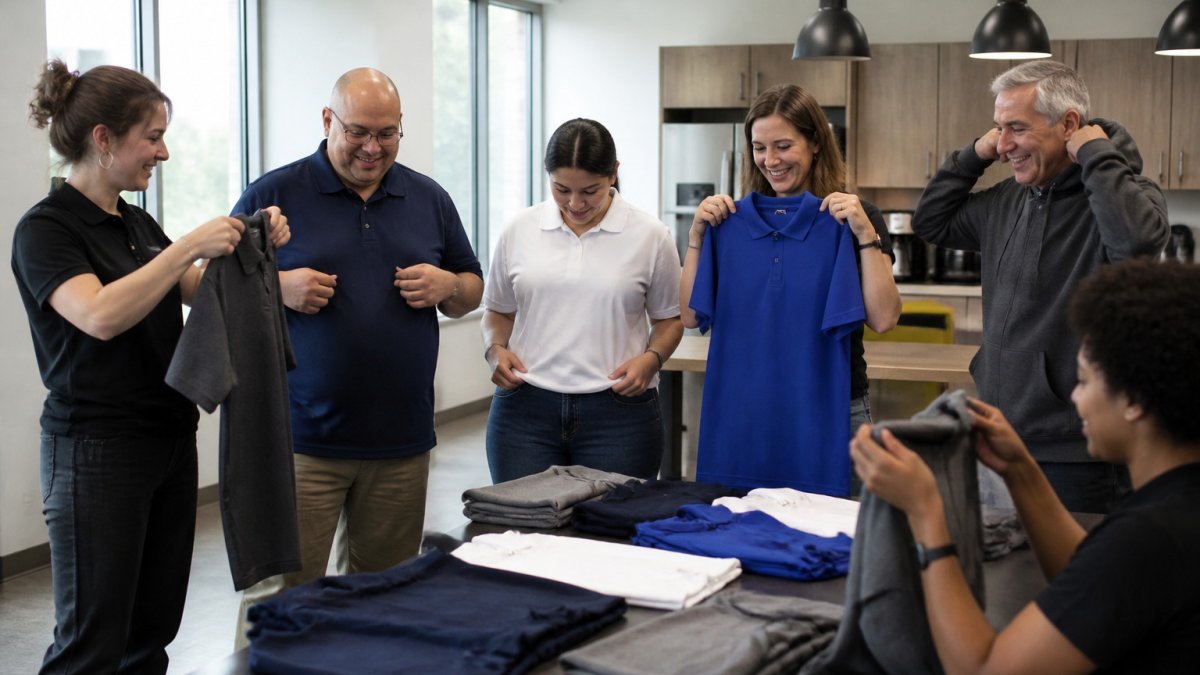
Start by asking staff which fabrics and cuts they prefer.
Fit, Fabric, and Inclusive Sizing
Offer a full size range and several cuts, including women’s and unisex options. Test fabrics for breathability and stretch, especially for roles that involve movement or outdoor work. Clear size charts help people choose correctly and reduce returns.
Company Apparel Examples for Staff by Role
Different roles call for different gear. A few examples:
Employee Uniform Policy Best Practices
A clear, fair policy prevents confusion and resentment. Keep it short and specific.
-
State which items are provided and which, if any, are optional
-
Explain when and where branded clothing must be worn
-
Review the policy each year with staff input
Good policies explain the reason behind the rule.
Measuring Whether Your Apparel Program Works
Treat your apparel program like any other workplace initiative and measure it against a baseline. You can pair a short employee survey with operational data you already collect.
Step 1: Capture a baseline before you order
Run a brief anonymous survey before launch. Useful items include:
- “I feel proud to be part of this team.”
- “I have clothing I am comfortable wearing during my shift.”
- “I would recommend this workplace to a friend.”
- “I feel recognized for my work.”
- “The company provides what I need to do my job well.”
Add two open-ended prompts: “What would make work apparel more useful to you?” and “What gets in the way of wearing it?” Record the response rate.
Step 2: Pick a small set of KPIs you can actually track
You do not need a research department. Choose three to five metrics that already exist in your records:
Do not promise a morale “score.”
Step 3: Re-survey on a fixed cadence
Repeat the same survey at 90 days and again at 6 and 12 months. Keep the questions identical so the comparison is valid. Report three numbers to leadership: the change in the pride item, the change in the comfort item, and the voluntary wear rate. If pride rises but comfort falls, you have a garment problem, not a culture problem, and that is a fixable, specific finding.
Step 4: Interpret honestly
Note what else changed during the period. If you cannot separate the effects, say so.
Avoid attributing turnover or productivity changes to apparel alone.
A simple one-page scorecard
| Metric | Baseline | 90 days | 6 months | 12 months |
|---|---|---|---|---|
| Pride item (avg score) | ||||
| Comfort item (avg score) | ||||
| Voluntary wear rate | ||||
| Participation rate | ||||
| Voluntary turnover (trailing 12 mo.) |
Review the scorecard with staff, not just leadership. Share what you learned, including what did not work.
Planning Your Staff Apparel Order With Piercy Sports and Apparel
Planning a staff order starts with the basics: who needs gear and how many pieces each person needs. A custom business apparel buying guide walks through options, quantities and steps before you commit. Pricing depends on quantity, dates, and delivery, so request a quote for current figures. If your team is small, review low minimum custom apparel order options before placing an order.
Piercy Sports and Apparel is based in Whiteland, Indiana, and offers custom team uniforms, business apparel, and sports gear. Our high-resolution digital printing, premium embroidery and screen printing services are available for custom apparel. For current details, check our website or reach out for a quote before you commit.
Get Started with Piercy Sports and Apparel to plan a staff apparel program your team will actually wear.
Frequently Asked Questions
Does branded clothing improve employee morale?
Whether it improves morale depends on the team and the apparel program. Measuring results through surveys before and after a rollout can help you assess your own team’s response.
How can branded apparel help employees feel like part of a team?
Matching apparel makes shared membership visible. Whether it reinforces team identity depends on the workplace and how the apparel is used.
Can a dress code or uniform lower employee morale?
A dress code or uniform may affect morale. Consider how the policy and apparel fit the needs of your staff.
Should employees have a choice in their company apparel?
Employee input can help a business consider apparel preferences. Ask staff what they would like before planning an order.