Table of Contents
- How Branded Staff Uniforms Strengthen Retail Brand Recognition
- Building Customer Trust and Professional First Impressions
- Retail Staff Uniform Ideas That Drive Customer Experience
- How to Choose Retail Uniforms for Your Store
- Employee Uniform Pros and Cons for Your Team
- Custom Business Apparel for Staff: Measuring Program Success
- Making the Transition: Implementing a Uniform Program
- Frequently Asked Questions
Last Updated: October 19, 2026
How Branded Staff Uniforms Strengthen Retail Brand Recognition
Branded staff uniforms are one of the most visible ways to build brand recognition in retail, and understanding the benefits of branded staff uniforms for retail is essential for any store looking to strengthen customer perception. When customers see employees in consistent, professionally designed apparel with your logo, they immediately recognize your brand identity, a lasting impression that extends beyond the transaction.
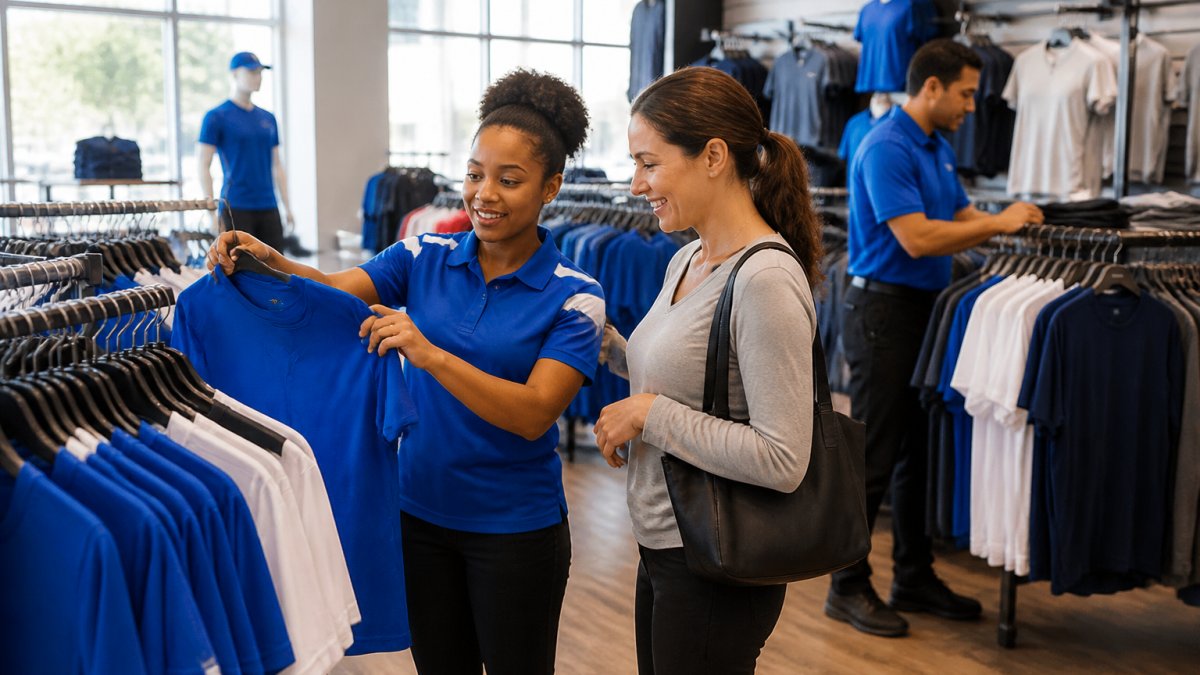
Branded staff uniforms turn every employee into a walking advertisement. A customer who interacts with a uniformed staff member is more likely to remember your brand on seeing that uniform again, in store, on the street, or on social media, strengthening recall without extra marketing spend.
Investing in quality custom business apparel for staff also signals that your business takes professionalism seriously. Uniforms communicate competence, organization, and attention to detail, building customer confidence before a word is spoken.
Consistency matters more than complexity. A simple, clean uniform design with your logo is more memorable than an intricate one. Customers remember what they see repeatedly, not what’s most elaborate.
Building Customer Trust and Professional First Impressions
A professional first impression influences whether a customer feels confident doing business with you. Retail staff in branded uniforms appear more credible and trustworthy, since customers associate uniform dress with authority, expertise, and reliability.
This reduces friction in customer interactions. A shopper approaching a uniformed employee feels comfortable asking questions, knowing that person officially represents the business. Without uniforms, customers may hesitate, unsure who is actually an employee.
Consistency across your team also builds trust through predictability. When every staff member looks the same, customers perceive your business as organized and well-run, and trust that your products and services meet consistent standards.
People make snap judgments about credibility within seconds. A well-designed uniform with your company branding creates an immediate sense of legitimacy that casual clothing cannot match.
Retail Staff Uniform Ideas That Drive Customer Experience
Most uniform guides stop at color and fabric. The retail-specific question is how a uniform choice changes what a shopper does in your store.
Start with identification. In a busy store, shoppers scan for someone who looks like they belong.
Match the uniform to the service model, not just the brand palette. A high-touch boutique benefits from a polished, tailored look signaling expertise. A high-volume grocery or big-box floor needs a durable, easy-to-clean polo or button-up that survives a shift of stocking and lifting.
Fit and comfort are customer-experience variables, not just HR ones. Staff adjusting a stiff collar or overheating in heavy fabric give shorter, less patient service.
Color and maintenance interact. If your brand requires a light color, choose a stain-release finish and budget for more frequent replacement. Logo placement matters too: left-chest embroidery reads as professional and survives washing better than a large screen-printed back panel, which can crack and peel.
Role differences deserve separate pieces. A vest or apron over a base shirt distinguishes cashier, stock associate, and floor lead without a second wardrobe. Climate matters too: a short-sleeve polo won’t serve a loading dock in winter and a sales floor in summer.
Finally, test before you commit. Give a small group of associates samples in their actual size and have them work a full shift. Watch for complaints about heat, restriction, or logo visibility from the customer’s sightline.
The best retail uniform is the one a shopper can identify from across the aisle and an employee can forget they are wearing. Design for both, and the customer-experience benefit follows.
::: Integrating custom labels into these garments reinforces this professional identity while ensuring that every piece of clothing remains a seamless extension of the brand story.
How to Choose Retail Uniforms for Your Store
Selecting retail uniforms means balancing practical and strategic factors. Start by defining the message your uniforms should send. Are you positioning as premium, approachable, modern, or traditional? Your uniform choice should reinforce that positioning.
Next, consider your operational environment. Warehouse staff need different uniforms than boutique staff, movement, durability, and functionality should match your actual work conditions.
Budget is a real constraint, but treating it as your only one leads to poor choices. Cheap uniforms fade, shrink, and fall apart within months, a false economy. Invest in mid-range quality that lasts through regular washing and wear.
Consider your team’s diversity. Sizes, body types, and accessibility needs vary, and uniforms that don’t fit properly undermine their entire purpose. Look for providers offering inclusive sizing and customization.
Test your choice with a small group before rolling out company-wide. Employee feedback reveals practical issues you might not anticipate, comfort complaints, durability problems, or visibility issues surface quickly once staff actually wear the uniforms.
Employee Uniform Pros and Cons for Your Team
Employee uniforms deliver clear benefits, but they also present real tradeoffs that deserve honest consideration.
Pros of employee uniforms:
- Simplifies daily decisions about what to wear, reducing decision fatigue
- Creates visual team identity and sense of belonging
- Reduces visible socioeconomic differences among staff
- Improves brand recognition and customer perception of professionalism
- Protects personal clothing from work-related wear and damage
- Makes it easier to identify staff in busy retail environments
- Demonstrates organizational standards to customers
Cons of employee uniforms:
- Initial investment in design, production, and inventory
- Ongoing costs for replacement and maintenance
- Some employees feel restricted or uncomfortable in uniforms
- Sizing and fit challenges across diverse teams
- Potential resistance to change from long-tenured staff
- Requires clear policies on uniform care and replacement
- May feel impersonal to employees who value individual expression
The employee uniform pros and cons depend on your business context. Retail environments where customer-facing professionalism is critical typically see strong net benefits; businesses where autonomy and individual expression are core values may face more resistance.
Rolling out uniforms without employee input often creates resentment. Even a brief survey asking for sizing preferences and comfort concerns significantly improves adoption rates.
Custom Business Apparel for Staff: Measuring Program Success
Measuring the benefits of branded staff uniforms for retail requires tracking both costs and outcomes, since a uniform program is a recurring operating expense, not a one-time purchase. Measure both the cost side, spend per employee per year, and the outcome side, changes in customer behavior and staff retention. Most retailers track neither, so programs drift into underinvestment or overspend.
Build a total cost of ownership model first. The purchase price is only one line. A realistic annual cost per employee includes:
- Initial garment cost (shirts, pants, aprons, outerwear) multiplied by the number of pieces per employee
- Embroidery or printing setup fees, which are often charged once per design and then per piece
- Replacement rate, how many pieces are lost, damaged, or outgrown per year
- Laundering, whether in-house or through a service
- Distribution and inventory management, including storage and reordering
- Administrative time for sizing, ordering, and compliance tracking
The purchase price is often roughly half the true annual cost per employee once replacement and laundering are counted. That changes the business case: a cheap garment that fades in three months can cost more per year than a mid-range piece lasting twelve. Track cost per wear, annual uniform spend divided by shifts worn, not cost per unit.
Then track the outcome metrics that matter in retail. Customer-facing metrics are the ones that justify the program to ownership:
- Customer recognition: in exit surveys or secret-shopper reports, ask whether the shopper could easily identify an employee. Track the percentage who say yes before and after rollout.
- Approach rate and service interaction time: secret shoppers can record how long it takes to be acknowledged and whether the interaction felt confident. Uniforms typically shorten the hesitation before a shopper asks for help.
- Brand recall: include a uniform-appearance question in customer surveys and compare recognition scores across stores with and without the program.
- Conversion and average transaction value: compare stores or periods with consistent uniform compliance against those without, controlling for seasonality.
- Employee satisfaction and retention: anonymous surveys on comfort, fit, and pride in the uniform, plus turnover rates for uniformed versus non-uniformed roles.
- Uniform compliance: the percentage of staff wearing the full uniform correctly on random audits. Low compliance undermines every other metric.
Set a review cadence. Quarterly suits most retail operations. Review cost per wear, replacement rates, and compliance together, high compliance with rising replacement costs signals a durability problem, while low compliance with stable costs signals a fit or comfort problem. Adjust the garment mix, sizing range, or vendor rather than abandoning the program.
Watch the compliance and tax details. Uniform policies should be in writing and applied consistently. Under federal tax rules, employers generally may require uniforms and can often deduct uniform costs as a business expense, but the treatment of employee-borne costs and maintenance varies, so confirm specifics with a qualified tax professional. State and local rules on payroll deductions for uniforms also differ. Documenting policy and costs protects the program and makes the ROI case auditable.
Do not measure uniforms only by purchase price. A low unit price with high replacement and laundering costs is often the most expensive option per wear.
Making the Transition: Implementing a Uniform Program
Rolling out a uniform program requires planning, communication, and clear policies, a poorly executed transition creates unnecessary friction.
Build buy-in before uniforms arrive. Explain why you’re implementing them and what benefits you expect; employees who understand the reasoning are more likely to embrace the change. Never announce uniforms as a surprise or present them as punishment.
Involve employees in the selection process when possible. Let them try different styles and provide feedback on fit and comfort. This participation creates ownership rather than resistance.
Establish clear policies on care, replacement, and compliance. Who pays? How often are uniforms replaced? What happens if an employee damages one? What’s the standard for wearing them correctly? Ambiguous policies create conflict.
Plan your rollout realistically. Don’t implement company-wide overnight, pilot with one location or department, identify problems, and refine before scaling.
Communicate throughout the process. Answer questions clearly. Address concerns directly. Be transparent about costs and expectations. The more information employees have, the less anxiety surrounds the change.
Consider an initial uniform allowance or stipend. This goodwill gesture acknowledges that uniforms are a business requirement, not something employees should fully fund, and it significantly improves adoption.
Branded staff uniforms are a strategic investment in how customers perceive your business. Executed well, they strengthen brand recognition, build customer trust, and create team identity, influencing customer experience, employee morale, and ultimately business performance.
At Piercy Sports and Apparel, we specialize in transforming your brand vision into durable, professional custom apparel. We work with retail businesses to design apparel solutions that reflect your brand identity while prioritizing comfort and durability. Learn more about custom apparel solutions for retail teams to explore how tailored uniform programs can elevate your customer experience.
Frequently Asked Questions
How do branded uniforms help retail customers identify staff?
Branded staff uniforms create instant visual recognition on the store floor. Customers can quickly spot employees who can answer questions or provide assistance. Consistent apparel with company logos and colors reinforces brand identity with every customer interaction, making your retail location feel organized and professional. This clarity improves the shopping experience and reduces customer frustration when they need help.
What are the main pros and cons of uniforms in retail?
Pros include stronger brand visibility, improved customer trust, reduced employee clothing costs, and increased team cohesion. Uniforms also simplify dress code enforcement and create a polished, cohesive image. Cons include upfront investment, sizing and fit challenges, potential employee resistance, and ongoing maintenance. Some employees may feel restricted by uniform requirements. Success depends on choosing comfortable, well-fitting apparel and involving staff in the selection process to address concerns early.
Should retail employees have to pay for a work uniform?
Best practice is for retailers to cover uniform costs. When employees pay out-of-pocket, it can create resentment and reduce program adoption. Employer-provided uniforms remove financial barriers, improve morale, and ensure consistent quality and fit across your team. This approach also simplifies inventory management and compliance. Many retailers view uniform costs as a business expense that pays for itself through improved brand recognition and customer experience.
How can I measure whether a retail uniform program is actually working?
Track metrics like customer feedback on staff appearance, employee satisfaction surveys, and retention rates before and after implementation. Monitor brand recall by asking customers if they remember your store’s branding. Compare clothing costs pre- and post-program to calculate savings. Some retailers survey customers about their shopping experience to see if uniforms improved perceived professionalism. Sales data and customer service metrics can also reveal whether uniforms contributed to better customer interactions and loyalty.