Table of Contents
- Define Your Hoodie’s Purpose and Intended Use
- Identify Your Target Audience and Team
- Select Hoodie Style, Fit, and Garment Quality
- Choose Brand-Aligned Colors and Design Elements
- How to Prepare Logo for Printing and Embroidery
- Embroidery vs. Screen Printing for Hoodies
- Logo Placement on Hoodies and Design Positioning
- Company Hoodie Design Ideas and Brand Governance
- Frequently Asked Questions
Last Updated: October 15, 2026
Define Your Hoodie’s Purpose and Intended Use
The first step in designing professional company branded hoodies is understanding exactly what you’re building them for. Team uniforms? Staff apparel? Fundraising merchandise? The purpose drives every decision that follows.
A hoodie for daily office wear needs different fabric weight and fit than one built for outdoor sports performance.
Define your intended use specifically:
- Team identity and performance wear, needs durability and moisture management
- Corporate staff apparel, requires a polished look and professional comfort
- Fundraising or promotional merchandise, prioritizes brand visibility and appeal
- Fan or supporter gear, balances team pride with wearability
Purpose also shapes your decoration method, hoodie style, and logo placement. A hoodie worn daily in a warehouse demands embroidery that won’t crack; a promotional piece might use screen printing for cost efficiency.
Start by writing down exactly when and where your hoodies will be worn. This single decision eliminates confusion later and keeps your design focused.
Identify Your Target Audience and Team
Who will wear these hoodies? The answer shapes sizing, color selection, and design elements.
Your audience determines fit expectations, color preferences, and comfort priorities. Youth league members need different sizing than corporate teams; school fundraising appeals to families, while business apparel targets daily-wearing employees.
Think through your specific audience:
- Age range, youth, teens, adults, or mixed
- Gender diversity, do you need inclusive sizing across all body types
- Wear frequency, daily wear, occasional events, or seasonal use
- Environment, indoor, outdoor, weather exposure, or climate-controlled
A youth sports team likely needs sizes XS to XXL; a corporate team might focus on adult sizing; a school fundraiser might emphasize broadly appealing unisex fits.
Document your audience size too. Ordering 15 hoodies versus 150 affects production timelines and decoration choices.
Your audience isn’t just “people who like our brand.” It’s specific people in specific situations wearing hoodies in specific ways. That specificity drives your design forward.
Select Hoodie Style, Fit, and Garment Quality
The hoodie style you choose affects how your logo looks, how the garment wears, and how long it lasts.
Pullover hoodies offer classic appeal and full-front printing space. Zip-ups add versatility and look more polished in business settings. Oversized fits appeal to younger audiences; tailored fits suit corporate wear.
Garment quality determines durability: premium fabric resists pilling and fading, and quality seams survive repeated washing. A cheap hoodie undermines even the best logo design.
When selecting a hoodie, evaluate:
- Fabric weight, heavier fabric (10+ oz) lasts longer; lighter fabric (7-9 oz) suits warmer climates
- Cotton blend, 100% cotton breathes better; poly blends resist wrinkles and shrinkage
- Seam construction, double-stitched seams outlast single stitching
- Pocket placement, chest pockets limit front logo space; side pockets preserve design area
- Hood design, drawstring color and lining affect the overall look
Fit matters too: a poorly fitting hoodie gets worn less, defeating the purpose of branded apparel.
Piercy Sports and Apparel helps teams and businesses select garments built for longevity.
Choose Brand-Aligned Colors and Design Elements
Your color choices communicate your brand instantly, triggering emotion and recognition faster than any other design element.
Start with your existing brand colors. If your team, company, or organization has established colors, use them, a hoodie in your brand colors becomes part of your visual identity across all touchpoints.
If you’re creating new colors, think about contrast and visibility:
- High contrast, dark hoodie with bright logo, or vice versa, ensures your design reads clearly
- Color psychology, blue conveys trust, red energizes, green suggests growth, black feels professional
- Fabric color impact, the hoodie base color affects how your logo appears; navy blue looks different with white versus gold embroidery
- Seasonal appeal, darker hoodies suit fall and winter; lighter colors work year-round
Keep your palette simple: two or three colors maximum beats five or six, making your design memorable and reducing production complexity.
Keep text, secondary logos, and graphic accents minimal. A clean logo with your organization name works better than a cluttered design trying to say everything at once.
Avoid trendy color combinations that date quickly. Choose colors that will still look professional in three years. Timeless beats fashionable when you’re building brand identity.
How to Prepare Logo for Printing and Embroidery
Your logo file quality determines whether your design looks sharp or pixelated on the finished hoodie. Preparation is critical.
Start with the highest-resolution version of your logo you can find. If it exists only as a small website image, recreate it or have a designer rebuild it at higher resolution.
File Format and Resolution Requirements
Different decoration methods require different file formats. Screen printing uses vector files. Embroidery uses digitized files. Direct-to-garment printing accepts high-resolution raster files.
For professional results, provide your logo in multiple formats:
- Vector format (.ai.eps.pdf), scalable without quality loss; best for screen printing and embroidery
- High-resolution raster (.png.jpg at 300 DPI minimum), works for direct-to-garment printing
- Embroidery format (.pes.dst.jef), if you’re using embroidery; these files contain stitch information
Resolution matters enormously: a logo that looks fine on a phone screen will look blurry printed 4 inches wide on a hoodie. Aim for 300 DPI minimum for any print method.
File size is a clue: a 50 KB logo is likely too low resolution, while a professional logo file is typically several MB.
Artwork Preparation Best Practices
Before sending your logo to production, prepare it properly. This prevents costly mistakes and delays.
Simplify your logo if needed. Intricate details that look fine on business cards disappear when embroidered at 3 inches wide.
For screen printing, check color separation, some colors need separating into layers. Your decoration provider can guide this, but understanding it helps you make informed decisions.
Provide your logo with clear background separation.
Include a size reference. Tell your provider the exact width or height you want your logo to be on the finished hoodie. This prevents surprises.
Get your logo file reviewed by your decoration provider before production starts. A 10-minute conversation catches file problems that would cost time and money to fix later.
Embroidery vs. Screen Printing for Hoodies
Two main decoration methods dominate professional hoodie production: embroidery and screen printing. Each has distinct advantages.
Embroidery stitches thread directly into the fabric, creating a raised, textured, premium-feeling design that works beautifully on left chest logos, sleeves, and back emblems, with vibrant, durable thread colors.
Screen printing pushes ink through a mesh screen onto the fabric, creating a flat, smooth design ideal for large prints, full-front graphics, and multi-color work, and it costs less per unit on large orders.
Durability, Fabric Compatibility, and Quantity Considerations
Durability differs: embroidery lasts hundreds of washes without fading or cracking, while screen printing depends on ink quality and fabric prep.
Fabric compatibility matters: embroidery works on any fabric weight, though very thin fabrics can pucker, while screen printing works best on tightly woven fabrics since loose weaves let ink seep through and heavy fabrics require more ink pressure.
Quantity affects economics: small orders often use embroidery or direct-to-garment printing, while large orders favor screen printing.
| Method | Best For | Durability | Cost at 50 Units | Cost at 200 Units | Setup Time |
|---|---|---|---|---|---|
| Embroidery | Premium look, left chest logos, small orders | Excellent | Lower | Higher | 3-5 days |
| Screen Printing | Large prints, multi-color, bulk orders | Very Good | Higher | Lower | 2-3 days |
| Direct-to-Garment | Photo-quality, small runs, complex art | Good | Moderate | Not ideal | 1-2 days |
Piercy Sports and Apparel offers these methods, so we help you choose based on your actual needs.
Logo Placement on Hoodies and Design Positioning
Where you place your logo dramatically affects how the hoodie looks and functions.
Logo placement depends on purpose and audience expectations: a corporate team expects a professional left-chest logo, a youth sports team might want a large back print, and a fundraising hoodie might feature a prominent front-center design.
Chest, Back, Sleeve, and Pocket Placement Options
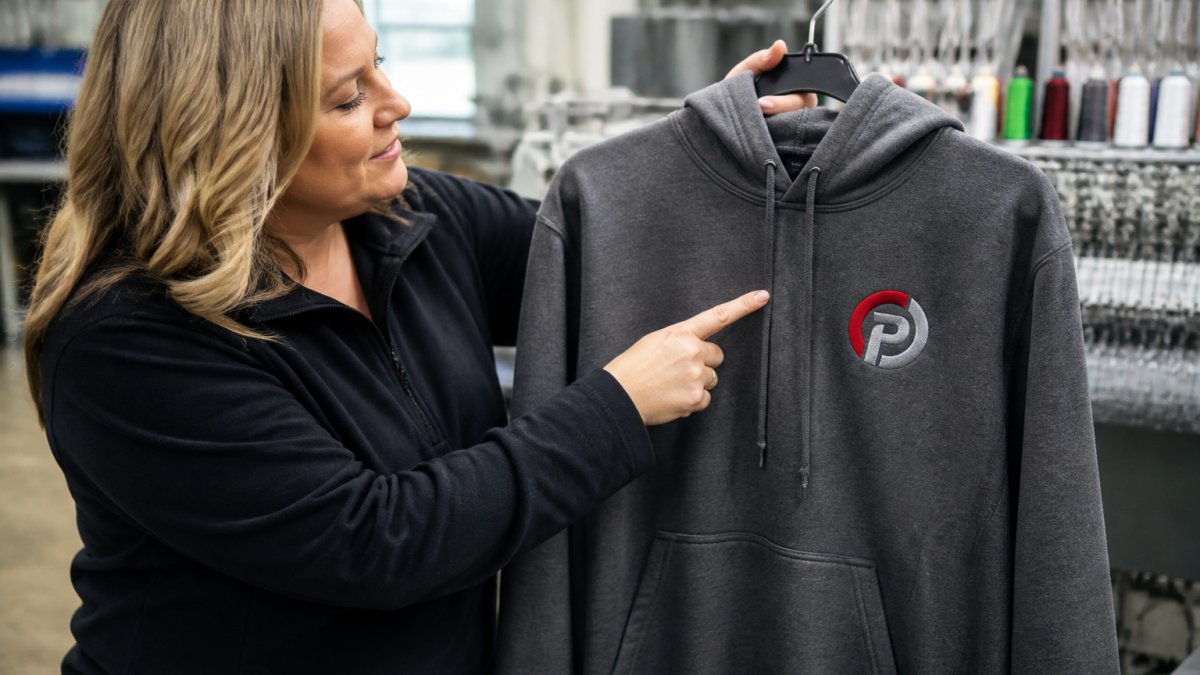
Left chest placement remains the most professional and versatile option, mirroring business shirt conventions.
Back placement commands attention and maximizes design real estate.
Sleeve placement adds visual interest without competing with chest or back space.
Pocket placement is limited: a small logo on a chest pocket offers subtle brand presence but little design space.
Logo Size, Legibility, and Visual Balance
Size determines whether your logo reads clearly or disappears into the fabric.
Too small a logo becomes illegible from a distance; too large overwhelms the garment.
Test your logo size with a mockup viewed from 6 feet away: if you can’t read it clearly, it’s too small.
Legibility requires contrast: a dark logo on a dark hoodie vanishes, as does a light logo on a light hoodie. Always contrast your logo color with the hoodie base color.
Visual balance matters too: a small left-chest logo feels incomplete on a large back area, and a massive back print on a small hoodie looks disproportionate.
Company Hoodie Design Ideas and Brand Governance
Your hoodie design should reflect your organization’s identity while remaining timeless enough to wear for years.
Good company hoodie designs balance brand recognition with wearability: simple enough to reproduce consistently across orders, distinctive enough to stand out.
Keep Designs Simple and Recognizable
The best hoodie designs use one or two elements maximum. Your logo. Your organization name. Maybe a single accent graphic. That’s it.
Complexity kills recognition: five colors, three fonts, and multiple graphics look busy and dated quickly, while a clean logo with your organization name in a single color looks professional and timeless.
Simplicity also ensures consistency: a simple design is easy to reproduce exactly on next year’s reorder, while a complex one invites variations and mistakes.
Test your design on people unfamiliar with your organization: if they can’t understand what it represents in three seconds, simplify further.
Production-Ready Artwork and Quality Control
Before sending your design to production, ensure it’s truly production-ready. This prevents costly revisions and delays.
Production-ready means correct file format, correct resolution, clearly specified colors, and an approved physical sample confirming size, placement, and appearance.
Request a sample before full production.
Inspect the first batch carefully for logo placement, color accuracy, and stitching quality, and address any issues immediately before the full order ships.
Production-ready artwork isn’t just a file. It’s a clear specification, a sample approval, and documented agreement between you and your provider about exactly what you’re getting.
At Piercy Sports and Apparel, we handle the technical details so you can focus on your brand.
Frequently Asked Questions
What file format should a logo be for hoodie printing?
Vector file formats like AI, EPS, or PDF work best for both screen printing and embroidery because they scale without losing quality. If you only have a raster image (JPG or PNG), ensure it’s at least 300 DPI and 2 inches by 2 inches at final size. When preparing logo files for printing, avoid embedded photos or gradients that may not reproduce cleanly. Piercy Sports can help assess your artwork and recommend adjustments to ensure production-ready results.
Where should a company logo go on a hoodie?
The most common placements are left chest (professional and visible when worn), full front (maximum impact for brand visibility), and back (bold statement for team identity). Sleeve placement works well for secondary logos or smaller designs. Pocket placement is subtle but effective for minimalist branding. Consider your intended use: employee wear favors chest placement, while fan apparel or team uniforms often feature back prints. Logo size and placement should maintain visual balance and keep the design recognizable from a distance.
Should company hoodies be embroidered or screen printed?
Embroidery offers a premium look, making it ideal for hoodies that will be worn frequently and washed regularly. Screen printing works best for detailed artwork, photos, or large front prints. Embroidery is durable on fabric and resists cracking after multiple washes, while screen printing can fade over time with heavy use. Consider your budget, design complexity, and how often the hoodie will be worn and washed when choosing between the two decoration methods.
How do I make a company hoodie look professional?
Focus on simplicity and brand consistency: use your official brand colors, keep logos clean and recognizable, and choose quality fabric with a comfortable fit. Ensure proper logo placement and size so designs don’t look cramped or oversized. Work with a professional apparel provider to verify your artwork meets production standards and select decoration methods that match your design. Test the design on a sample hoodie before committing to a full order. Professional hoodies combine thoughtful design decisions, quality materials, and precise production execution.