Last Updated: November 5, 2026
Quick Summary
To design custom sports uniforms, first set the sport, fit and roster size, then choose two or three team colors and one accent color. Build the layout on accurate, true-size blueprints, supply vector artwork, and match the decoration method to the fabric, such as sublimation on polyester or embroidery for logos.
- Count the roster and add two to three spare pieces per size group before ordering.
- Use two or three team colors plus one accent, tested for readability on your fabric.
- Keep critical artwork at least half an inch inside every seam line.
- Send vector files such as AI, EPS or SVG for sharp results at any size.
- Sublimation bonds reliably only to polyester, so check fiber content before choosing it.
Table of Contents
- Start With Your Team’s Requirements: Sport, Fit, and Roster Size
- Build the Design Concept: Colors, Logo Placement, and Typography
- Design Your Own Jersey Template Using Accurate Blueprints
- Prepare Print-Ready Artwork: Vector Files, Resolution, and Color Separation
- Choose Fabric and Decoration: Sublimation, Screen Printing, or Embroidery
- Best Practices for Sports Uniform Design That Hold Up Over Time
- Add a Custom Jersey With Logo and Plan Your Order Timeline
- Frequently Asked Questions
Custom sports uniforms look simple on screen, but the design choices you make early decide whether the final jersey looks sharp and holds up after a season of washing. The same questions come up every time: What do we need? How many? What will it cost to get right? This guide walks through the process one step at a time, so you can design uniforms that look good and last.
Start With Your Team’s Requirements: Sport, Fit, and Roster Size
Before you touch a design tool, write down three things: the sport, the fit, and the number of players. A basketball jersey, a softball jersey and a soccer kit each have different cut, length and sleeve needs. Fit matters too, since youth players grow fast and a jersey that fits well in August may be too tight by the next season.
Count your roster carefully, and add a few extra pieces for mid-season changes. Small squads can often order with no minimums to avoid buying more than you need. Roster changes are common in youth leagues, so plan for them now.
- Note the sport and the league’s uniform rules
- Measure or request size ranges for each age group
- Count players, plus two to three spares per size group
- Decide whether goalkeepers or captains need a different color
Pricing depends on quantity, sizes, decoration method and delivery date. Leagues can compare cost-effective bulk jersey options before finalizing quantities. For current prices or a quote, contact Piercy Sports and Apparel directly.
Build the Design Concept: Colors, Logo Placement, and Typography
Start with two or three team colors and one accent color. Choose colors that stay readable on the fabric you plan to use, and test them against each other on a screen before you commit. Dark text on a light jersey and light text on a dark one are the safest pairings.
Logo placement follows a simple pattern. The main logo usually sits centered on the chest, with the team name across the upper back and player numbers on the back and shorts. Keep the design balanced so no single element overpowers the rest.
Typography should be easy to read from the sidelines. Bold, block-style fonts work best for numbers and names. Avoid thin script fonts for anything a referee or parent needs to read quickly.
Design Your Own Jersey Template Using Accurate Blueprints
A jersey blueprint is a flat, true-size technical drawing of every panel, front, back, sleeves, collar, and any side or gusset pieces, with seam lines, stitch allowances, and grain direction marked. It is the document a printer or cut-and-sew factory actually builds from, so an inaccurate blueprint is the most expensive mistake in the design process.
What a usable blueprint contains
- Panel outlines at true size, not scaled to fit a screen. A youth medium front panel and an adult 3XL front panel are different shapes, and artwork sized for one will distort on the other.
- Seam and stitch lines with a marked allowance (commonly 3/8 inch to 1/2 inch on cut-and-sew garments). Artwork that crosses a seam allowance gets cut off or folded under.
- Grain line and stretch direction. On performance knits, the greatest stretch usually runs horizontally around the body. Graphics stretched along the grain behave differently than graphics placed across it.
- Registration marks and color callouts so the printer knows which panel gets which color and where panels align at the side seam.
- A placement grid for chest logo, back name, back number, and sleeve marks, measured from the neckline and centerline rather than eyeballed.
Build the layout in the right order
- Drop the blank template into your design program (Adobe Illustrator is the industry standard; Affinity Designer and CorelDRAW are common lower-cost alternatives).
- Lock the template layer so panel lines cannot move accidentally.
- Place the largest element first, usually the back number, then the back name, then the chest logo, then sleeve and short marks.
- Check every element against the seam lines at 100% zoom. A logo that looks centered on screen can sit a half inch off once the panel is cut.
- Export a flattened PDF proof at actual size and, if possible, print it on tabloid paper and tape the panels together. A paper mockup is the cheapest way to catch a placement error before production.
Match the blueprint to the decoration method
Watch out: designs placed within roughly a quarter inch of a seam are the first to crack, peel, or pucker, because the seam allowance flexes differently than the flat panel. Keep critical artwork, logos, numbers, sponsor marks, at least half an inch inside every seam line.
Prepare Print-Ready Artwork: Vector Files, Resolution, and Color Separation
Print-ready artwork is where most custom uniform projects go wrong. Logos sent as small screenshots or low-resolution web images will look blurry or pixelated on fabric. Vector files, such as AI, EPS or SVG, scale to any size without losing sharpness.
- Send vector files whenever you have them
- Use CMYK or Pantone color references for consistent results
- Remove any unwanted background or stray pixels
- Confirm the final artwork at actual print size
Choose Fabric and Decoration: Sublimation, Screen Printing, or Embroidery
Decoration method and fabric are a matched pair. Choosing one without the other is how teams end up with graphics that crack, colors that shift, or a jersey that feels heavy in July. The three mainstream methods behave very differently on performance knits, cotton blends, and outerwear.
Sublimation: full-color, all-over graphics
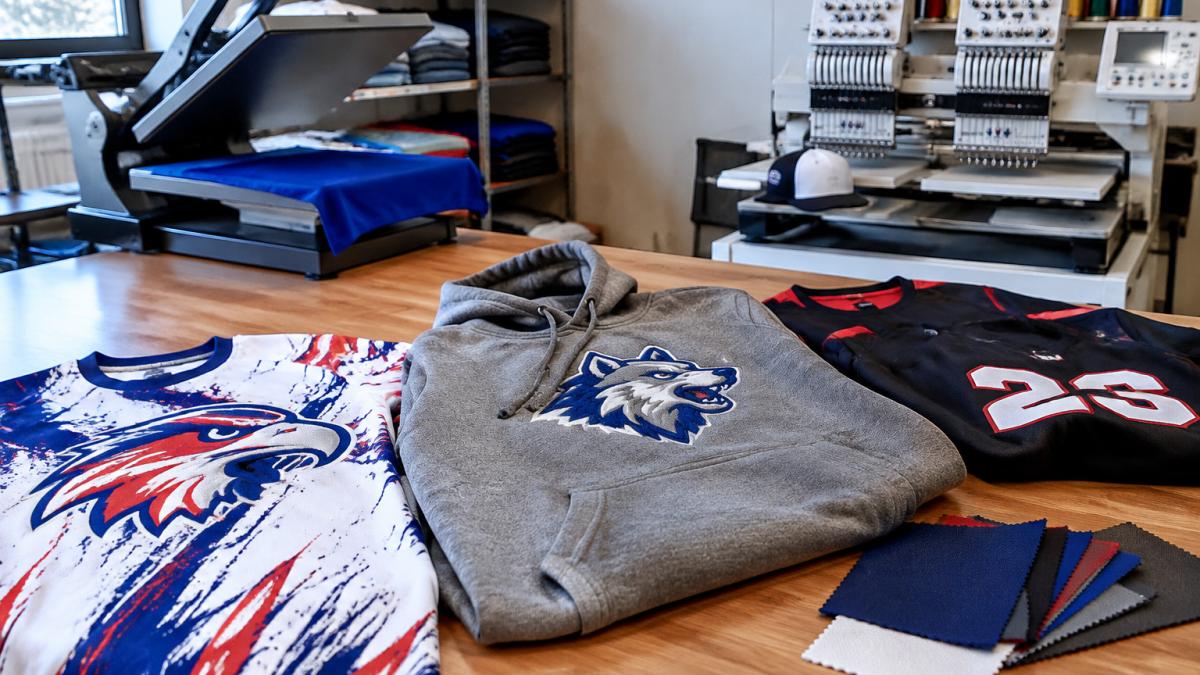
The catch is fiber content. Sublimation only bonds reliably to polyester, typically 100% polyester or blends with a high polyester content. Teams can explore custom sublimation uniforms with edge-to-edge designs for this approach. On cotton or cotton-rich blends, the ink has nothing to bond to and the print looks faded or washes out. Most performance uniforms, cycling kits, and esports jerseys are built around this method for that reason.
Screen printing: bold solids at volume
On stretchy performance fabrics, plastisol can feel stiff over large areas and may crack if the ink deposit is heavy. Our guide to screen printing for jerseys compares inks and durability in more detail. Water-based inks sit softer in the fabric and are often preferred for breathable athletic wear.
Embroidery: texture and durability for logos and outerwear
Embroidery stitches thread directly into the garment, giving a raised, premium look that survives repeated washing. You can see how professional logo embroidery services handle digitization and file requirements. It is the standard for chest logos, caps, polos, jackets, and coach gear. The trade-off is detail: fine text, small lettering, and gradients do not reproduce well in thread, and very dense designs can feel stiff or pucker on lightweight fabric. Embroidery is usually priced by stitch count, so simplifying a logo, fewer colors, cleaner shapes, lowers cost.
Fabric technology worth specifying
- Moisture-wicking polyester moves sweat to the surface to evaporate; it is the default for jerseys, shorts, and training tops.
- Spandex (elastane) content, commonly 5-15%, adds stretch and recovery for fitted cuts and movement-heavy sports.
- Mesh and micromesh panels increase breathability in high-heat zones such as the back and underarms.
- Fabric weight is usually quoted in grams per square meter (GSM). Lighter knits (roughly 130-150 GSM) suit hot-weather jerseys; heavier knits (180 GSM and up) feel more substantial and suit outerwear or contact sports.
- Anti-odor and UV treatments are increasingly offered on performance knits and are worth asking about for outdoor summer leagues.
Match the method to the garment
| Garment | Common method | Why |
|---|---|---|
| Sublimated jersey | Dye sublimation | Full-color, no added weight, no cracking |
| Cotton tee or hoodie | Screen print or embroidery | Ink bonds to cotton; embroidery suits logos |
| Cap or beanie | Embroidery | Durable, premium, holds shape |
| Polo or coach shirt | Embroidery | Clean chest logo, professional look |
| Practice pinnie | Screen print (1-2 colors) | Low setup, high volume |
Best Practices for Sports Uniform Design That Hold Up Over Time
Designs that last share a few habits. Keep graphics simple enough to read at a distance. Limit the number of colors, since more colors add cost and create more places for things to go wrong.
Think about the full season, not just opening day. A jersey that looks great new but fades after five washes is a poor investment for a league that plays every weekend.
Good design also considers the wearer. Keep names and numbers clear, avoid placing graphics where they rub against equipment or straps, and make sure the sizing chart matches the real cut.
Add a Custom Jersey With Logo and Plan Your Order Timeline
Once the design is final, place your order with enough time to spare. Production takes time, and rush schedules cost more. Work backward from your first game date, allow time for a sample or proof, and build in a buffer for any corrections.
Before you order, confirm the following: final artwork file, color references, sizes and quantities, roster names and numbers, and delivery address. Ask for a digital proof and review it carefully, since the proof is your last chance to catch spelling or sizing errors.
Piercy Sports and Apparel is a one-stop shop for custom team uniforms, business apparel and sports gear. For current pricing, turnaround times and options for your league, visit the Piercy Sports and Apparel website or request a quote.
Frequently Asked Questions
How can I design my own uniform?
Start by gathering your team’s sport, roster size, colors, and logo files. Sketch two or three layouts, choose a jersey style that fits the sport’s rules, and decide where the logo, team name, and numbers will go. Then create a digital mockup in a graphic design program or share your concept with a vendor who can build a proof. Keep the design simple enough to read from the stands and check that colors contrast well.
What software is best for designing custom jerseys?
Vector-based programs such as Adobe Illustrator are widely used for jersey design because they keep logos sharp at any size. Many teams also use Adobe Photoshop for mockups or free online uniform builders for quick layouts. Whichever tool you choose, save final artwork as a vector file (AI, EPS, or SVG) or a high-resolution PNG so your printer can use it. A design template with the jersey’s exact dimensions helps keep numbers and names properly placed.
What is the difference between screen printing and digital printing for uniforms?
Screen printing pushes ink through a stencil onto fabric, one color at a time, so it works well for simple logos and larger quantities. Sublimation, a form of digital printing, uses heat to bond dye into polyester, allowing full-color designs, gradients, and photo-style graphics with no limit on colors. Sublimation is generally better for detailed, multi-color jerseys, while screen printing suits bold designs on cotton. Ask your vendor which method fits your fabric and design before you finalize artwork.
How do I choose the right fabric for custom sports uniforms?
Choose fabric based on the sport, climate, and how often the uniforms will be washed. Moisture-wicking polyester performs well for most athletic jerseys because it dries quickly and holds color through repeated washing. Consider fabric weight for the season, with lighter knits for summer play and heavier options for cold weather. Ask about durability and colorfastness before ordering, and request a fabric sample when possible.
Ready to get your team outfitted? Get started with Piercy Sports and Apparel today for custom uniforms built for performance and durability.