Last Updated: October 28, 2026
Quick Summary
To design youth baseball uniforms, first check your league’s written uniform rules, then choose a jersey style, fabric, and the full set of pieces. Next pick two or three contrasting team colors, lay out names, numbers, and logos for readability, collect and verify roster measurements, approve a digital proof, and work backward from your first game date.
- Get your league’s written uniform rules before you start designing anything.
- Test team colors on a swatch, since bright colors can print differently on fabric.
- Limit your design to three colors total to keep costs down and reproduction clean.
- Collect chest, waist, height, and inseam measurements from each player over a t-shirt.
- Allow at least one to two weeks for fitting and distribution before your first game.
Table of Contents
- Check League and Age-Group Rules Before You Design Anything
- Choose a Jersey Style, Fabric, and Uniform Pieces
- Pick Team Colors and a Color Combination That Reproduces Well
- Youth Baseball Jersey Design Ideas: Names, Numbers, Logos and Layout
- How to Choose Youth Baseball Uniform Sizes and Collect Roster Measurements
- Using a Custom Baseball Uniform Builder, Proofing and Approving Your Design
- Your Custom Baseball Uniforms Ordering Checklist for Budget, Timing and Care
- Frequently Asked Questions
Check League and Age-Group Rules Before You Design Anything
Before you plan anything, check your youth league’s uniform rules.
Check your league’s uniform rules before you begin designing.
Ask your league director for its written uniform rules.
Choose a Jersey Style, Fabric, and Uniform Pieces
Start with the jersey cut. Button-front jerseys look traditional and suit older youth players. Pullover styles are simpler to produce and often cost less per piece. Pick the style that matches your league’s look and your budget. See a complete youth uniform package to compare against your own plan.
Fabric matters just as much as the cut. Many teams choose moisture-wicking polyester blends because players sweat through a long summer season. Heavier knits last longer but run hotter. Ask the vendor for fabric weight and care instructions before you commit.
Decide on the full set of pieces now, not later:
- Jersey (home and away, if needed)
- Pants, with or without piping
- Socks and caps
- Belts and practice tops
Ordering the full set of youth baseball uniforms at once keeps colors matched across items.
Pick Team Colors and a Color Combination That Reproduces Well
Bright colors look great on screen but can print differently on fabric. Test your choices on a swatch before you order. A common mistake is picking two colors that blend together at a distance, such as navy and black or royal and purple.
Aim for strong contrast between your primary color and your trim. Light trim on a dark jersey, or dark trim on a light jersey, keeps numbers and logos easy to read from the stands. Limit yourself to three colors total. Each extra color adds cost and makes the design harder to reproduce cleanly. Maintaining this disciplined approach to your palette ensures a professional aesthetic as you design custom team apparel for the rest of your gear.
Youth Baseball Jersey Design Ideas: Names, Numbers, Logos and Layout
Design decisions here shape how the uniform looks on the field. Keep the layout simple and readable.
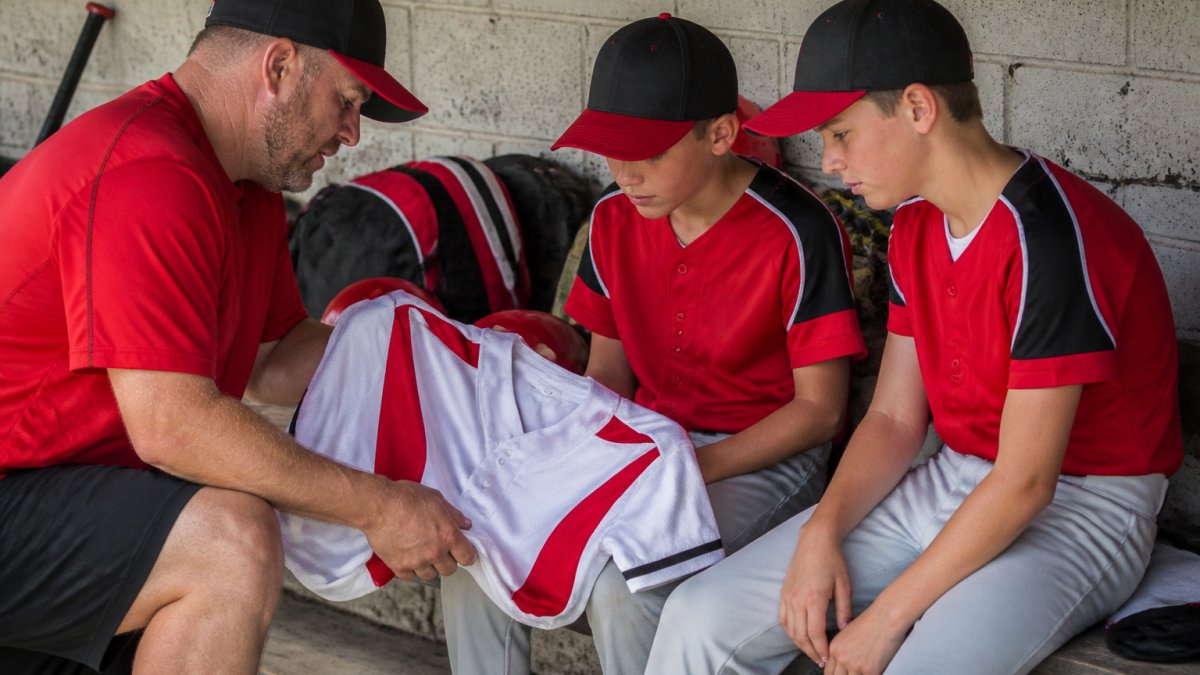
- Team name: Place it across the chest in a bold, legible font.
- Logo: Put the logo on the left chest or center chest, sized so it doesn’t crowd the name.
- Player name: Add it across the back above the number, if your league allows names.
- Jersey number: Use a size large enough to read from the outfield, with a contrasting outline.
Ask yourself one question for every element: does this help a parent in the stands tell players apart? If not, remove it.
How to Choose Youth Baseball Uniform Sizes and Collect Roster Measurements
Treat sizing as a data-collection project, not a guess based on age or grade.
Collect the right measurements
Ask each family to take four measurements with a soft tape measure over a t-shirt, not over a jacket: Learn practical ways to measure players for custom uniforms
- Chest: around the fullest part, arms down, tape level under the armpits.
- Waist: at the natural waistline, usually just above the hip bones.
- Height: standing against a wall, no shoes.
- Inseam: from the crotch seam of a well-fitting pair of pants to the floor.
Handle growth and between-size players
A common pattern among youth coaches is to size up when a player sits near the top of a size range, especially for players in a growth spurt. But a jersey that is too loose can swallow a smaller player and look sloppy, and pants that are too long drag on the field. Practical rules of thumb:
- If a player is within about half an inch of the top of a size range on chest or waist, consider the next size up.
- For pants, favor fit at the waist over length; a hem can be shortened, but a waist cannot be enlarged.
- Ask parents whether the player is expected to grow during the season. A player who just had a growth spurt is a safer bet to stay in size than one who has not.
- Check league rules on fit. Some leagues require jerseys to be tucked in, which changes how much length you need.
Build and verify the roster sheet
Create a single roster sheet with these columns: player name (as it will appear on the jersey), jersey number, chest, waist, height, inseam, requested size, and parent confirmation. Then run three checks before you submit:
- Duplicate numbers. Confirm no two players share a jersey number unless your league allows it.
- Name spelling. Have each parent initial the spelling of the name that will be printed. Nicknames and suffixes (Jr., II) are common sources of reprints.
- Size sanity check. Scan the sheet for outliers, a player listed two sizes larger than teammates of similar height usually means a measurement error.
Keep the completed sheet and the vendor’s size chart together in one file. If a player needs a replacement mid-season, you will have the exact size and name on record instead of re-measuring under time pressure.
The article lists four measurements to collect from each player, and the table below summarises each one with its placement.
| Measurement | How to take it | Note |
|---|---|---|
| Chest | Around the fullest part, arms down | Tape level under the armpits |
| Waist | At the natural waistline | Usually just above the hip bones |
| Height | Standing against a wall | No shoes |
| Inseam | From crotch seam to floor | Use well-fitting pants |
Using a Custom Baseball Uniform Builder, Proofing and Approving Your Design
Most vendors offer an online uniform builder or let you send artwork for a designer to set up. Either way, you will receive a digital proof to review before production starts. Compare custom jersey design software options before you pick a builder for your proofs.
Check the proof carefully:
- Spelling of the team name, player names, and numbers
- Logo sharpness, especially on small logo files
- Color accuracy compared to your swatch
- Number placement and size on both front and back
- Each piece in the set, not just the jersey
Send one consolidated list of corrections, not piecemeal emails. Ask for a final written approval before the order goes into production. Once approved, changes usually cost extra or delay the order.
Your Custom Baseball Uniforms Ordering Checklist for Budget, Timing and Care
Planning budget and timeline early can help organize your decisions.
Understand what drives cost
Pricing depends on quantity, dates, and delivery. For current prices or a quote, contact Piercy Sports and Apparel through its website.
For current prices or a quote, contact Piercy Sports and Apparel directly through its website.
Work backward from your first game
Build the timeline from the date you need uniforms in hand, not from the date you place the order: Understand what drives uniform turnaround times.
- First game date minus a buffer for fitting and distribution (allow at least one to two weeks).
- Minus shipping time (ask the vendor for an estimate to your address).
- Minus production time (ask for the standard, not rush, estimate).
- Minus proof review and revision time (allow at least a week for one round of corrections).
- Minus roster and measurement collection (allow two to three weeks for families to respond).
The result is your latest order date. If that date has already passed, ask the vendor which levers, fewer colors, standard shipping, simpler decoration, can compress the schedule without sacrificing the design.
Choose for durability and season-long performance
Fabric and decoration choices affect comfort, heat, movement, and how the uniform survives repeated washing:
- Moisture-wicking polyester blends are common for youth play because they move sweat and dry quickly in summer heat.
- Heavier knits last longer but run hotter; they suit cooler climates or older players better than young players in midsummer.
- Screen-printed numbers and logos can crack over time if washed in high heat or dried on high settings.
- Twill applique and embroidery tend to hold up well through a season but add weight and cost.
Share care instructions with families at distribution: wash jerseys inside out in cold water, avoid fabric softener, and hang to dry or tumble on low. Avoid high heat, which is the most common cause of cracked prints and peeling logos.
Pre-order checklist
- League rules reviewed and approved in writing
- Jersey style, fabric, and pieces chosen
- Colors tested on a swatch
- Roster measurements collected and double-checked
- Written quote with garment, decoration, and shipping broken out
- Final proof approved in writing
- Delivery date works backward from your first game
- Care instructions prepared for families
Frequently Asked Questions
How do you design a youth baseball uniform?
Start by confirming league rules and deciding on the design you want. For information about available options and the ordering process, contact Piercy Sports and Apparel.
How do you choose the right sizes for youth baseball uniforms?
For information about sizing and available options, contact Piercy Sports and Apparel.
What information do you need before ordering custom baseball uniforms?
Confirm your league’s uniform rules and contact Piercy Sports and Apparel for information about available options, ordering requirements, timing, and a quote.
How long does it take to design and order custom baseball uniforms?
For current turnaround information, contact Piercy Sports and Apparel before placing an order.