Table of Contents
- What ‘Turnaround Time’ Actually Means for Custom Uniforms
- The Artwork Approval Stage: Where Most Delays Begin
- Key Factors Affecting Apparel Turnaround
- Screen Printing vs. Embroidery Lead Times
- Uniform Turnaround Times: Standard vs. Expedited Options
- Team Uniform Ordering Best Practices
- Conclusion
Last Updated: August 30, 2026
What ‘Turnaround Time’ Actually Means for Custom Uniforms
Turnaround time is the total number of business days from the moment your order is confirmed to the moment your uniforms are ready to ship, and understanding it is the difference between arriving at opening day prepared and scrambling with borrowed gear.
At Piercy Sports and Apparel, we get this question from coaches and team managers constantly: "How long is this actually going to take?" The honest answer is that turnaround time is not a single number. It’s a production window that encompasses artwork approval, manufacturing, quality control, and fulfillment, each with its own timeline, and each capable of compressing or expanding the overall schedule.
Most guides give you a generic range and move on. This one won’t. Below, we’ll break down every stage that affects your delivery estimate, explain the variables that compress or extend your lead time, and give you a practical framework for planning your uniform order without cutting it dangerously close.
Production Time vs. Shipping Time: Why Both Matter
A common mistake is conflating production time with delivery time. These are two separate phases of your manufacturing cycle, and conflating them is how teams end up surprised when uniforms don’t arrive before their first game.
Production time covers everything that happens in the facility: artwork finalization, screen printing or embroidery, quality control checks, and packaging. Shipping time is what happens after the box leaves the building, and it depends entirely on your carrier, service level, and geographic distance from the production facility.
The practical implication: always add your shipping logistics window on top of your production window when calculating whether an order will arrive on time. A five-business-day production run paired with three-day ground shipping is not a five-day lead time. It’s eight days, minimum.
| Phase | Typical Duration | Key Variable |
|---|---|---|
| Artwork approval | 1-3 business days | File quality, revision rounds |
| Production (standard) | 7-14 business days | Order volume, decoration method |
| Production (expedited) | 3-7 business days | Rush fee applies |
| Shipping (ground) | 2-5 business days | Distance from facility |
| Shipping (expedited) | 1-2 business days | Higher carrier cost |
The Artwork Approval Stage: Where Most Delays Begin
The artwork approval stage is where most uniform orders lose time, often more time than the actual production run. This is the part most guides gloss over, and it’s the most controllable variable in your entire timeline.
Before a single jersey goes through a press or under a needle, your design must be reviewed, approved as a digital proof, and signed off by you. Any revision request, a color adjustment, a font change, a repositioned logo, restarts that clock.
How the Digital Proofing Workflow Works
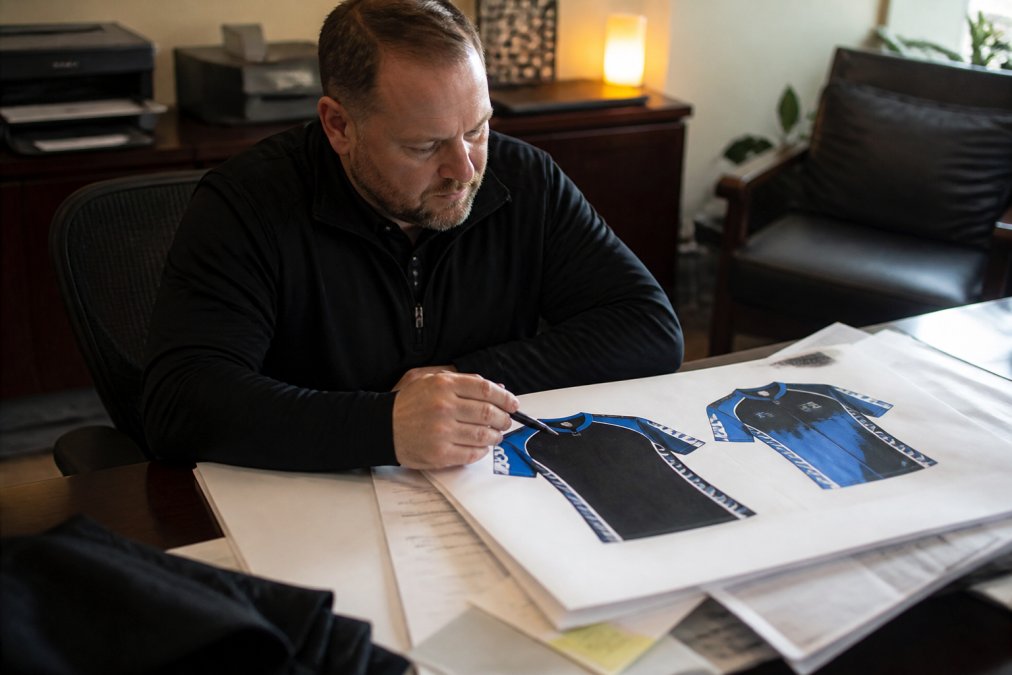
The digital proofing workflow is a structured review process where the production team converts your submitted artwork into a mockup showing exactly how the finished uniform will look, colors, placement, sizing, and all decoration elements.
Here’s how the process typically unfolds:
- Submit your artwork files. Vector files (AI, EPS, PDF) are strongly preferred. Low-resolution JPEGs or PNGs frequently require redrawing, which adds a business day or more before proofing even begins.
- Receive your digital proof. The production team generates a mockup, usually within one to two business days of receiving clean files.
- Review and approve, or revise. Check every element: player numbers, name spellings, color accuracy, logo placement. Approve it in writing.
- Production begins. Only after written approval does the manufacturing cycle start.
The thing nobody tells you about this stage: the most common delay isn’t the production team, it’s the customer. Slow email responses, committee-style approvals where three people need to sign off, or a logo file that needs to be recreated from scratch can add three to five business days before a single garment is touched.
Send your artwork files before you finalize your order. Many providers will review files and flag issues in advance, so you’re not losing production days after payment clears.
Key Factors Affecting Apparel Turnaround
Factors affecting apparel turnaround are rarely mysterious, they’re predictable once you know what drives the production schedule. Understanding these variables lets you plan realistically rather than optimistically.
Order Volume and Customization Complexity
Order volume and customization complexity are the two biggest levers on your production timeline. A 12-piece youth league order with a single-color chest logo processes very differently than a 200-piece travel team order with individual player names, numbers, and a multi-color custom graphic on both front and back.
Higher volume means more machine time, more quality control checkpoints, and more packaging steps. Greater customization complexity, particularly multi-color screen printing, mixed decoration methods, or unique sizing configurations, increases the number of production passes each garment requires.
Bulk order logistics also introduce coordination challenges that smaller orders don’t face: managing size runs, sorting by player, and verifying accuracy across a large inventory before shipment. Teams ordering 100 or more pieces should build an additional two to three business days into their expected production window to account for this.
Submitting a roster with missing sizes or last-minute additions after production has started is one of the most disruptive things a team manager can do. It can halt an entire production run. Lock your roster before you place your order.
Seasonal Peak Demand and Production Capacity
Seasonal demand is the variable most teams don’t account for, and it’s the one that bites hardest. Production capacity at any custom apparel facility is finite. During peak seasons, that capacity fills up fast.
The highest-demand periods for team uniforms typically cluster around:
- Late winter to early spring (February through April): baseball, softball, lacrosse, and soccer seasons launch simultaneously
- Late summer (July through August): fall football, volleyball, and cross-country programs place orders before school starts
- November through December: end-of-year holiday orders and spring sport early-bird orders overlap
During these windows, standard production timelines can extend by several business days simply because the facility is running at full capacity. Orders placed in January for a March season opener are in a very different position than orders placed in early March. According to guidance from the Promotional Products Association International on seasonal planning, early ordering is the single most effective way to avoid peak-season delays.
Screen Printing vs. Embroidery Lead Times
Screen printing and embroidery have meaningfully different lead times, and choosing the wrong decoration method for your timeline can cost you days you don’t have.
Screen printing is generally faster for large, flat-color graphics on fabric. Once the screens are burned and set up, the actual printing process moves quickly, particularly for high-volume orders. Setup time is front-loaded, which means screen printing becomes more time-efficient as order size grows. The Screen Printing and Embroidery industry overview notes that setup complexity scales with color count, not order size.
Embroidery takes longer per piece because each item is individually stitched. The process is slower by nature, but it produces a textured, premium finish that’s particularly durable on performance fabrics and outerwear. For small orders with a detailed logo, embroidery may actually be competitive on timeline. For large orders with complex designs, expect embroidery to add production days compared to screen printing.
The real difference between the two methods comes down to this: screen printing scales efficiently with volume, while embroidery scales with detail. If your deadline is tight and your order is large, screen printing is typically the faster path. If you need a premium finish on a smaller run, embroidery is worth the additional production time.
Sublimation, where ink is infused directly into the fabric rather than applied on top, sits in a different category entirely. Sublimation timelines are often comparable to screen printing for full-garment designs, and the method produces no cracking or peeling because there’s no surface layer to degrade. For performance jerseys with all-over custom graphics, sublimation is worth understanding as part of your apparel sourcing decision.
Uniform Turnaround Times: Standard vs. Expedited Options
Uniform turnaround times generally fall into two tiers: standard and expedited. Standard production runs typically span seven to fourteen business days, depending on order volume, decoration method, and current production capacity. Expedited options compress that window to three to seven business days, but they come with rush fees that increase with the urgency of the timeline.
The decision between standard and expedited isn’t purely about speed. It’s about supply chain transparency: knowing exactly where your order is in the production queue and what it will cost to accelerate it.
A few practical realities about expedited production:
- Rush fees are applied per order, not per piece, so they’re proportionally less painful on larger orders
- Expedited production does not automatically mean expedited shipping, you need to upgrade both independently
- Not all decoration methods can be expedited equally; embroidery has a physical speed limit that screen printing does not
Contingency Planning When Deadlines Are Tight
Contingency planning is the discipline that separates experienced team managers from first-timers. Even with a well-run order, things outside anyone’s control, a carrier delay, a fabric sourcing issue, an unexpected production backlog, can push delivery dates.
Build your contingency plan before you need it:
- Set your internal deadline two weeks before your actual deadline. If uniforms must arrive by game day, your personal order deadline should be fourteen days earlier.
- Confirm the production window in writing before payment. Get a documented delivery estimate, not a verbal assurance.
- Identify a backup option for practice gear. If uniforms arrive late, having practice jerseys ready keeps the team functional.
- Ask about order tracking. Knowing where your shipment is in transit removes a significant amount of uncertainty.
According to APICS supply chain management principles, contingency buffers of 20-25% above estimated lead times are standard practice in professional procurement, a principle that applies just as well to uniform ordering as to industrial supply chains.
The most effective contingency plan is simply ordering earlier than you think you need to. Every day of buffer you build in is a day of stress you eliminate.
Team Uniform Ordering Best Practices
The best team managers treat uniform ordering as a project management exercise, not a shopping task. That shift in mindset is what keeps orders on time and on budget.
Start with these practices before you place a single order:
- Lock your roster first. No size changes, no additions after order submission. A mid-production roster change can halt your entire manufacturing cycle.
- Prepare your artwork files in advance. Vector formats are the standard for a reason, they scale without quality loss and don’t require redrawing. If your logo only exists as a low-resolution image, address that before you contact a provider.
- Understand your decoration method. Screen printing, embroidery, and sublimation each have different timelines, durability characteristics, and minimum order considerations. Choose based on your actual needs, not just price.
- Confirm the re-order process upfront. Rosters change mid-season. Knowing whether a provider can handle small-batch re-orders at a reasonable cost is worth asking before you commit.
- Request a digital proof before approving production. Never approve an order without seeing a mockup. This is your last opportunity to catch errors before they’re stitched or printed onto 50 jerseys.
The Sporting Goods Manufacturers Association on uniform procurement planning recommends placing orders a minimum of six to eight weeks before the season start date for standard production, and ten to twelve weeks during peak demand periods.
For teams working with Piercy Sports and Apparel, the process is built around exactly these principles: high-resolution digital proofing, clear production timelines, and tailored solutions that account for your specific order size and decoration requirements. Whether you’re outfitting a 15-kid youth league or a 200-player travel program, the workflow is the same, lock the details, approve the proof, confirm the timeline.
Uniform turnaround times are predictable when you understand what drives them. The teams that consistently get their gear on time aren’t lucky, they plan earlier, prepare better artwork, and ask the right questions before placing an order. Piercy Sports and Apparel specializes in fast, reliable production backed by high-resolution digital printing, premium embroidery, and screen printing built for durability. Get started with Piercy Sports and Apparel and get your uniforms delivered on time, every season.
Frequently Asked Questions
How long does it typically take to produce custom team jerseys?
Production time for custom team jerseys generally ranges from 7 to 21 business days after artwork approval, depending on order volume, decoration method, and current production capacity. Expedited options can compress that window, though rush fees may apply. Always confirm the production window with your supplier before placing the order so you can plan shipping logistics around your season start date.
What is the difference between production time and shipping time?
Production time is the manufacturing cycle: the days your supplier needs to print, embroider, quality check, and fulfill your order. Shipping time starts only after the order leaves the facility. Both are separate legs of your total lead time. A uniform quoted at '10 business days' may still take two additional weeks to arrive if standard ground shipping is selected. Always ask for a delivery estimate that combines both figures, not just the production window, so your team receives gear before the first practice.
What factors influence the turnaround time for custom apparel?
Several variables shape apparel turnaround: artwork approval speed, decoration method (sublimation, screen printing, or embroidery), order volume, fabric sourcing availability, and seasonal demand peaks. Complex custom graphics with multiple colors add setup time. Large bulk orders require longer manufacturing cycles. Submitting print-ready files, approving digital proofs quickly, and placing orders well outside peak season, late summer and fall for most sports leagues, are the most reliable ways to protect your timeline.
Does screen printing take longer than digital printing for team uniforms?
Screen printing requires physical screen setup for each color in a design, which adds time at the start of the manufacturing cycle. A four-color logo needs four separate screens prepared before a single garment is printed. Sublimation and direct digital printing skip that setup stage, so they often move faster for smaller orders or designs with many colors. For large re-order runs of the same design, screen printing setup is a one-time cost and production speed per unit improves significantly.
This article was written using GrandRanker