Last Updated: October 25, 2026
Quick Summary
The 7 ways to measure players for custom uniforms are chest circumference, natural waist, shoulder width, armhole depth, arm length, inseam, and front/back length. Each measurement requires specific body landmarks and consistent technique across all players to ensure proper fit and comfort.
- Measure chest at the fullest part under the armpits with the tape snug but not tight.
- Waist measurement goes at the natural waistline just above hip bones, not at the belly button.
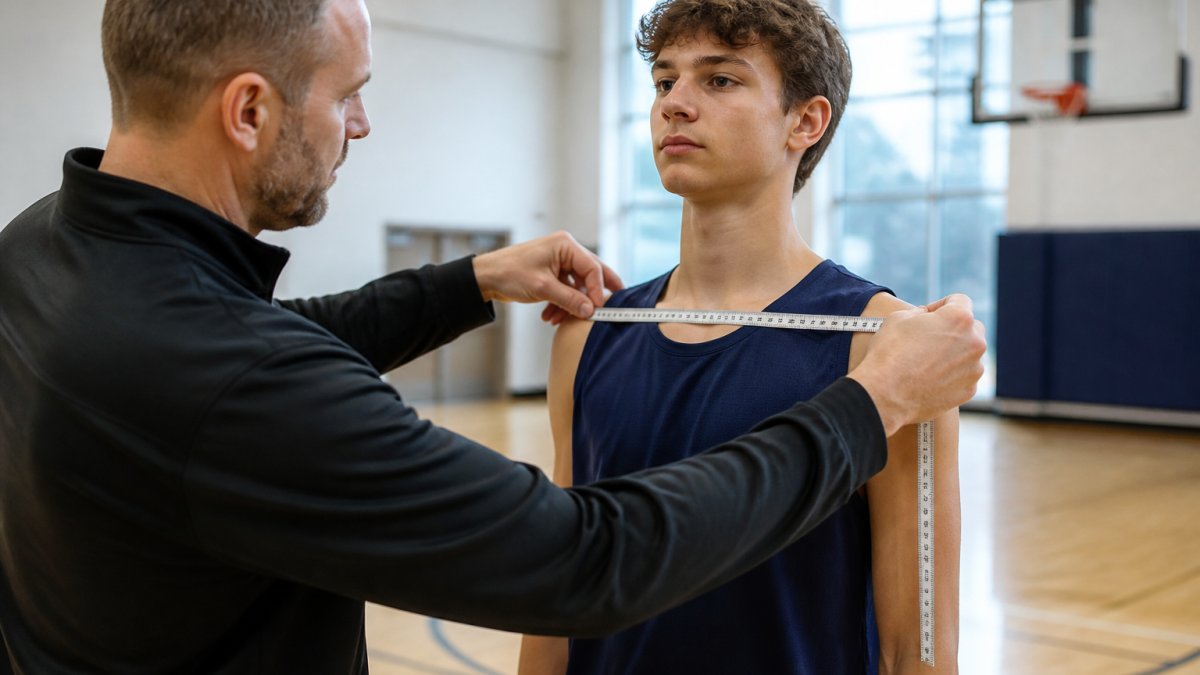
- Shoulder width runs from the top of one shoulder bone to the other across the back.
- Arm length measures from the shoulder point down the outside of the arm to the wrist bone.
- Inseam measures from the inside crotch seam down to the inside ankle bone with feet shoulder-width apart.
Table of Contents
- Why Accurate Player Measurements Matter for Custom Uniforms
- 1. Measure Chest and Body Circumference
- 2. Take Waist Measurements at the Natural Waistline
- 3. Record Shoulder Width and Armhole Depth
- 4. Measure Arm Length and Sleeve Length for Jerseys
- 5. Determine Inseam and Front/Back Length for Shorts
- How to Take Body Measurements for Clothing: A Complete Uniform Sizing Guide
- Custom Uniform Sizing Guide: Fit Allowances and Between-Size Decisions
- Frequently Asked Questions
Why Accurate Player Measurements Matter for Custom Uniforms
Getting player measurements right is the foundation of a great custom uniform fit. Learn how to prepare artwork for custom uniforms once your measurements are finalized.
Accurate measurements can help teams make informed sizing decisions before production starts.
This guide covers 7 ways to measure players for custom uniforms, each body measurement you need, common errors to avoid, and how to standardize the process across your team.
1. Measure Chest and Body Circumference
Chest measurement is one of the most critical for jersey fit, determining how snug or loose the shirt feels across the torso. Too tight restricts movement; too loose looks sloppy.
To measure chest circumference:
- Have the player stand straight with arms relaxed at their sides
- Wrap a soft measuring tape around the fullest part of the chest, directly under the armpits
- Keep the tape level and snug but not tight, you should be able to slide one finger under the tape
- Record the measurement in inches
This measurement drives the overall width of the jersey and how well it fits across the shoulders and torso. Many teams skip or estimate it, which leads to jerseys that don’t drape correctly.
Pro tip: Measure the same spot on every player.
2. Take Waist Measurements at the Natural Waistline
Waist measurement is essential for shorts and bottoms. The natural waistline is where the body narrows, typically just above the hip bones, not at the belly button.
To measure the waist:
- Have the player stand relaxed with feet shoulder-width apart
- Place the measuring tape around the natural waistline
- Keep the tape level all the way around the body
- The tape should be snug but not compressing, one finger should fit underneath
- Record the measurement
This measurement is critical for shorts that fit properly. Too tight restricts movement; too loose slides down during play.
Watch out: Many people measure at the belly button or the lowest part of the hips. The natural waistline is higher and narrower, measure there consistently for all players.
3. Record Shoulder Width and Armhole Depth
Shoulder width affects how the jersey sits on the shoulders and determines sleeve placement. Armhole depth influences room for arm movement.
To measure shoulder width:
- Have the player stand straight with arms at their sides
- Measure from the top of one shoulder bone to the top of the other shoulder bone
- Keep the tape straight across the back
- Record the measurement
To measure armhole depth:
- Have the player stand with one arm at their side
- Measure from the top of the shoulder (where the shoulder bone meets the collarbone) down to the underarm
- This tells you how deep the armhole should be on the jersey
- Record the measurement for each side if there’s a significant difference
These measurements ensure sleeves are positioned correctly and don’t ride up or sit too low, affecting overall comfort and range of motion.
4. Measure Arm Length and Sleeve Length for Jerseys
Sleeve length determines where the jersey cuff ends on the wrist. Too short looks like a kid’s shirt; too long bunches up and interferes with play.
To measure arm length:
- Have the player stand with one arm bent slightly at the elbow, relaxed at their side
- Measure from the center back of the neck, across the shoulder, down the outside of the arm to the wrist bone
- This is the full arm length measurement
- Record it for both sides if needed
Alternatively, measure from the shoulder point down to the wrist:
- Place the tape at the top of the shoulder (where the arm meets the torso)
- Measure straight down the outside of the arm to the wrist bone
- This gives you the sleeve length directly
Stick with one method for all players.
5. Determine Inseam and Front/Back Length for Shorts
Inseam and front/back length determine how long the shorts are and prevent them from being too baggy or too short.
To measure inseam:
- Have the player stand with feet shoulder-width apart
- Measure from the inside of the thigh, starting at the crotch seam, down to the inside of the ankle bone
- This is the inseam length
- Record it
To measure front length:
- Have the player stand straight
- Measure from the natural waistline down the front of the leg to just above the knee or to the desired shorts length
- Record it
To measure back length:
- Have the player stand straight
- Measure from the natural waistline down the back of the leg to the same point as the front length
- Back length is often slightly longer than front length to account for the curve of the body
These three measurements work together to ensure shorts fit properly and look proportional.
How to Take Body Measurements for Clothing: A Complete Uniform Sizing Guide
Taking accurate body measurements requires the right tools, a consistent process, and attention to detail.
What you’ll need:
- Soft measuring tape (fabric, not metal)
- Pen and paper or a spreadsheet to record measurements
- A quiet space where players can stand still
- A helper to hold the tape steady while you read it
The measurement process:
- Have each player wear close-fitting clothes or undergarments, baggy clothes hide the actual body shape
- Stand the player on a flat surface with feet shoulder-width apart
- Keep the measuring tape level and snug but not tight
- Read measurements to the nearest quarter inch
- Double-check each measurement before moving on
- Record measurements immediately to avoid mix-ups
The key to consistency is using the same technique for every player. Small variations in tape placement can throw off sizing across your team.
Standardizing Measurements Across Your Team
When you’re measuring 15 or 20 players, consistency matters. Measure one player one way and another differently, and your size chart becomes unreliable.
Create a measurement sheet listing each measurement in the same order for every player.
Record measurements in a spreadsheet to spot outliers or errors. If one player’s measurements are drastically different from similar-sized teammates, double-check before submitting to your vendor.
Share the measurement sheet with your uniform vendor.
Remote Measurement and Data Collection
If you can’t measure players in person, remote measurement requires clear instructions.
Provide a simple form or template with space for the player’s name, age, and any fit-preference notes.
Video calls work well for spot-checking: watch the player measure and guide them if the tape is misplaced.
Create a centralized spreadsheet for all remote measurements and review it before sending to your vendor. If anything seems inconsistent, reach out to verify.
Common Measurement Errors and How to Correct Them
Even experienced people make measurement mistakes. Here are the most common errors and how to avoid them.
Error: Measuring over loose clothing. Baggy shirts and pants hide the actual body shape.
Error: Holding the tape too tight. This compresses the body and makes measurements smaller than they should be.
Error: Not keeping the tape level. If the tape slants or angles, the measurement will be inaccurate.
Error: Recording measurements incorrectly. Transposing a number or rounding up when you should round down causes fit issues.
Custom Uniform Sizing Guide: Fit Allowances and Between-Size Decisions
Once you have accurate measurements, decide on fit. Custom uniforms aren’t one-size-fits-all; different sports and players need different amounts of room.
Fit categories:
- Slim fit: Minimal extra room, follows the body closely. Good for basketball or soccer where movement is unrestricted and a snug fit looks professional.
- Regular fit: Moderate extra room for comfort and layering. Works for most sports and most players.
- Loose fit: Extra room for layering, protection, or player preference. Good for football, hockey, or cold-weather sports.
- Athletic fit: Tapered at the waist, wider through the chest and shoulders. Designed for athletic builds.
Accounting for Layering and Movement
If players will wear compression gear, moisture-wicking shirts, or pads under their uniforms, account for that bulk. A jersey that fits over bare skin may be too tight over a compression shirt.
Also consider the sport. Basketball players need full range of motion for shooting and jumping. Football players might benefit from slightly more room for protection. Soccer players typically prefer a snugger fit for speed and agility.
When to Size Up or Down
Between-size decisions come up often. A player’s measurements might fall between two standard sizes. Do you size up or down?
Size up if:
- The player is between sizes and prefers a looser fit
- The player will layer underneath the uniform
- The player is still growing (common in youth sports)
- The player prefers more room for movement
Size down if:
- The player prefers a snug, athletic fit
- The player’s measurements are closer to the smaller size
- The uniform needs to look sleek and professional
- The player won’t layer underneath
When in doubt, ask your uniform vendor.
Take time to measure carefully, standardize your process across the team, and communicate clearly with your vendor. How to Manage Team Jersey Orders: 7 Essential Steps walks you through the next phase after measurements are finalized. Get started with Piercy Sports and Apparel.
| Measurement | Purpose | Key Placement |
|---|---|---|
| Chest circumference | Jersey width and fit | Fullest part of chest, under armpits |
| Natural waist | Shorts waistband | Just above hip bones, not belly button |
| Shoulder width | Sleeve placement | Top of shoulder bone to shoulder bone |
| Armhole depth | Sleeve room and comfort | Shoulder to underarm |
| Arm length | Sleeve length | Shoulder point to wrist bone |
| Inseam | Shorts length | Inside thigh from crotch to ankle bone |
| Front/back length | Shorts fit | Waistline to knee or desired length |
ASTM International standards for clothing measurement
American Society for Testing and Materials guidelines on apparel sizing
U.S. Consumer Product Safety Commission guidance on youth sports equipment
Frequently Asked Questions
What measurements do you need for a custom sports uniform?
A complete custom uniform requires seven key measurements: chest circumference, natural waist, shoulder width, armhole depth, arm and sleeve length, inseam, and front/back length. These measurements ensure jerseys fit properly across the shoulders and torso, shorts sit at the correct waist with the right inseam, and sleeves end at the wrist. Accurate measurements prevent uniforms from being too tight, too loose, or restricting player movement during competition.
How should a player measure for a basketball jersey to ensure proper fit?
For a basketball jersey, have the player stand relaxed in athletic wear. Measure arm length from the center back neck down to the wrist, and measure sleeve length from the shoulder point to the wrist. Measure chest circumference at the fullest part of the chest. For basketball, jerseys typically allow 2-4 inches of extra room for movement. Always use a soft tape measure and have a second person assist to keep the tape level and snug but not tight against the body.
Can you measure players remotely for custom uniforms?
Yes, you can collect measurements remotely by providing players or parents with clear written instructions and a video guide showing proper measurement technique. Send a standardized measurement form with diagrams, have players measure themselves using a soft tape measure, and verify measurements for consistency. For youth teams, consider scheduling a team measurement day where players gather in one location for consistency, or work with parents to collect measurements using video calls where you can confirm proper tape placement and positioning.
What are common measurement errors when sizing for custom uniforms?
Common errors include pulling the tape too tight (creating artificially small measurements), measuring over heavy clothing or pads, using hard rulers instead of soft tape measures, and measuring at the wrong body landmarks. Players often don’t stand in a natural, relaxed position. Avoid measuring over shoulder pads or compression gear. Always measure at the natural waistline, not the hip or lower abdomen. Double-check measurements for outliers that don’t match the rest of the team, as these often indicate measurement technique errors rather than actual player size.


One Response