Table of Contents
- Start With the Sport: Match Jersey Fabric to How It Will Be Used
- Single Jersey vs Double Jersey: Types of Jersey Fabric Explained
- Fabric Weight and GSM: The Number That Decides Everything
- Polyester vs Cotton Jersey for Sports: Which Fiber Belongs on the Field
- Test Stretch, Recovery, and Pilling Before You Commit
- Needles, Thread, and Screen Printing on Jersey Knit
- How to Care for Custom Jersey Apparel So It Lasts the Season
- Conclusion
- Frequently Asked Questions
Last Updated: September 26, 2026
Start With the Sport: Match Jersey Fabric to How It Will Be Used
The fastest way to choose jersey fabric is to start with the activity, not the fabric swatch. A soccer kit that sprints for 90 minutes needs different properties than a team polo worn at a fundraiser, and matching the fabric to the sport prevents most ordering mistakes before they happen.
The right jersey fabric balances three things: how much the wearer sweats, how much the garment stretches, and how often it gets washed. The right jersey fabric balances three things: how much the wearer sweats, how much the garment stretches, and how often it gets washed.
Here’s a quick decision framework:
- High-sweat, high-movement sports (soccer, basketball, track): prioritize moisture-wicking synthetic blends
- Moderate-activity sports (baseball, softball, golf): prioritize breathability and a comfortable hand feel
- Spirit wear and sideline apparel: prioritize softness and printability over performance
Get this match right first. Every other decision, from weight to fiber, follows from it.
Single Jersey vs Double Jersey: Types of Jersey Fabric Explained
Jersey fabric is a knit fabric made on a circular knitting machine, where loops interlock in a single direction to create a stretchy, draping material. Two main types dominate custom apparel: single jersey and double jersey.
Single jersey has loops on one face and purl stitches on the other. It’s thinner, lighter, and stretches in one direction, making it the standard choice for t-shirts and lightweight athletic tops. Double jersey knits two sets of yarn together, producing a thicker, more stable fabric with two smooth faces that resists curling at the edges.
A third option, interlock knit, sits between the two: it’s a double-knit variant with a tighter structure and less stretch than single jersey, often used for structured polos. Ponte di Roma is a heavier double-knit with excellent recovery, better suited to jackets and dressier team wear than performance jerseys.
| Type | Weight Range | Stretch | Best For |
|---|---|---|---|
| Single jersey | Light | Two-way | T-shirts, athletic tops |
| Double jersey | Medium | Limited | Polos, structured tops |
| Interlock knit | Medium | Minimal | Collared team wear |
| Ponte di Roma | Heavy | Low | Jackets, dressier apparel |
Fabric Weight and GSM: The Number That Decides Everything
GSM (grams per square meter) is the single most useful spec when choosing jersey fabric for a specific garment. It tells you how heavy and dense the fabric is, which predicts how it drapes, how opaque it is, and how warm it feels. For most team and custom apparel, the working range runs from roughly 140 GSM for light summer tops up to about 220 GSM for heavier, more structured garments.
For most team and custom apparel, the working range runs from roughly 140 GSM for light summer tops up to about 220 GSM for heavier, more structured garments. Here is how that range maps to real projects:
| GSM Range | Typical Use | What It Feels Like |
|---|---|---|
| 120-150 | Lightweight performance tops, summer jerseys, sublimated athletic wear | Thin, airy, dries fast, can be semi-sheer in white |
| 150-180 | Standard t-shirts, spirit wear, casual team tees | Balanced drape, good print surface, everyday hand feel |
| 180-210 | Structured polos, heavier team tops, rugby-style jerseys | Denser, holds shape, prints cleanly with less ink show-through |
| 210-240+ | Jackets, dressier team wear, ponte-style double knits | Substantial, low stretch, tailored drape |
Weight also interacts with fiber. A 150 GSM polyester jersey feels lighter and dries faster than a 150 GSM cotton jersey, because polyester does not absorb water the way cotton does. That means two fabrics with the same GSM can perform very differently on the field. When you compare swatches, weigh the GSM against the fiber before you judge the hand feel.
Opacity is the other variable GSM controls. Thin single jersey in light colors can show through under bright stadium lights, which is why darker or double-knit options are often safer for white-based designs. If your design relies on white or pastel panels, aim for the upper end of the range or a double-knit construction.
A fabric that feels right in a small swatch can behave completely differently at full garment size, especially once it’s been washed and dried a few times.
A quick way to sanity-check a swatch without a scale: hold it up to a light. If you can read text through it, it is likely under 150 GSM and will need a backing or a darker print for opacity. If it blocks light cleanly and feels substantial in hand, it is likely 180 GSM or higher and will hold structure well.
Polyester vs Cotton Jersey for Sports: Which Fiber Belongs on the Field
Polyester wins for active sports. Cotton wins for comfort and casual wear. That’s the short version, and it holds up across most team apparel decisions. The longer version is about fiber blends and percentages, because most jerseys on the market are not 100% of either.
Polyester jersey is moisture-wicking, pulling sweat away from skin and drying quickly. It also holds its shape better through repeated washing and resists pilling longer than cotton under heavy use.
| Blend | Typical Use | Trade-off |
|---|---|---|
| 100% polyester | Performance jerseys, sublimated uniforms | Best wicking and durability, least natural feel |
| 90/10 poly/spandex | Fitted athletic tops, compression-style jerseys | Excellent recovery and four-way stretch, higher cost |
| 50/50 cotton/poly | Spirit wear, fan tees, casual team apparel | Balanced softness and durability, moderate wicking |
| 60/40 cotton/poly | Everyday team tees, fundraiser shirts | Softer hand, prints well, shrinks less than 100% cotton |
| 95/5 cotton/spandex | Fitted casual tops, lightweight jerseys | Stretch and recovery without synthetic feel |
Fiber content and GSM work together. A 180 GSM 100% cotton jersey and a 180 GSM 90/10 poly/spandex jersey will feel and perform nothing alike. Always read the fiber percentage alongside the weight before you decide.
One more variable worth checking: how the fabric is finished. Some polyester jerseys are treated with a wicking finish that can wash out over time, while others build wicking into the fiber itself.
Test Stretch, Recovery, and Pilling Before You Commit
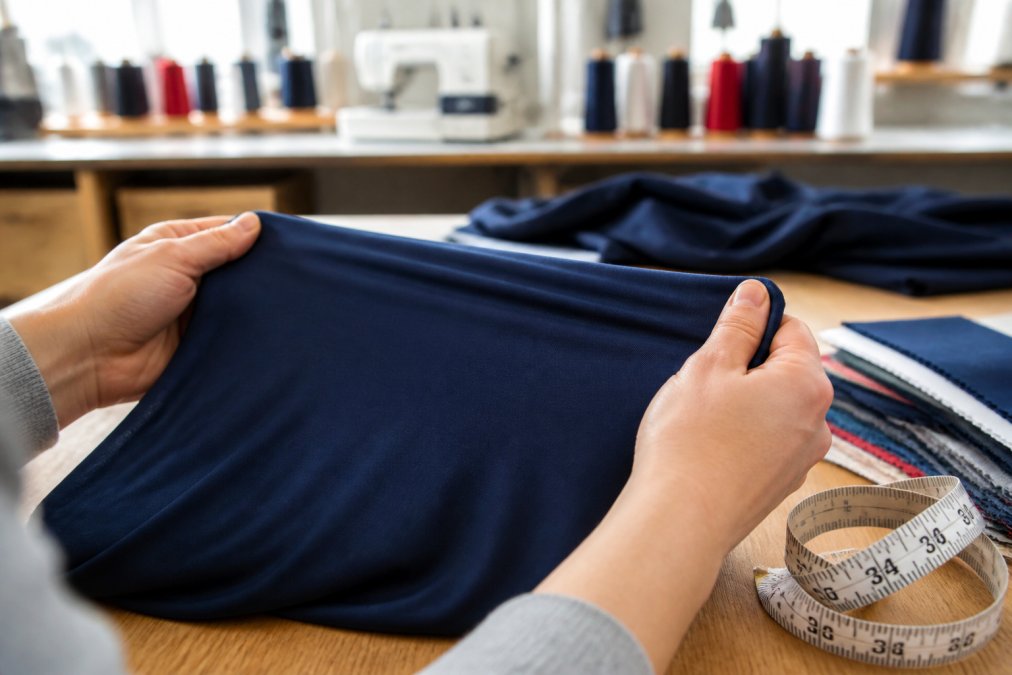
A fabric that passes a quick stretch and recovery check rarely triggers the “it lost its shape” returns that plague poorly spec’d orders.
Needles, Thread, and Screen Printing on Jersey Knit
Screen printing on jersey knit demands the right setup, because knit fabric stretches and a stiff print can crack. The fix starts with ink choice and mesh count, not just the artwork.
- Ballpoint needle: rounded tip slips between knit loops instead of cutting them, preventing runs
- Stretch or jersey needle: sized 75/11 or 90/14 for most athletic knits
- Serger with overlock stitch: finishes seams so they stretch without snapping
- Sewing tension: loosen slightly, since tight tension puckers knit seams
The single biggest factor in print durability is full curing, not ink brand. A well-cured print on quality jersey fabric outlasts a premium ink on an under-cured one.
How to Care for Custom Jersey Apparel So It Lasts the Season
Washing custom jersey apparel inside out in cold water is the simplest habit that extends its life. Heat is the enemy of both prints and stretch fibers, so cold water and low-heat drying protect the design and the fabric structure at once.
A few care rules that make a real difference:
- Turn garments inside out before washing to shield the print from friction
- Wash in cold water on a gentle cycle
- Skip fabric softener, which coats performance fibers and reduces moisture-wicking
- Tumble dry low or hang dry to preserve recovery and prevent shrinkage
- Avoid ironing directly on prints; if needed, iron the reverse side on low
Conclusion
Choosing the right jersey fabric comes down to matching GSM, fiber, and stretch to how the garment will actually be worn, then testing a swatch before you commit to a full run. Get those three right and the uniform performs all season instead of sagging by week three.
Frequently Asked Questions
Which jersey fabric is best for athletic performance?
Polyester jersey with 5-10% spandex or elastane works best for most team sports. It pulls moisture away from the body, holds shape through repeated washing, and takes screen printing and embroidery without cracking. For practice gear on a budget, 100% polyester at 150-180 GSM is a solid pick. For game-day uniforms, look for a four-way stretch blend at 180-220 GSM. Cotton jersey feels softer but soaks up sweat and gets heavy, so it suits fan wear more than competition play.
What are the downsides of jersey fabric for custom uniforms?
Jersey knit can pill under friction, snag on rough surfaces, and lose shape if the recovery is poor. Thin single jersey at 120-140 GSM can be semi-sheer, which matters for light-colored uniforms. Cotton versions shrink unless pre-shrunk and fade faster with repeated washing. The fix is simple: check GSM, test stretch recovery, and choose a fiber blend matched to the sport. A 180-220 GSM polyester-spandex jersey avoids most of these issues.
How do I test the stretch and recovery of jersey fabric before ordering?
Cut a 4-inch square swatch and mark a 2-inch line across the width. Stretch it gently until you feel resistance, then measure the new length. A 50% stretch means the 2-inch mark reaches 3 inches. Hold for 10 seconds, release, and wait one minute. If it snaps back to 2 inches, recovery is good. If it stays stretched past 2.2 inches, the jersey will bag out at the knees and elbows after a few games.
Is jersey fabric suitable for screen printing or embroidery?
Yes, both work well when the fabric is matched to the method. Screen printing bonds best to polyester and cotton-poly blends with a smooth, tight knit. Plastisol inks cure at higher temperatures, so check the fabric’s heat tolerance first. Embroidery needs a cut-away backing on stretchy jersey to stop the stitches from pulling. A ballpoint needle and a serger with an overlock stitch keep seams from popping when the fabric stretches during wear.