Table of Contents
- Step 1: Set Your Spirit Wear Fundraiser Goals and Pick a Model
- Step 2: Choose the Right Custom Apparel and Merchandise
- Step 3: How to Price Spirit Wear for Profit
- Step 4: Build Your Spirit Wear Order Form Template and Storefront
- Step 5: Spirit Wear Fundraiser Ideas to Promote Your Campaign
- Step 6: How Long to Run a Spirit Wear Fundraiser
- Step 7: Manage Orders, Fulfillment, and Compliance
- Frequently Asked Questions
Last Updated: September 13, 2026
Step 1: Set Your Spirit Wear Fundraiser Goals and Pick a Model
A spirit wear fundraiser works best when you decide the money target and the sales model before anything else. Most school groups and booster clubs pick a number first, then reverse-engineer the campaign around it.
You have three models to choose from, and the choice drives everything downstream:
- Pre-sell: Families order and pay before you place the bulk order. Zero upfront cost, zero leftover inventory.
- Bulk order: You buy a set quantity upfront and sell from stock. Faster delivery, but unsold shirts are money lost.
- Print-on-demand: Items are produced after each order. No inventory risk, but higher per-unit cost and longer turnaround.
For a first-time campaign, pre-sell is the safest route. You collect orders during a set window, hit a minimum order quantity, and place one bulk order with your printer.
Set your goal as a net figure, not gross sales. If you need $2,000 for new equipment, you’ll need to sell considerably more than $2,000 in apparel once production costs come out.
Step 2: Choose the Right Custom Apparel and Merchandise
The products you pick determine how well your fundraiser sells. Start with one hero item, usually a short-sleeve tee or hoodie in school colors, then add two or three lower-cost add-ons.
Design matters more than variety. A clean mascot graphic and the school name beat a cluttered layout every time. If your logo file is low-resolution, supply the highest-quality version you have.
Common merchandise mix for a school spirit wear fundraiser:
- Cotton or cotton-blend tees in youth and adult sizes
- Hoodies and crewnecks for cooler months
- Long-sleeve tees and joggers as add-ons
- Hats, beanies, and drawstring bags for lower price points
Step 3: How to Price Spirit Wear for Profit
Pricing is where most fundraisers quietly lose money. Your selling price has to cover four things, the blank garment, the decoration, inbound shipping, and a buffer for exchanges and misprints, and still leave a margin that justifies the volunteer hours. Skip any one of those and you can hit your sales goal and still come up short on cash.
Work backward from your net goal
Start with the dollar figure you actually need, not gross sales. If your group needs $2,000 for new equipment and your net margin is $8 per item, you need to move 250 items. That single calculation tells you whether your goal is realistic before you print a single order form.
A common pattern among booster clubs and PTAs is to target a net margin of roughly 40-50% of the retail price on tees and 30-40% on hoodies, since hoodies carry a higher blank cost. Treat those as starting ranges, not rules, your printer’s quote drives the real number.
Run the math on a single tee
Here is the mechanism, using placeholder figures you replace with your own quote:
- Blank garment cost (bulk, per unit): your printer’s quoted price
- Decoration cost (screen print, per unit): quoted price, plus any one-time setup fee spread across your run
- Inbound shipping: quoted freight divided by total units
- Exchange/misprint buffer: set aside a small per-unit allowance
- Landed cost = the sum of the above
- Retail price = landed cost ÷ (1 − target margin)
If your landed cost is $10 and you want a 45% margin, your retail price is roughly $18. Round to a clean number families can pay in cash or via a link.
Compare the three models on cost and risk
This is the part most guides skip, and it is where your fundraiser is actually won or lost:
- Pre-sell: You collect payment before ordering. Landed cost is lowest because you buy at bulk quantity, and leftover inventory risk is zero. The trade-off is a hard order deadline and a longer wait for families.
- Bulk order: You buy a set quantity upfront. Per-unit cost is similar to pre-sell, but every unsold shirt is money out of your budget. Only choose this if you have a proven seller and a place to store the leftovers.
- Print-on-demand: No upfront cost and no leftover stock, but per-unit cost is meaningfully higher and turnaround is longer. Your margin per item shrinks, so you need higher volume or a higher retail price to hit the same net goal.
For a first campaign, pre-sell usually produces the best margin-to-risk ratio. Print-on-demand is the safer choice when you cannot predict demand at all.
Pricing traps that quietly kill margin
- Pricing at cost and hoping volume makes up the difference, volume does not create margin.
- Forgetting the one-time screen setup fee, which can wipe out profit on a small run.
- Ignoring inbound freight on bulk orders.
- Not budgeting for size exchanges, which often means eating the cost of a reprint or a second shipment.
- Setting a retail price so high that families buy one item instead of three.
Before you publish prices, get a written quote from your printer that itemizes garment, decoration, setup, and shipping. Build your retail price from that quote, never from a guess.
Pricing depends on quantity, garment type, and decoration method, so the numbers move every campaign. Re-quote each season rather than reusing last year’s math.
Step 4: Build Your Spirit Wear Order Form Template and Storefront
An online store beats a paper order form for almost every campaign. Families order at any hour, payment is collected upfront, and you get a clean sales report instead of a stack of handwritten slips.
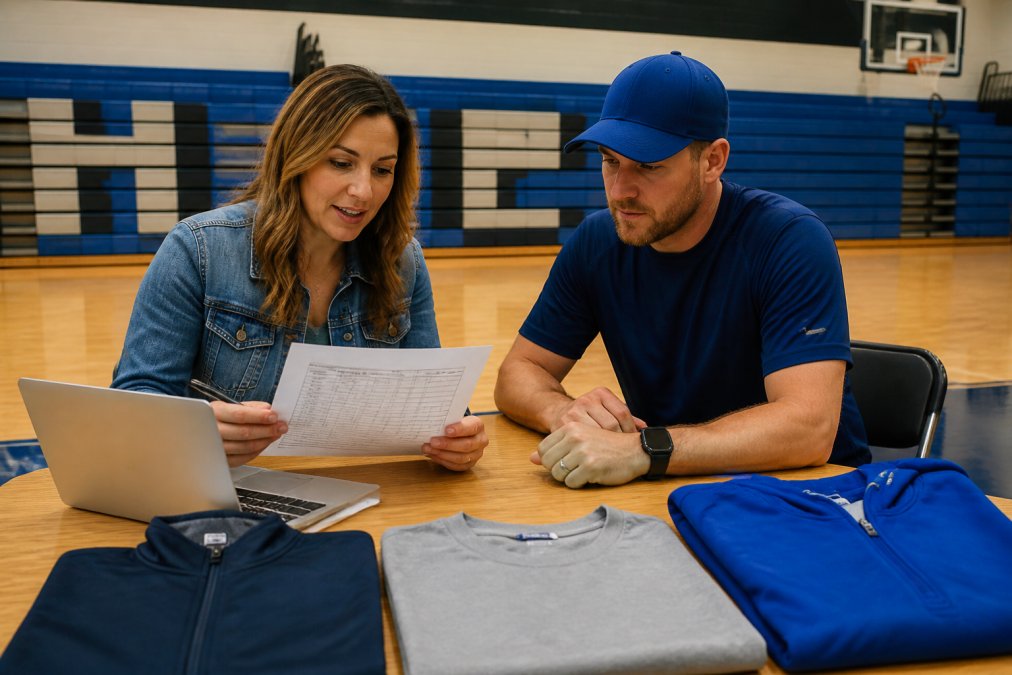
Your spirit wear order form template needs these fields at minimum:
- Student name and homeroom or team
- Item, color, and size (with a size chart linked)
- Quantity per item
- Parent contact email and phone
- Payment confirmation
If you run a paper form, print the size chart on the back and set a hard return deadline. Online storefronts handle sales tracking, secure checkout, and order fulfillment data automatically, which saves hours of manual reconciliation.
Step 5: Spirit Wear Fundraiser Ideas to Promote Your Campaign
Promotion is what separates a campaign that hits its goal from one that fizzles. Start with the channels parents already check: school newsletters, team group chats, and social media.
Spirit wear fundraiser ideas that consistently work:
- Launch at a home game or school event where families are already gathered
- Offer a limited-edition design that’s only available during the campaign
- Run a class or grade-level competition for most items sold
- Post daily photos of sample gear on social media
- Ask teachers and coaches to wear the gear on launch day
Give parents a shareable link and a one-line message they can forward. Word of mouth moves faster than any single announcement.
Step 6: How Long to Run a Spirit Wear Fundraiser
Most campaigns run two to three weeks (ptotoday.com). That window is long enough for paydays and reminders, and short enough to keep urgency high.
A workable timeline looks like this:
| Phase | Duration | Key Action |
|---|---|---|
| Launch | Days 1-2 | Announce and open the store |
| Mid-campaign push | Days 7-10 | Reminder and social proof |
| Final call | Last 3 days | Deadline reminders |
| Close and order | Day 1 after close | Submit bulk order |
For a print-on-demand store, you can leave it open longer since there’s no bulk deadline. For pre-sell, close on time, every time. Extending the window trains families to wait.
Step 7: Manage Orders, Fulfillment, and Compliance
The campaign is not done when sales close. Sorting, bagging, distributing, and closing the books correctly is where a fundraiser either ends cleanly or turns into a months-long headache for volunteers. Most guides stop at “place the order”, this section covers what actually happens after. Streamlining these final logistics ensures that your organization maintains the momentum needed to successfully integrate custom fundraising pins into future outreach efforts.
Sort and bag before distribution day
When the bulk shipment arrives, do not hand families a pile of shirts and hope for the best. A repeatable process saves hours:
- Print your order report and sort by homeroom, team, or grade level, whichever grouping matches how families will pick up.
- Bag each family’s items together and label the bag with the student’s name and the order number.
- Set aside a small “problem pile” for misprints, wrong sizes, and short shipments so they do not get mixed into the good orders.
- Recruit two or three volunteers for a single sorting session rather than spreading it across the week.
Plan one pickup window with a backup
Set one primary pickup window, often right after school or before a home game, and one backup window for families who miss it. Publish both dates in advance. Unclaimed bags should be logged with the family’s name and contact info so you can follow up rather than storing them indefinitely.
If you used print-on-demand, most or all of this is handled by the printer, who ships directly to each family. That removes the sorting day entirely, which is the main operational reason groups choose POD even at a higher per-unit cost.
Legal and tax basics for school groups
PTAs and booster clubs are usually separate nonprofit entities from the school district, and that distinction matters for how you handle money. A few practical steps:
- Confirm your group’s tax-exempt status and its employer identification number (EIN) before you collect a dollar.
- Open a dedicated bank account for the fundraiser so revenue and expenses are never commingled with general funds.
- Check whether your state requires a sales tax permit for apparel sales, and whether your group’s nonprofit status exempts you from collecting sales tax on the items you sell.
- Keep a written record of every sale, every expense, and every donation, including receipts.
- Confirm whether your group needs to file an annual information return, such as IRS Form 990-N, 990-EZ, or 990, based on gross receipts (irs.gov).
- Get written permission before using any licensed school, team, or mascot logo.
Because rules vary by state and by the structure of your group, confirm your specific obligations with your school district and a qualified tax professional. Do not rely on another group’s process just because it worked for them.
Selling merchandise with a trademarked mascot or logo without permission can trigger a cease-and-desist and force you to pull inventory (uspto.gov). Confirm licensing rights with your school before printing anything.
Close the books while the campaign is fresh
Within a week of the final pickup, reconcile your sales report against your bank deposits, pay the printer’s invoice, and write down the net total raised. That number is what you report to your group and what you use to set next season’s goal. Groups that skip this step often cannot tell whether the fundraiser actually made money.
If managing bulk inventory, sorting, and distribution sounds like more than your volunteers can take on, print-on-demand shifts fulfillment to the printer and removes leftover stock risk entirely, at the cost of a lower margin per item.
Frequently Asked Questions
How long should a spirit wear fundraiser last?
Most campaigns run for two to three weeks. A shorter window creates urgency and reduces the chance that families forget to order, while still giving you enough time to promote through email, social media, and school announcements. If your group is new to online stores, add a few extra days for setup and testing before launch.
How do you price spirit wear for maximum profit?
Start by calculating your landed cost per item, including the garment, decoration, and any shipping. Then set your retail price at roughly two to two and a half times that cost. Factor in minimum order quantities and bulk order discounts, and leave room for a small contingency. Pricing depends on quantity, decoration method, and delivery timing, so request a current quote for exact figures.
What are some creative spirit wear fundraiser ideas?
Try a pre-sell campaign with a limited-edition design, a mascot gear bundle that includes a tee and hoodie, or a student design contest where the winning artwork appears on the shirt. You can also offer family packs, add-on items like hats and bags, and a social media promotion that unlocks a bonus item once you hit a sales milestone.
Should we use inventory management or print-on-demand for our fundraiser?
Print-on-demand eliminates upfront inventory costs and works well for smaller groups or uncertain demand, but the per-item cost is usually higher. Buying inventory in bulk lowers the unit price and lets you sell at events, but you risk leftover stock. Many school groups use a hybrid approach: pre-sell to gauge demand, then place a bulk order for the most popular items.