Quick Summary
Embroidered work shirts build brand identity by putting a consistent, professional logo on staff who already meet customers, so every interaction reinforces who the business is. Stitched logos read clearly at conversation distance and are durable because the thread sits within the fabric rather than on its surface.
- Simplify logos to a few bold shapes, since fine lines and small text often turn to noise when stitched.
- Embroidery stitches thread through the fabric, so the logo sits within the garment rather than on top of it.
- The left chest is the conventional placement, visible during conversation without dominating the shirt.
- Test placements on a sample garment and wear it before approving the design.
- Track customer recall, employee adoption on each shift, and the number of who-do-I-ask moments to measure results.
Table of Contents
- How Embroidered Work Shirts Strengthen Brand Visibility
- Custom Business Apparel for Staff: Where Embroidery Fits
- Durability of Embroidery vs Screen Printing
- Design and Logo Placement for Work Shirts
- Maintaining Brand Consistency With Custom Uniforms
- Measuring Brand Identity Outcomes and Total Cost
- Ordering Your Embroidered Work Shirts With Piercy Sports
- Frequently Asked Questions
How Embroidered Work Shirts Strengthen Brand Visibility
Last Updated: November 5, 2026
Embroidered work shirts are one of the most effective ways for a business to build a consistent, professional brand identity. When your staff wear the same logo on every shift, every customer interaction becomes a small piece of marketing. Embroidered benefits for brand identity tend to show most clearly when a business moves from mismatched, improvised clothing to a unified uniform program.
Brand identity is the set of visual and behavioral signals that tell customers who you are. Embroidered work shirts carry those signals into the physical world, on people who already stand where your customers are.
Logo Clarity and Professional Appearance
Embroidery produces a raised, textured logo that can read clearly at conversation distance. A stitched mark can look deliberate in a way that a sticker or a faded print often does not.
A common mistake is choosing a logo that works on a business card but turns to noise when stitched. Fine lines, small text and heavy gradients rarely survive embroidery. Simplify the mark to a few bold shapes and check it at actual size before ordering.
Employee Identification and Customer Trust
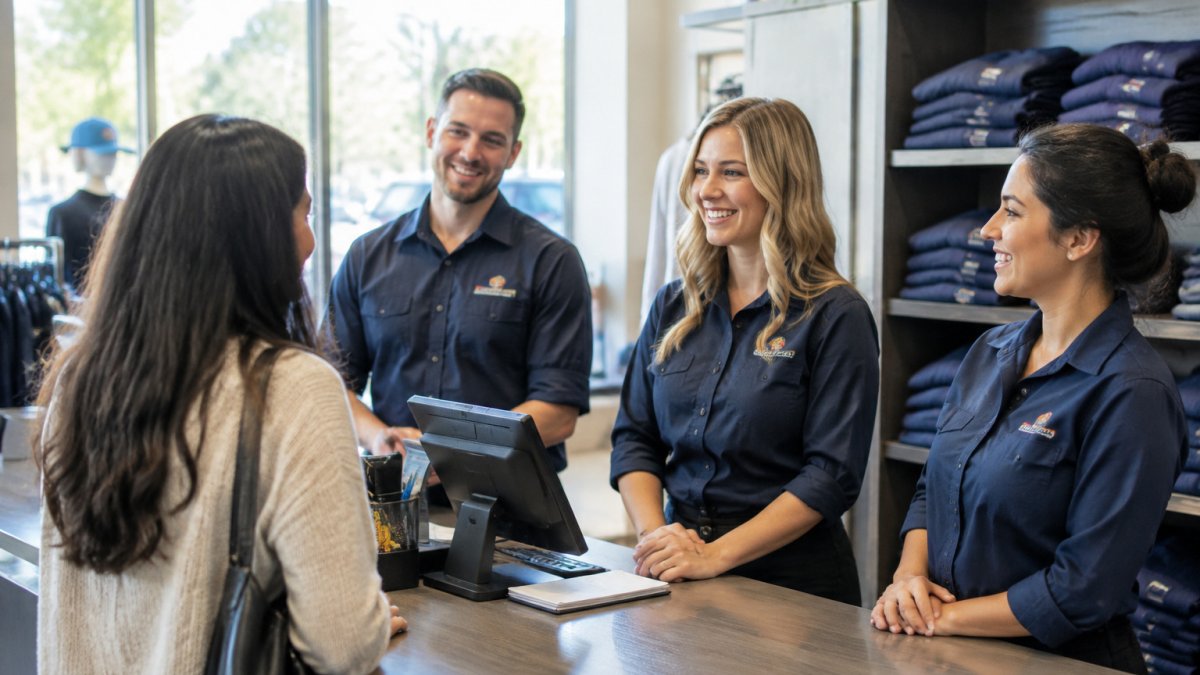
When staff are easy to identify, customers know whom to ask for help. That simple clarity reduces the friction of finding an employee in a busy store, a clinic lobby or a job site, and it signals that the business is organized.
Consistency also builds trust. Customers tend to read matching, well-kept uniforms as a sign of a business that pays attention to details, which carries over to how they judge the service itself.
Custom Business Apparel for Staff: Where Embroidery Fits
Custom business apparel for staff covers far more than shirts. Polos, jackets, aprons and caps all carry the brand, and each piece has a different job. Shirts handle everyday contact with customers, while outerwear extends visibility into outdoor and transit settings.
Embroidery suits the garments that are worn most often and need to look sharp for years. Pieces that will be heavily laundered or worn in demanding conditions are the best fit for stitched logos. Choose the garment first, then decide the decoration method for that garment.
Durability of Embroidery vs Screen Printing
Embroidery and screen printing fail in different ways, and understanding those failure modes is what separates a uniform program that lasts from one that looks shabby within a year. Embroidery stitches thread through the fabric, so the logo sits within the garment rather than on its surface. To compare the two methods head to head, see Screen Printing vs Embroidery: Which Method Works Best.
Screen printing, by contrast, lays ink on the surface of the garment.
The article’s durability points come down to how each method sits on the garment.
| Method | How it sits on the garment | Key difference |
|---|---|---|
| Embroidery | Thread stitched through the fabric | Logo sits within the garment |
| Screen printing | Ink laid on the surface | Logo sits on top of the garment |
Design and Logo Placement for Work Shirts
Placement decides how readable a logo is. The left chest is the conventional spot for a business mark, as it is visible during conversation without dominating the garment. Sleeves and back placements work well for secondary text or a larger graphic when the staff member is often seen from behind or at a distance.
Keep the logo size proportional to the shirt. A mark that is too large looks like an advertisement, while one that is too small disappears. Test placements on a sample garment and wear it before approving the design.
Maintaining Brand Consistency With Custom Uniforms
Brand consistency depends on keeping the uniform program aligned as the team changes. New hires should receive the same garments, colors and logo placement as existing staff, and worn or outdated pieces should be replaced on a schedule rather than mixed in indefinitely.
Set a short internal standard that covers color, fit, logo position and how the uniform should be worn. A written standard keeps managers and new staff working from the same reference, and it makes replacement orders simple to specify. This is a practical area where the custom business apparel for staff program pays off over time.
Measuring Brand Identity Outcomes and Total Cost
A useful approach is to track a few practical indicators and to build a realistic total-cost model before you order. For a closer look at digitization, file requirements and pricing factors, read professional logo embroidery services explained.
On the measurement side, start with customer recall. A simple pattern is to ask new customers at checkout or intake how they found you and whether they noticed staff uniforms, a one-question addition to an existing form costs nothing and produces a running tally. Track employee adoption by counting how many staff wear the full uniform on a given shift versus partial or improvised clothing; a rising adoption rate is a leading indicator that the program is working. Monitor customer feedback for mentions of staff appearance, helpfulness, or ease of finding an employee, and review whether the number of “who do I ask?” moments has dropped. For promotional exposure, note where uniforms are worn outside the workplace, trade shows, deliveries, community events, and estimate impressions from attendance or foot traffic rather than claiming a precise ROI.
On the cost side, total cost includes more than the shirt. Build the model from these components: garment cost per piece, decoration setup or digitizing fee (a one-time charge per logo, often waived or reduced on larger orders), per-piece embroidery cost, replacement rate (how many shirts per employee per year), laundering wear, and administrative time spent managing sizes and reorders. Ask for a quote based on your actual quantities, delivery dates, and decoration method, and request the setup fee and replacement pricing separately so you can see the lifecycle cost rather than the sticker price. You can also compare bulk jersey pricing and no-minimum options for team uniforms to see how order size changes the total.
Ordering Your Embroidered Work Shirts With Piercy Sports
To see the available options and request a quote, visit the Piercy Sports and Apparel website and start your order.
Frequently Asked Questions
How do you make embroidery more durable?
Embroidery holds up best when the garment is matched to the wear it will get. Wash shirts in cold or warm water on a gentle cycle, turn them inside out, and avoid bleach and high-heat drying. Those habits protect both the thread and the logo edges, which are the first places wear appears.
Should embroidered shirts be washed inside out?
Yes. Washing embroidered work shirts inside out reduces friction against the stitches and keeps the raised thread from rubbing against other garments or the drum. It also helps preserve thread color by limiting direct contact with detergent residue and lint. Fasten zippers and hook-and-loop closures before washing, and use a mild detergent. The habit costs nothing and noticeably extends how long the logo stays crisp.
Are embroidered work shirts more durable than other branding methods?
Embroidery still needs care, since frequent high-heat drying or abrasion can wear it over time.
How do custom work shirts help customers identify staff?
Consistent embroidered shirts with a visible company logo and, where appropriate, a name or title make staff easy to spot on a sales floor, in a warehouse, or at an event. Customers can find help faster, and staff are recognized as representatives of the business. Placing the logo on the chest and a name tag on the opposite side keeps identification clear without cluttering the design.