Table of Contents
- What Affects Bulk Embroidery Turnaround Time
- Bulk Embroidery Turnaround Time: Breaking Down Each Production Stage
- How Order Quantity Impacts Your Timeline
- Rush Embroidery Orders: When You Need Faster Turnaround
- How to Plan Your Bulk Order Timeline and Prevent Delays
- Conclusion
- Frequently Asked Questions
Last Updated: October 16, 2026
What Affects Bulk Embroidery Turnaround Time
Bulk embroidery turnaround time depends on order size, design complexity, garment availability, and current production capacity.
The most common surprise is how much order quantity and design choices affect the schedule. A 50-piece order moves through production differently than a 500-piece order, and a simple logo takes less time than a multi-color design with high stitch counts.
Order Quantity and Production Scheduling
Order quantity is the single biggest driver of turnaround time. Smaller orders process faster per piece but still hit production queues; larger orders take longer but benefit from continuous machine time and less setup waste.
Your order size determines how the embroidery shop schedules you:
- Small orders (under 50 pieces): Fit into available machine slots between larger jobs
- Medium orders (50-200 pieces): Get dedicated production time but may wait for garment sourcing
- Large orders (200+ pieces): Scheduled in advance, often with priority placement
Production backlog matters too. During busy seasons (August through September for back-to-school, November through December for holiday merchandise), lead times stretch; off-season orders move faster.
Design Complexity and Stitch Count
A simple one-color chest logo takes 10-15 minutes per garment; a complex multi-color design with fine detail takes 30-45 minutes or more.
Thread changes also slow production: each color change requires the machine to pause, the operator to swap thread, and the machine to re-tension.
Garment Availability and Sourcing
You can’t embroider garments you don’t have yet. If your blank apparel isn’t in stock at the shop, production waits, often the hidden delay that surprises customers.
Some shops stock common items (basic t-shirts, polos, baseball caps) and ship immediately.
Confirm garment availability before finalizing your order.
Bulk Embroidery Turnaround Time: Breaking Down Each Production Stage
Understanding each production stage gives you a realistic timeline. Most delays happen in the early stages, artwork approval and digitizing, not during the actual stitching.
Artwork Approval and Design Preparation
This stage is where many projects stall. You submit your logo, the shop reviews it, and you approve placement and sizing.
Here’s what happens:
- You submit artwork (logo file, design details, placement preferences)
- The shop reviews file quality and compatibility
- They send a proof showing placement, size, and how it will look on the garment
A straightforward approval takes 2-3 business days.
Tip: Prepare your artwork in advance, a clear, high-resolution logo file, exact placement, and size. This cuts approval time in half.
Embroidery Digitizing Turnaround Time
Embroidery digitizing converts your artwork into a digital file the embroidery machine reads, following stitch-by-stitch instructions.
Digitizing complexity depends on your design:
- Simple logos: 1-2 business days
- Moderate designs (3-5 colors): 2-3 business days
- Complex designs (6+ colors, fine detail): 3-5 business days
Some shops digitize in-house and turn it around quickly; others outsource, adding 2-3 days. Ask upfront: “Do you digitize in-house, or do you use an outside service?”
Machine Setup and Production Run
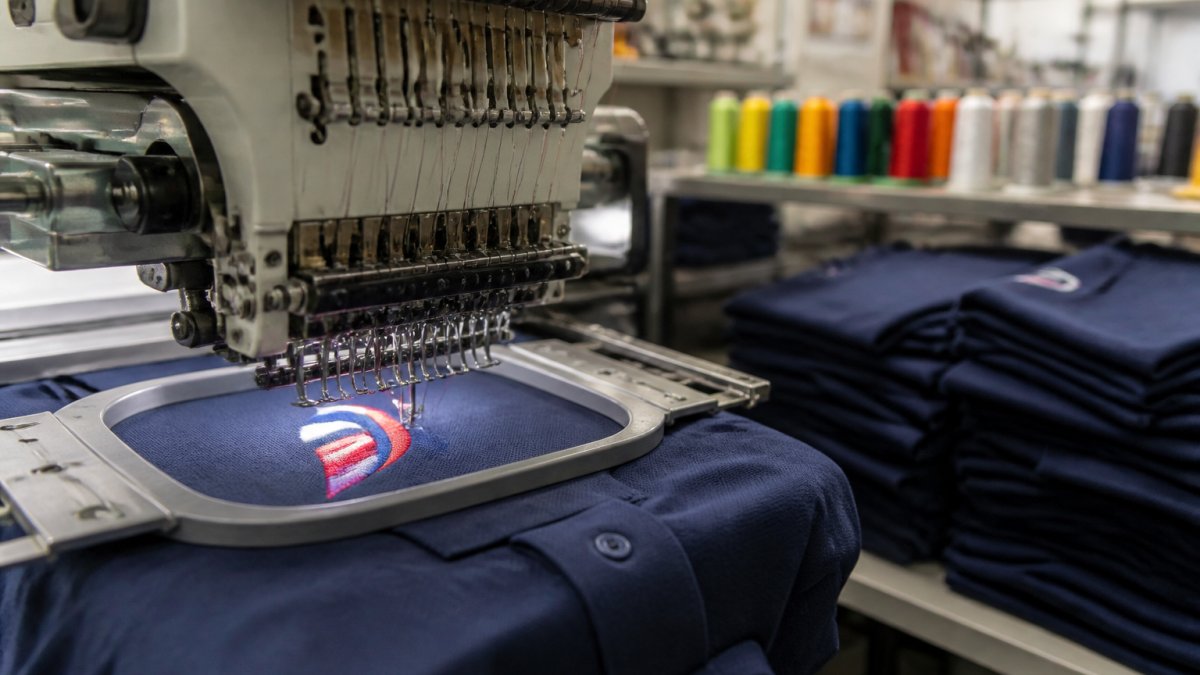
Once digitizing is complete and garments are in hand, production begins. Setup takes 30-60 minutes per design: loading the garment, threading the machine, running test stitches, and making adjustments.
The actual stitching time depends on stitch count and order size:
- 50 pieces at 8 minutes each = 400 minutes (6.5 hours)
- 200 pieces at 8 minutes each = 1,600 minutes (26.5 hours)
- 500 pieces at 8 minutes each = 4,000 minutes (67 hours)
Most shops run machines 8-10 hours per day. A 500-piece order with multiple locations or colors might take 7-10 business days, depending on how many machines run simultaneously.
Quality Control and Final Inspection
Every finished garment gets inspected for stitch quality, thread tension, color accuracy, placement alignment, and loose threads or defects. Quality control adds 1-2 business days; rework can add another 2-3 days.
How Order Quantity Impacts Your Timeline
Order size changes your timeline, but not the way most buyers expect: the number of pieces matters less than the total machine hours your order consumes. Two same-size orders can take very different times if one has a 4,000-stitch chest logo and the other a 20,000-stitch back design with six thread colors.
The Throughput Math Behind Every Bulk Timeline
A commercial multi-head machine runs at roughly 600-800 stitches per minute per head, with 6 to 18 heads stitching the same design simultaneously.
The practical formula most shops use looks like this:
- Stitch time per piece = stitch count ÷ machine speed. A 6,000-stitch design at 700 stitches per minute is about 8.5 minutes of pure stitching.
- Cycle time per piece = stitch time + hooping and unhooping + thread trims + any thread changes. Hooping and handling commonly add 1-3 minutes per piece; each thread change adds 30-90 seconds depending on the machine.
- Total machine hours = cycle time × quantity ÷ number of heads running your job.
Run the numbers on a 200-piece order with a 6,000-stitch, three-color chest logo.
Stitch count compounds fast. A 25,000-stitch jacket-back design at 700 stitches per minute is about 36 minutes of pure stitching per piece, near 40 with handling and thread changes.
Small Orders (Under 50 Pieces)
Small orders clear approval and digitizing quickly, usually 3-5 business days, but often wait for a production slot because a 25-piece job doesn’t fill a machine day. Expect 3-5 business days of queue time, then 1-3 business days of stitching, a realistic total of 7-10 business days.
Medium Orders (50-200 Pieces)
Medium orders justify dedicated machine time and can schedule within a week or two. Approval and digitizing run 3-5 business days; production runs 4-7 business days depending on stitch count, head count, and backlog. A 150-piece order with a two-color 6,000-stitch logo might look like this:
- Artwork approval: 2 business days
- Digitizing: 2 business days
- Production: 4 business days (about 26 machine hours on a 12-head machine, or 78 on a 4-head machine)
Large Orders (200+ Pieces)
Large orders get scheduled in advance and often run continuously, improving per-piece efficiency but stretching the calendar. A 500-piece order with a single chest logo on a 12-head machine may need 10-15 business days of production; a complex back design or multiple locations can push to 15-20. Garment sourcing is the wildcard: if blanks aren’t in stock, add 5-15 business days. A realistic 500-piece plan looks like this:
- Artwork approval: 2 business days
- Digitizing: 3 business days
- Garment sourcing (if needed): 5-10 business days
Ask your shop two questions before you compare quotes: how many heads will run my job, and what is the stitch count and color count per piece? Those two answers explain most of the difference between a 10-day and a 25-day estimate.
Why Two Shops Quote Different Timelines for the Same Order
Head count, staffing, and queue position explain most of the gap. A shop with 12-head machines and two shifts can absorb a 500-piece order in a week; a shop with 4-head machines and one shift may need three weeks. Seasonal backlog matters too: during back-to-school (July-August) and holiday (October-December) peaks, lead times can stretch 50-100%, while off-peak orders (January-March, May-June) move faster.
Rush Embroidery Orders: When You Need Faster Turnaround
Rush service is a set of trade-offs applied to specific stages. Most shops can compress approval, digitizing, and queue position; almost none can compress pure stitch time, because machine speed and head count are fixed. If your order is dominated by stitching hours, rush buys you less than you expect.
What Rush Can Actually Compress
- Queue position: Moving your job to the front of the production schedule is the biggest and most common rush lever. It can save 3-10 business days depending on backlog.
- Approval and digitizing: Rush digitizing can deliver in 24-48 hours instead of 2-5 business days. Approval can compress to same-day if you respond quickly and your artwork is clean.
- Operating hours: Running machines during off-hours or weekends, or adding a second shift, can add 8-16 productive hours per day.
What Rush Cannot Compress
Stitch time is fixed by stitch count, machine speed, and head count. A 500-piece order with a 20,000-stitch back design consumes a set number of machine hours no matter how much you pay; if that exceeds the hours available before your deadline, the order cannot be rushed to that date.
How to Decide Whether Rush Is Worth It
Work backward from your deadline and compare compressible hours to fixed hours. If your order is mostly queue and approval time, rush is effective and often worth the premium; if it’s mostly stitch time, rush may only shave a few days. A standard 10-business-day order can often compress to 5-7 business days with rush service at 25-50% higher cost, but a 20-business-day order dominated by stitching may only compress to 15-17.
Not all designs can be rushed. Complex multi-location designs, very large orders, and orders dependent on backordered garments may not compress much because machine time or sourcing is the bottleneck, not approval or digitizing. Ask your shop which specific stages they can accelerate before you commit to a rush timeline and price.
A Practical Rush Checklist
- Confirm the garment is in stock or can be substituted before paying for rush.
- Submit vector artwork and final placement specs on day one so approval does not eat your compressed window.
- Ask for a written rush timeline that names the production start date, not just the delivery date.
Rush is a scheduling tool, not a magic wand: on the right order it rescues a deadline; on the wrong order it adds cost without adding speed.
How to Plan Your Bulk Order Timeline and Prevent Delays
The best way to get fast turnaround is to plan ahead. Most delays are preventable with clear communication and advance preparation.
Start With a Clear Delivery Date
Work backward from your deadline. If you need uniforms by August 15, subtract 3-4 weeks for production, digitizing, and approval, placing your order around mid-July.
Build in a buffer. Add 3-5 business days as contingency for a digitizing revision, a garment sourcing hiccup, or production queue shifts.
Prepare Your Artwork in Advance
This is the single biggest time-saver. Have your logo file ready before you contact the shop. Ideally, provide:
- High-resolution logo file (vector format like .AI or .EPS is best)
- Exact placement specifications (chest, sleeve, back, etc.)
- Desired size or dimensions
Shops can’t start digitizing without this information, every day you delay submitting artwork is a day your timeline slips.
Account for Seasonal Demand and Production Backlog
Back-to-school (July-August) and holiday seasons (October-December) are peak times for custom apparel, when production backlogs can extend lead times by 50-100%.
If you’re ordering during peak season, plan for longer timelines; off-peak months (January-March, May-June) bring faster turnaround and potentially better pricing.
Ask your shop: “What’s your current production backlog?
Request a Written Estimate and Firm Delivery Date
Don’t rely on verbal estimates. Ask for a written timeline that includes:
- Artwork approval window
- Digitizing timeline
- Production start date and completion date
A written estimate protects both you and the shop, setting clear expectations and giving you recourse if timelines slip.
Last Updated: October 16, 2026
Conclusion
Bulk embroidery turnaround time isn’t one number, it’s a combination of approval cycles, digitizing, production scheduling, and quality control.
The key to faster turnaround is planning ahead: prepare your artwork in advance, confirm garment availability, and choose a realistic deadline that accounts for seasonal demand.
Request a written timeline estimate before you commit to an order. This prevents surprises and gives you a clear accountability point if delays occur.
Frequently Asked Questions
How long does a bulk embroidery order usually take?
Bulk embroidery turnaround time typically ranges from 7 to 14 business days from artwork approval to shipping, depending on order size and design complexity. Smaller orders (under 50 pieces) may finish in 5-7 business days, while larger orders (200+ pieces) may require 10-14 business days due to production scheduling and machine capacity. Rush options can compress this timeline, though expedited shipping and rush production incur additional costs. Always request a written estimate from your provider to confirm your specific delivery date.
What factors affect the turnaround time for custom embroidery?
Several factors influence embroidery production time: order quantity affects production scheduling and machine setup; design complexity and stitch count determine stitching duration; garment availability impacts when production can begin; artwork approval and design preparation add lead time before digitizing starts; and production capacity and seasonal demand create scheduling delays. Thread changes, embroidery location (sleeve, chest, back), and quality control inspections also extend timelines. Communicating these details upfront helps your vendor provide an accurate estimate.
How long does embroidery digitizing turnaround time typically take?
Embroidery digitizing usually takes 1-3 business days once your artwork is approved and submitted. Simple logos may digitize in 24 hours, while complex multi-color designs with intricate details can take 2-3 business days. This is why submitting high-quality, high-resolution artwork upfront matters, poor-quality files require rework, adding days to your timeline. Digitizing is a critical step that cannot be rushed without compromising stitch quality, so plan accordingly in your overall production schedule.
Can I get a rush turnaround on a bulk embroidery order?
Yes, rush embroidery orders are possible, but availability depends on your vendor’s current production capacity and backlog. Rush production can compress timelines from 10-14 business days down to 3-5 business days, though rush fees typically apply. Expedited shipping options can further speed delivery. However, rushing is most feasible for smaller orders and simpler designs; large orders with complex artwork may have limited rush availability. Contact your vendor immediately with your deadline to confirm whether rush production is possible and what the additional cost will be.