Table of Contents
- Why Local Custom Apparel Vendors Matter for Your Brand
- Custom Team Uniform Turnaround Times: Speed Without Compromise
- Hidden delays in remote ordering:
- Quality Control and Production Standards That Last
- How to Choose a Custom Apparel Vendor That Fits Your Needs
- Benefits of Screen Printing vs Digital Printing for Durability
- Supply Chain Transparency and Direct Communication
- Cost-Effectiveness and Supporting the Local Economy
- Frequently Asked Questions
Last Updated: October 1, 2026
Why Local Custom Apparel Vendors Matter for Your Brand
When you partner with a local custom apparel vendor, you’re not just ordering uniforms or promotional gear, you’re investing in your brand’s identity and your team’s morale. At Piercy Sports and Apparel, we understand that every stitch, every color match, and every delivery deadline directly impacts how your organization is perceived.
Local vendors offer something national chains can’t: direct access to decision-makers, real-time problem-solving, and accountability that matters. You’re not a ticket number in a massive queue. You’re a valued client whose success drives the vendor’s reputation in your community.
The difference becomes clear when you need something urgent. When your roster changes mid-season or a design needs tweaking, a local partner responds in days, not weeks. This responsiveness protects your budget and keeps your team’s momentum intact.
Beyond speed, local custom apparel vendors provide transparency. You can see the production process, inspect quality firsthand, and build relationships with the people handling your order. That proximity creates better communication and fewer surprises on delivery day.
Ask potential vendors for references from similar organizations, teams, businesses, or groups like yours. A vendor’s track record with comparable clients is the strongest indicator of whether they’ll deliver for you.
Custom Team Uniform Turnaround Times: Speed Without Compromise
This speed matters because seasons start on fixed dates, and late uniforms create scrambling, frustration, and sometimes uniforms that aren’t game-ready.
But the real timeline gap is wider than production speed alone. When you order from a remote vendor, you’re also adding:
Hidden delays in remote ordering:
Local vendors eliminate most of these friction points. Design consultation happens in real time. You see physical samples or finished pieces before they ship. If there’s a problem, you can address it directly with the vendor.
The real advantage isn’t just speed; it’s predictability and the ability to course-correct without losing weeks. Need to swap out five names mid-roster? A local vendor can often accommodate that without forcing you to reorder entire batches or pay remake fees. This adaptability saves money and keeps your team looking polished throughout the season.
What affects turnaround times:
- Complexity of design (simple logos print faster than intricate multi-color artwork)
- Order quantity (larger orders sometimes take longer, but economies of scale apply)
- Decoration method (screen printing and embroidery have different timelines)
- Rush fees
- Proof revision rounds
The key question isn’t just “how fast,” but “how fast without sacrificing quality and without hidden delays.” A 5-day turnaround that produces cracking logos or loose stitches costs more in the long run than a 12-day turnaround that delivers durability. Similarly, a 20-day quote from a national vendor that becomes 35 days after proof revisions and shipping delays defeats the purpose of ordering early.
Local vendors also offer flexibility on rush fees. If you genuinely need expedited service, they can often accommodate it because they control the entire production pipeline and can shift priorities without coordinating across multiple facilities.
Quality Control and Production Standards That Last
Quality control separates vendors who understand durability from those chasing quick profits. The best local custom apparel vendors implement multi-stage inspection processes: checking incoming fabric, monitoring production, inspecting finished products, and spot-checking after delivery.
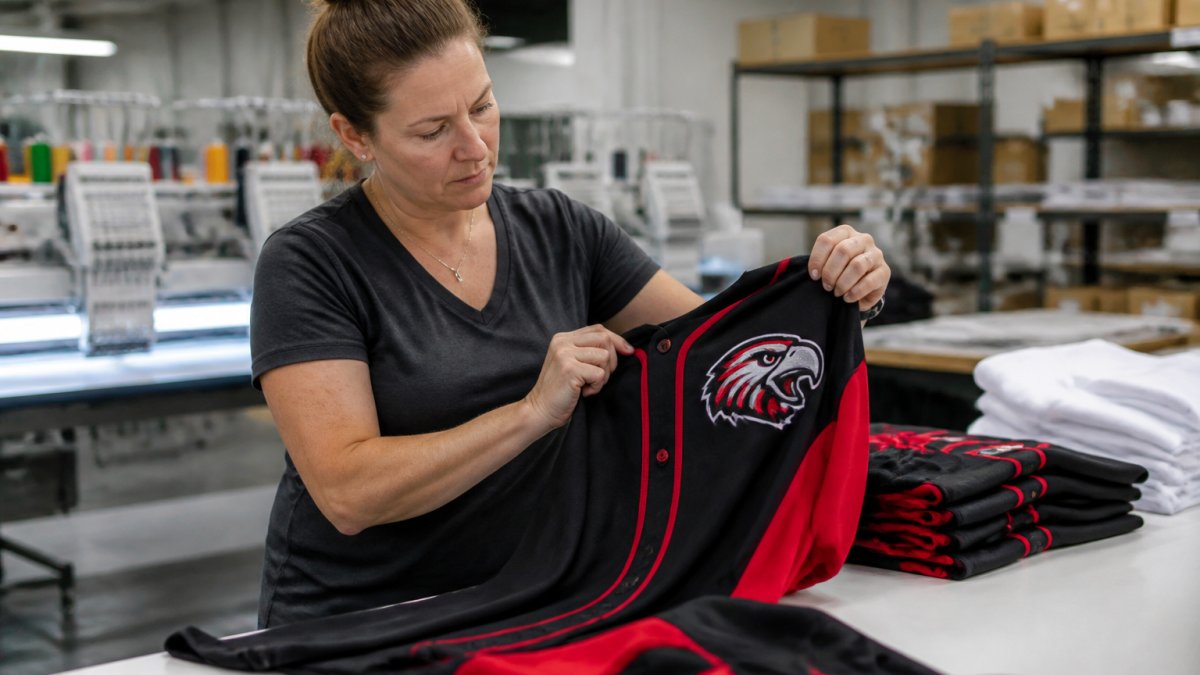
When you work with a vendor committed to production standards, logos don’t crack after three washes. Embroidery doesn’t unravel. Screen-printed designs maintain their vibrant color through seasons of wear and laundering. This durability directly impacts brand recognition, your team looks professional week after week.
Local vendors typically source premium fabric and materials because their reputation depends on it. They’re not racing to the bottom on cost; they’re building relationships that last years. This means they invest in quality blanks, quality inks, and quality embroidery thread.
Common quality issues to watch for:
- Loose stitching in embroidery (pulls apart after a few washes)
- Ink cracking on screen-printed designs (happens with low-quality plastisol inks)
- Color fading (especially reds and dark colors with inferior dyes)
- Pilling on fabric (sign of cheap polyester blends)
The best vendors provide guarantees on their work. If a logo peels or stitching fails within a reasonable timeframe, they’ll remake the order. This confidence comes from knowing their standards are solid.
Avoid vendors who won’t show you samples of finished work or who rush you through the design approval process. Skipping proper quality checks upfront creates expensive problems later.
How to Choose a Custom Apparel Vendor That Fits Your Needs
Choosing the right vendor requires evaluating several factors beyond just price. Start by clarifying your actual needs: Are you ordering once per season or multiple times? Do you need design help or do you have finished artwork? What’s your budget, and how flexible is your timeline?
Request samples from vendors before committing to a large order. Ask to see work they’ve done for similar organizations. A vendor confident in their quality will happily provide references and examples. This step alone prevents costly mistakes.
Key evaluation criteria:
- Design consultation services (do they help if your logo file needs work?)
- Minimum order quantities (can they handle small orders, or do you have to over-order?)
- Decoration options available (screen printing, embroidery, digital printing, heat transfer)
- Turnaround time options and rush fees
- Return and remake policies
- Communication responsiveness (how quickly do they answer questions?)
Ask about their production process. Where do they source materials? Do they use in-house equipment or subcontract? Local vendors who control their own production typically deliver better consistency than those outsourcing to third parties.
Pricing matters, but it’s not the only factor. A vendor charging slightly more but delivering durability and responsive service costs less overall than a cheaper option that requires reordering after one season.
Benefits of Screen Printing vs Digital Printing for Durability
Screen printing and digital printing serve different purposes, and durability differs significantly between them.
Screen printing advantages:
- Superior durability
- Cost-effective for large orders
- Vibrant colors that don’t fade easily
- Works on any fabric type
Digital printing advantages:
- Ideal for complex, multi-color designs
- No minimum order quantities
- Faster for small orders
- Photorealistic detail possible
For team uniforms that see heavy use, screen printing is the stronger choice. For promotional items with intricate designs that you’re ordering in small quantities, digital printing makes sense.
The best local vendors offer both options and recommend the right method based on your actual use case. They’re not trying to upsell you to the most expensive option; they’re solving for longevity.
Screen printing creates longer-lasting designs on uniforms and gear that endure repeated washing and athletic wear. Digital printing excels for detailed, multi-color designs in smaller quantities where durability is less critical.
Supply Chain Transparency and Direct Communication
One of the clearest advantages of working with local custom apparel vendors is visibility into your supply chain. You know where your materials come from, you can communicate directly with the people producing your order, and you can address problems immediately.
With national vendors, your order enters a black box. You submit artwork, pay, and hope for the best. If something goes wrong, you’re dealing with customer service representatives who have limited power to fix issues. With a local vendor, you can walk in, speak with the decision-maker, and resolve problems on the spot.
This transparency also matters for compliance and quality assurance. You can verify that materials meet your standards, that production follows your specifications, and that the final product matches your expectations before it ships.
Direct communication reduces misunderstandings. Instead of email chains with generic responses, you’re working with someone who understands your brand, remembers your previous orders, and anticipates your needs. This relationship-based approach prevents costly errors.
According to the National Association of Manufacturers, supply chain transparency and direct vendor relationships reduce order errors by an average of 30% compared to impersonal, large-scale operations.
Cost-Effectiveness and Supporting the Local Economy
Local custom apparel vendors often offer competitive pricing, especially when you factor in the hidden costs of working with distant providers. A simple price-per-unit comparison is misleading because it ignores the true cost of ownership.
The hidden costs of remote vendors:
When you order from a national vendor, the sticker price is often lower, but additional charges accumulate quickly.
A local vendor’s pricing is transparent and all-inclusive. You see exactly what you’re paying for: materials, labor, decoration, and delivery. There are no surprise fees or hidden charges buried in fine print. This clarity helps you budget accurately and compare options fairly.
Supply chain transparency: A cost and quality advantage
One of the clearest cost advantages of working with local custom apparel vendors is visibility into your supply chain.
Economic alignment and flexible terms
Total cost of ownership: A real example
Frequently Asked Questions
What are the primary advantages of using a local custom apparel vendor?
Local custom apparel vendors provide faster turnaround times, direct communication with your designer and production team, superior quality control, and stronger supply chain transparency. You benefit from personalized service, the ability to handle last-minute changes without excessive fees, and the assurance that your team uniforms or branded apparel will meet exact specifications. Local vendors also support the community economy and often provide post-production support and returns handling that larger national providers cannot match.
Do local custom apparel vendors offer faster turnaround times than online retailers?
Yes. Because production happens nearby, you avoid extended shipping delays and can coordinate directly with the production team if you need expedited orders or mid-season roster changes. This speed advantage is especially valuable for youth sports leagues and corporate teams with tight deadlines before season starts or events.
How do I know screen printing and embroidery will actually hold up after washing?
Quality local vendors use industry-standard techniques and premium materials that resist cracking and peeling. Ask for examples of work they’ve completed for teams similar to yours, and inquire about their specific fabric quality, ink formulations, and stitching standards. Reputable local vendors stand behind their work with guarantees and can explain exactly how their decoration techniques ensure durability, something you can verify by seeing finished uniforms in person or reviewing customer references.
Can local custom apparel vendors work with small orders and low-quality logo files?
Many local vendors specialize in flexible order minimums and can work with small youth leagues ordering 15-20 uniforms. They often offer design consultation services to improve low-resolution logo files, vectorizing or recreating designs so they print cleanly without pixelation. This hands-on support is a key advantage over national providers with rigid minimums and no design assistance, local vendors invest in getting your project right.