Table of Contents
- What Drives Bulk Custom Embroidery Pricing
- Understanding Embroidery Digitizing Cost
- Custom Embroidery Stitch Count Guide and Impact on Price
- Setup Fees, Bulk Discounts, and Volume Pricing
- Custom Logo Embroidery Turnaround Time and Rush Costs
- Design Choices That Impact Your Total Cost
- Getting an Accurate Quote for Your Bulk Order
- Frequently Asked Questions
Last Updated: September 18, 2026
What Drives Bulk Custom Embroidery Pricing
Understanding bulk custom embroidery pricing requires examining the factors that shape your final cost. The variables are more straightforward than most vendors make them seem.
Core cost drivers include setup and digitizing, stitch count, design complexity, garment type, and order quantity. A 20-unit order with a simple left chest logo costs far more per unit than 200 units with the same design because fixed costs spread across more units.
Beyond per-unit price, understand the digitizing fee, setup charges, thread colors, and design choices that compound cost. Rush orders add premiums many teams discover too late.
Bulk custom embroidery pricing isn’t arbitrary. Understanding the mechanics lets you make design decisions that save money without sacrificing quality.
Ask your vendor to break down pricing into three categories: one-time setup costs, per-unit production costs, and volume discounts. This transparency makes it easy to compare quotes and see where you can optimize.
Understanding Embroidery Digitizing Cost
Digitizing converts your logo into a format an embroidery machine can read. This separate cost often surprises buyers.
A digitizing fee covers translating your artwork into stitch data. Design complexity, fine lines, gradients, text, intricate details, determines digitizer time. A simple two-color logo takes less time than a photorealistic design with shading.
Digitizing is a one-time charge, reusable for unlimited future orders. This is why bulk orders make financial sense: you spread the initial digitizing investment across many units.
Some vendors include digitizing in setup fees; others charge separately. Ask for clarification. Low-quality files (pixelated, low resolution, wrong format) may require additional cleanup work and cost extra.
Submitting a low-resolution or poorly formatted design file can trigger additional digitizing charges. Vector artwork (AI, EPS, or PDF) is ideal. Avoid JPEGs and PNGs unless they’re high resolution and simple in design.
Custom Embroidery Stitch Count Guide and Impact on Price
Stitch count, the total number of individual stitches, directly drives production cost: more stitches mean more thread, machine time, and labor.
A 5,000-stitch logo costs less than a 15,000-stitch version. On a 500-unit order, this difference translates into significant per-unit cost variation.
A well-digitized logo balances visual quality with production efficiency. Finer details require more stitches, but oversimplifying damages appearance.
Thread density affects stitch count: denser embroidery looks richer but uses more stitches. Backing material (the stabilizing layer) adds cost, especially heavier backing for athletic wear.
Request stitch count when quoting to compare vendors. Different stitch counts reflect different digitizing choices and affect both cost and appearance.
| Design Complexity | Typical Stitch Range | Production Impact |
|---|---|---|
| Simple logo (1-2 colors) | 3,000-6,000 | Low per-unit cost |
| Standard logo (3-4 colors) | 6,000-12,000 | Moderate per-unit cost |
| Detailed design (5+ colors) | 12,000-20,000 | Higher per-unit cost |
| Photorealistic design | 20,000+ | Highest per-unit cost |
Setup Fees, Bulk Discounts, and Volume Pricing
Setup fees cover one-time preparation: digitizing, production files, threading, hooping, and test stitches. These fixed costs don’t change whether you order 10 or 1,000 units.
Bulk discounts exist because a 500-unit order spreads the same setup fee across five times as many units, dropping per-unit cost significantly.
Most vendors use tiered discounts: units 1-50 at one price, 51-100 lower, 101-250 lower still. Larger quantities always mean lower per-unit cost.
Volume pricing reflects production economies of scale: continuous machine runs reduce thread waste and setup time per unit, lowering per-unit pricing.
Ask vendors for their volume discount structure. Some offer aggressive discounts at lower quantities; others require massive orders for meaningful savings.
The sweet spot for bulk custom embroidery pricing is usually 75-150 units. Below that, per-unit costs stay high. Above that, discounts flatten out because you’ve already captured most of the efficiency gains.
Custom Logo Embroidery Turnaround Time and Rush Costs
Standard turnaround is typically 10-15 business days from order approval. Understanding rush premiums and how to avoid them is a major cost-saving opportunity.
Why Rush Orders Cost So Much More
Rush premiums reflect real operational costs: machine downtime, overtime labor (1.5x-2x standard rates), compressed quality control, and increased material waste from setup errors.
Typical rush premiums: Expedited (7-10 days) +15-25%, Rush (5-7 days) +30-50%, Overnight +75-100% or unavailable. Premiums reflect actual disruption costs.
Design Complexity and Rush Feasibility
Rush timelines work better for simple designs and smaller quantities. A 50-unit single-color order may take 3-5 days; a 500-unit five-color order needs 7-10 days even expedited. Ask vendors about hard cutoffs for your specific order before committing to a deadline.
How to Plan Ahead and Avoid Rush Costs
Plan backward from your need date. For August 15 delivery, order by July 25-31 to avoid rush premiums. Account for digitizing (2-3 days), proof review (2-3 days), production (7-10 days), shipping (2-3 days), and buffer (2-3 days). For 200+ units, add an extra week.
Seasonal Rush Premiums
Peak season (summer for sports, November-December for corporate gifts) extends turnaround 3-5 days and increases rush premiums. Ask vendors upfront about current turnaround, rush options, costs, and blackout dates to avoid expensive surprises.
The single biggest cost-saving move for bulk embroidery is planning 2-3 weeks ahead. This eliminates rush premiums entirely and often qualifies you for better volume discounts because you’re not forcing the vendor into a constrained timeline.
Design Choices That Impact Your Total Cost
Design decisions directly shape bulk custom embroidery pricing. Smart choices, logo size, color count, placement, thread type, can reduce per-unit cost by 20-40% without sacrificing quality or brand recognition.
Logo Size and Stitch Count Relationship
Logo size directly controls stitch count. A 2-inch logo typically requires 4,000-7,000 stitches; at 4 inches, 10,000-15,000 stitches, a 50-100% increase. Ask your digitizer for stitch count estimates at your intended size to balance visual impact with production efficiency.
Color Count and Machine Stops
Each color change stops the machine, adding 30-60 seconds per unit. On a 500-unit order, that’s 4-8 hours downtime. Cost impact: 1 color baseline, 2 colors +8-12%, 3 colors +15-22%, 4 colors +25-35%, 5+ colors +40-60%. A 300-unit order with five colors versus three could cost $200-400 more.
How to Simplify Without Losing Brand Impact
Identify which colors are essential to brand identity versus decorative. A logo with blue base, white highlight, and red accent can simplify to blue and white, dropping cost 15-20% while remaining recognizable. Ask your digitizer for multiple versions at different color counts and stitch estimates.
Placement Strategy and Labor Efficiency
Single chest placement is baseline cost. Multiple placements add labor: chest + back +20-30%, chest + sleeves +30-50%, all-over +50-100%. For bulk orders, use single placement when possible. Ask vendors about batching to minimize re-hooping.
Thread Type and Material Costs
Standard polyester thread is baseline. Specialty threads cost more: metallic +15-25%, variegated +10-20%, glow-in-dark +30-50%, 3D puff +40-60%. For budget bulk orders, use standard thread or add a second color for visual interest.
Backing Material Selection
Backing stabilizes embroidery and prevents puckering. Lightweight tear-away is baseline (woven fabrics), medium-weight +5-10% (knits), cutaway +10-15% (athletic wear), wash-away +15-25% (premium). For team uniforms, cutaway is worth the cost; for one-time events, lightweight tear-away saves money.
The Cost-Optimization Checklist
Before finalizing, optimize: reduce logo size if possible, eliminate non-essential colors, simplify details, use single placement, avoid specialty thread, match backing to garment type. Reducing stitch count by 2,000 per unit on a 300-unit order saves 600,000 stitches and measurable per-unit cost.
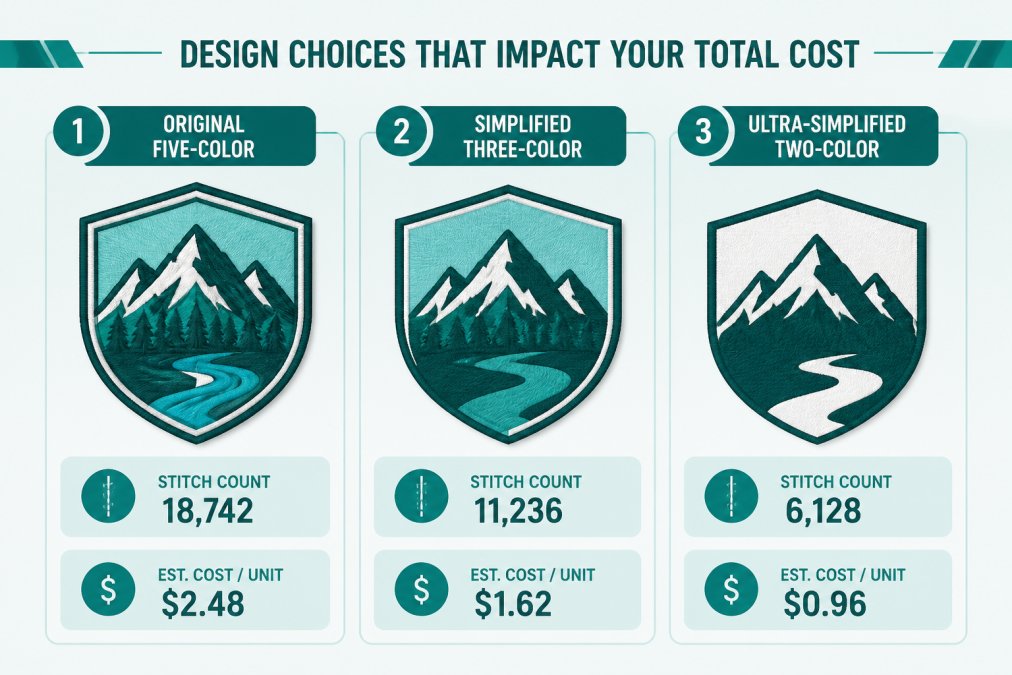
Request digitizing estimates for 2-3 versions of your logo at different color counts and sizes. This lets you see the cost impact of each design choice before committing, and often reveals that a simpler version looks nearly as good at a fraction of the cost.
Getting an Accurate Quote for Your Bulk Order
Provide specific details: unit count, garment type, design file, placement, and timeline. Ask vendors to break down quotes into digitizing fee, setup charge, per-unit cost, and volume discounts. Request a proof before production to catch sizing or color issues. Get quotes in writing with clear scope. Compare multiple vendors, but don’t choose on price alone, cheaper quotes may cut corners on quality or turnaround.
Understanding bulk custom embroidery pricing mechanics, setup fees, digitizing costs, stitch count, volume discounts, lets you make smart design decisions that keep per-unit costs reasonable. Work with a vendor who breaks down costs transparently and delivers durable results. Get a detailed quote reflecting your exact specifications and timeline.
Frequently Asked Questions
How does stitch count affect the cost of bulk custom embroidery?
Stitch count is one of the primary cost drivers in custom embroidery pricing. More stitches require more thread, machine time, and labor. A simple single-color logo with 5,000 stitches costs significantly less than a complex multi-color design with 50,000 stitches. When planning bulk orders, optimizing your design for lower stitch counts can reduce per-unit costs across your entire production run. Request a custom embroidery stitch count guide from your provider to understand how your specific design will be priced.
What is the difference between digitizing fees and embroidery costs?
Digitizing fees are one-time charges to convert your logo or artwork into embroidery machine-readable format. This is a separate cost from the actual embroidery production. Embroidery costs cover the thread, machine time, labor, and garment placement for each unit produced. For bulk orders, the digitizing fee is split across all units, making the per-piece impact smaller on larger quantities. Understanding this breakdown helps you plan your budget accurately and recognize why two quotes might differ.
How can businesses reduce costs on large-scale embroidery orders?
Several strategies lower your per-unit cost on bulk custom embroidery: order larger quantities to maximize volume discounts, simplify your design to reduce stitch count, limit thread colors, choose standard garment placement (left chest or sleeve), provide high-quality vector artwork to minimize digitizing rework, and plan ahead to avoid rush fees. Consolidating multiple small orders into one larger production run also reduces setup charges per unit. Work with your embroidery provider to discuss cost-saving options before finalizing your design.
Are there setup fees for bulk embroidery orders?
Yes, most embroidery providers charge setup fees that cover design approval, machine programming, and production preparation. These flat-rate charges are typically a one-time cost per order, regardless of quantity. For bulk orders, this setup fee gets distributed across all units, significantly lowering the per-piece impact. Larger orders make setup fees less noticeable in your total cost. Always ask your provider to itemize setup charges and digitizing fees separately from per-unit embroidery costs so you understand your complete price breakdown.