Table of Contents
- Pro Team Design: What It Takes to Get Custom Uniforms Right
- Screen Printing vs Embroidery for Uniforms: Which Method Fits Your Team
- How to Design Custom Jerseys That Look Sharp on Game Day
- Best Practices for Team Logo Design
- Fabric and Garment Selection for Different Sports
- Design File Requirements: What Your Printer Actually Needs
- Bulk Ordering, Turnaround Times, and What to Expect
- Sustainability in Apparel: What Teams Should Know
- Frequently Asked Questions
Last Updated: September 12, 2026
Pro Team Design: What It Takes to Get Custom Uniforms Right
Pro team design is the process of planning, sourcing, and producing custom uniforms and apparel that carry a team’s identity across an entire season without looking tired by week three.
Why Design Decisions Start Before You Pick a Printer
The decoration method, fabric, and artwork all constrain each other, so choosing a printer first is backwards. A logo with fine detail and thin strokes will fail in screen printing but work in embroidery, and a performance jersey fabric may not accept certain inks cleanly. Lock in artwork and garment before requesting quotes to get accurate pricing and fewer production surprises.
Sending a low-resolution logo file after placing an order is the most common cause of production delays. Reworking artwork mid-order can push delivery past your first game.
Screen Printing vs Embroidery for Uniforms: Which Method Fits Your Team
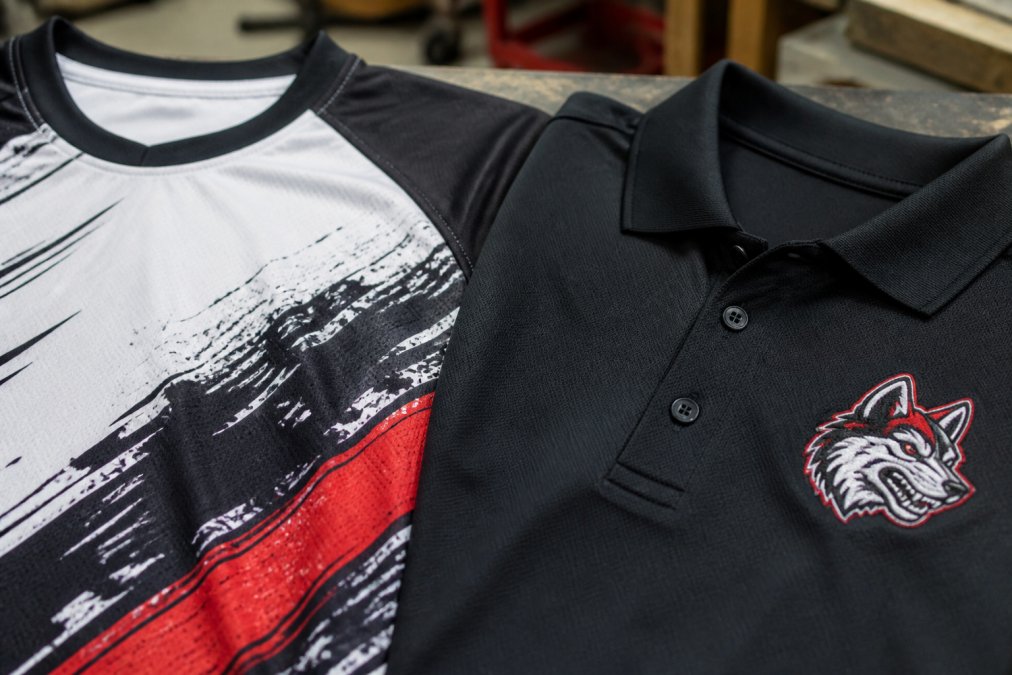
Screen printing is best for large, flat, multi-color graphics on high volumes of garments, while embroidery is best for logos on polos, caps, and outerwear where texture and durability matter. The decision is mechanical, not aesthetic: each method has hard limits on color count, detail size, and fabrics.
When Screen Printing Wins
Screen printing wins on bold graphics, large chest or back prints, and orders where cost per piece matters. The tradeoff is setup: each color needs its own screen, so complex artwork costs more to prepare.
Plastisol ink sits on top of the fabric and produces the opaque, saturated look most athletic jerseys use. Water-based and discharge inks soak in for a softer hand-feel, but they only work reliably on cotton and cotton blends, on 100% polyester performance wear, discharge inks may not develop at all, and water-based inks can bleed or fade without a proper catalyst. That is why a moisture-wicking jersey and a cotton spirit tee often need different ink systems even with the same logo.
Detail has a floor. Very fine lines, hairline strokes, and text below roughly a quarter-inch tall tend to fill in or blur because the ink spreads through the mesh. Expect the printer to simplify thin script or a detailed mascot, or recommend embroidery instead.
When Embroidery Wins
Embroidery wins on durability and a premium look. Stitched logos resist cracking and peeling through repeated washing, which matters for uniforms worn multiple times a week. It suits left-chest logos, caps, and jackets better than large back prints, and thread count and stitch density affect how crisp the logo looks.
Embroidery has its own detail ceiling. Small text, thin outlines, and tight negative space can disappear into the stitching, so most shops recommend a minimum text height and stroke width. Dense designs also add weight and stiffness, which is why a large embroidered back panel on a lightweight jersey is usually a bad idea.
Embroidery behaves differently across fabrics. Stable, mid-weight knits and wovens hold stitches cleanly, but very stretchy performance fabrics can distort under dense stitching unless the shop uses a backing or stabilizer, and very lightweight fabrics may need a softer, lower-density stitch pattern. Ask how the shop handles stretch fabrics before committing.
Where Heat Transfer and Sublimation Fit
Heat transfer and sublimation are the two methods teams most often overlook, and they solve problems screen printing and embroidery cannot.
- Heat transfer (names and numbers): Names and numbers are usually applied as heat transfers rather than screen printed, because each player needs a unique combination. This keeps per-piece cost reasonable on small and mid-size rosters and makes mid-season additions easy, a single replacement jersey can be decorated without rebuilding a screen.
- Sublimation: For 100% polyester performance wear, dye sublimation prints the design into the fabric itself rather than onto it. There is no ink layer to crack or peel, the print adds no weight, and there is no color-count limit, a full-color gradient costs the same as a solid color. The catch: sublimation only works on polyester (or polyester-coated substrates) and is typically a cut-and-sew process, so it suits fully custom jerseys better than decorating a stock blank.
Choosing Between Them
Work backward from the garment and the artwork:
- Identify the fabric first. Cotton and cotton blends accept plastisol, water-based, and discharge inks well. Polyester performance wear points toward sublimation or a poly-specific ink system. Stretch fabrics push toward embroidery with stabilizer or sublimation.
- Count the colors and the detail. One to three bold colors on a large area favors screen printing. A full-color gradient or photographic element favors sublimation. A small, textured logo on a collar or cap favors embroidery.
- Match the method to the wear pattern. Uniforms washed multiple times a week favor embroidery and sublimation, which do not crack or peel. One-off event tees can use screen printing without durability concerns.
- Confirm the file can support the method. Vector art with clean lines supports all three. A raster logo may need to be redrawn before any method will reproduce it cleanly.
| Method | Best For | Durability | Detail Level | Fabric Notes |
|---|---|---|---|---|
| Screen printing | Large graphics, bulk orders | Good with proper ink curing | Bold, simple shapes | Plastisol on most fabrics; water-based and discharge favor cotton |
| Embroidery | Polos, caps, outerwear | Excellent through repeated washing | Medium detail, textured | Best on stable knits and wovens; stretch fabrics need stabilizer |
| Heat transfer | Names and numbers, small runs | Moderate | High detail, full color | Works on most fabrics; ideal for unique per-player elements |
| Sublimation | Full-color performance jerseys | Excellent, print is in the fabric | Unlimited color, high detail | 100% polyester only; cut-and-sew process |
If your order mixes garments, say, performance jerseys plus cotton coach polos, expect the shop to use more than one decoration method. That is normal, and it is usually cheaper than forcing one method onto every piece.
How to Design Custom Jerseys That Look Sharp on Game Day
Designing custom jerseys starts with the number and name layout, because that is what fans and officials read from a distance. Build the jersey around legibility first, then add color and branding. A jersey that photographs well on a phone screen usually means the numbers are large, high-contrast, and free of busy background patterns.
Laying Out Numbers, Names, and Logos
Follow this sequence when building a jersey layout:
- Place the back number at the largest readable size your league rules allow
- Add the player name above the number with clear spacing
- Position the team logo on the chest, scaled to the garment size
- Add sponsor or league marks only after the core elements are set
- Check contrast between every element and the base fabric color
Logo placement should stay consistent across every garment in the order. If the chest logo sits two inches lower on the away jersey than the home jersey, it shows in every team photo.
Best Practices for Team Logo Design
Team logo design works best when the artwork is simple, high-contrast, and built as vector art from the start. Vector files scale to any size without losing quality, which is why printers ask for them. A logo that looks sharp on a business card can turn muddy on a jersey back if it was built as a low-resolution image.
Common Logo Mistakes That Cost Teams Money
The mistakes that cost the most are predictable. A logo with thin lines and tiny text will not reproduce cleanly in embroidery or screen printing. Too many colors increases setup cost on every reorder. Artwork without a clean background forces the printer to rebuild the file, adding time before production starts.
Ask for a design proof before approving production. A proof shows exactly how the logo, numbers, and colors will sit on the actual garment, and catching a placement error there costs nothing compared to catching it after the order ships.
Fabric and Garment Selection for Different Sports
Fabric choice should follow the sport, not the other way around. Performance wear built for moisture management suits high-sweat sports, while heavier cotton blends suit sideline and spirit wear. Getting this wrong shows up as uncomfortable players and uniforms that wear out before the season ends.
The Properties That Actually Matter
Four fabric properties drive almost every uniform decision:
- Fabric weight (GSM or oz/yd²): Lighter fabrics (roughly 4-5 oz/yd²) breathe and suit hot-weather sports; heavier fabrics (6-8 oz/yd² and up) resist abrasion and hold shape but trap heat.
- Moisture management: Performance fabrics wick sweat away from the skin and spread it across the surface to evaporate (textileschool.com). This is a fiber and knit-structure property, not a coating, so it does not wash out. Cotton absorbs sweat and holds it, which is why a 100% cotton tee gets heavy and clingy during play.
- Abrasion resistance: How well the fabric survives friction against turf, pads, and other players. Tightly woven or high-denier synthetics resist pilling and tearing far better than loose knits. Contact sports live or die on this property.
- Shrinkage and colorfastness: Cotton shrinks unless pre-shrunk or blended; synthetics generally hold size. Colorfastness determines whether colors bleed or fade after repeated washing, critical when a uniform has to match across home and away sets all season.
Matching Fabric to Sport
- Football and hockey: durable, abrasion-resistant fabrics that hold up to contact. Look for heavier synthetic knits or woven panels with reinforced seams. Stretch is a feature here, not a flaw, it lets the garment move without tearing.
- Basketball and soccer: lightweight performance wear with moisture-wicking properties. These sports reward breathability and low weight over abrasion resistance, so lighter synthetic knits dominate.
- Baseball and softball: mid-weight fabrics that balance breathability and durability. Pants take the most abuse, so look for reinforced knees and a fabric that resists pilling on the slide.
- Spirit wear and fan apparel: cotton and cotton-blend garments for comfort and printability. These are worn casually, not competitively, so softness and how well the fabric accepts decoration matter more than performance.
Performance Fabric vs. Cotton: The Real Trade-off
The choice between performance fabric and cotton is not about quality, it is about use case. Performance synthetics (usually polyester, sometimes with spandex for stretch) win on moisture management, durability, and shape retention, making them right for anything worn during competition. Cotton and cotton blends win on comfort, breathability in dry heat, and how well they accept certain inks and embroidery, right for sideline, warm-up, and fan apparel.
A common mistake is ordering performance fabric for spirit wear because it sounds more premium. Players and fans often find it less comfortable for casual wear, and it can be harder to decorate with the ink systems that produce the softest prints. Match the fabric to how the garment will actually be worn, not to which one sounds better on a spec sheet.
Sustainability Through Durability
Sustainability in team apparel is less about a label and more about lifespan. A uniform that lasts three seasons displaces two full replacement orders, a larger environmental and budget win than any single material swap. Two practical levers:
- Choose durable decoration. Embroidery and sublimation do not crack or peel, so the garment stays presentable long after a screen print would have started to fail. That extends usable life without changing the fabric.
- Choose fabrics that hold their shape and color. A fabric that pills, fades, or shrinks after a few washes gets retired early regardless of what it is made of. Abrasion resistance and colorfastness are sustainability features, even if they are not marketed that way.
Recycled polyester and organic cotton options exist across most garment categories, and they are worth asking about. But the highest-impact decision is still ordering accurate size runs, keeping a small stock of blanks for mid-season roster additions, and picking decoration that survives repeated washing. Those choices lower long-term cost while reducing how often gear ends up discarded.
Before you commit to a full order, ask three questions about any garment: What is the fabric weight? Is moisture management built into the fiber or applied as a coating? And how does it hold up after 20 washes? The answers tell you more than the marketing copy on the product page.
Design File Requirements: What Your Printer Actually Needs
Print-ready files are vector-based, layered, and saved in a format the printer can open directly. The most reliable formats are AI, EPS, PDF, and SVG, because they preserve scalable line data. If you only have a JPG or PNG, the printer will likely need to redraw it, which adds cost and time.
What a printer typically needs from you:
- Vector artwork with no embedded background
- Exact color values, ideally as Pantone references
- Font files or outlined text
- Correct dimensions for each placement
- A clear note on which elements are required versus optional
If your designer is not a professional, send the highest-resolution version you have and ask upfront whether the file needs cleanup. Most shops can rebuild simple logos, but complex artwork takes longer.
Bulk Ordering, Turnaround Times, and What to Expect
Bulk orders move fastest when artwork, garment, and sizing are all confirmed before the order is placed. Turnaround time depends on quantity, decoration method, and color count. Multi-color screen printing takes longer to set up than single-color embroidery, and large orders naturally take longer to produce than small ones.
Plan your order timeline around these stages:
- Approve artwork and request a proof
- Confirm garment style, color, and full size run
- Place the order and lock the design
- Production and decoration
- Quality check and shipping
For a season that starts in six weeks, place your order as early as possible and confirm the production window in writing. Roster changes mid-season are common, so ask how reorders and single-piece additions are handled before committing to the first order.
The teams that avoid last-minute panic are the ones that finalize artwork and sizing before the season schedule is even published. Front-loading those decisions is the single biggest lever on turnaround time.
Sustainability in Apparel: What Teams Should Know
Sustainability in team apparel comes down to two choices: what the garment is made of, and how long it stays in use. Recycled polyester and organic cotton options exist across most garment categories, and durable decoration like embroidery extends a uniform’s usable life. The most sustainable uniform is the one a team wears for several seasons instead of replacing every year.
Frequently Asked Questions
What elements make a professional team uniform design?
A professional pro team design combines a clean logo, readable jersey numbers, consistent color placement, and a fabric that suits the sport. Logo placement matters most: chest, sleeve, and back locations should follow league rules and stay consistent across home and away sets. Vector art files keep every element sharp at any size. Teams that finalize these choices before ordering avoid costly reprints and mid-season mismatches.
How do I choose between screen printing and embroidery for team gear?
Screen printing works best for large, colorful graphics on t-shirts and performance wear, especially in bulk where the per-piece cost drops. Embroidery suits polos, hats, and jackets where a raised, durable logo reads as more formal. Many teams mix both: screen-printed jerseys with embroidered sideline polos. Ask your provider for a sample of each on the actual garment before committing to a full order.
How long does it take to get custom team uniforms designed and produced?
Turnaround time depends on design approval, garment stock, and order size. Simple screen-printed orders often move faster than fully embroidered sets because digitizing adds a step. Start the design process at least six to eight weeks before your season opener. If your roster changes mid-season, confirm reorder policies upfront so you are not paying rush fees for a few extra jerseys.
Can I create a custom logo for my sports team if I only have a low-quality image?
Yes, most providers can redraw or vectorize a low-resolution logo into a print-ready file, though the quality of the original affects how much cleanup is needed. Send the highest-resolution version you have, plus any brand colors or fonts. If the file is unusable, a designer can recreate it from scratch. Always request a digital proof before production so you can catch spacing or color issues early.
Getting a team outfitted on a deadline is the real challenge, and it is where most orders go sideways. Piercy Sports and Apparel handles the whole process in one place, from high-resolution digital printing and premium embroidery to screen printing, with tailored solutions built around your exact vision and top-grade products made for longevity and performance. Get started with Piercy Sports and Apparel and give your team uniforms that look sharp from the first game to the last.