Table of Contents
- Why Local Custom Sports Apparel Beats Online-Only Shops
- Screen Printing vs Embroidery for Jerseys: What to Choose
- Custom Team Uniforms Design Tips That Actually Look Good
- Fabric Technology: Choosing Performance Material for Custom Sports Apparel
- Custom Sports Apparel Turnaround Time: What to Expect
- Budgeting for Bulk Orders and Team Seasons
- Eco-Friendly Inks and Sustainable Apparel Options
- Get Started with Your Custom Order
- Frequently Asked Questions
Last Updated: September 7, 2026
Youth sports seasons move fast, and waiting weeks on a national online vendor often means missing your first game. That is why searching for custom sports apparel near me usually leads coaches to a local shop like Piercy Sports and Apparel, where you can see fabric samples, confirm logo placement, and pick up finished jerseys without shipping delays. Local providers also fix problems in person, whether that means a last-minute roster change or a design tweak before production starts.
This guide walks through the technical decisions that separate durable, professional-looking gear from uniforms that fade, crack, or shrink after a few washes. We will compare printing methods, explain what makes a design file production-ready, and break down realistic timelines so you can plan your season with confidence.
Why Local Custom Sports Apparel Beats Online-Only Shops
The biggest advantage of working with a local custom sports apparel provider is accountability. When you order from an online-only shop, your communication happens through email tickets and your only recourse for a bad batch is a return label. A local shop shows you physical samples, lets you feel the fabric weight, and stands behind the finished product because your team is in their community.
Turnaround also favors local providers. National vendors often quote 20-25 days for production alone, before shipping (sba.gov). A local shop that controls its own production can compress that timeline significantly, which matters when your league schedule shifts or a sponsor adds their logo at the last minute. For teams that order year after year, that relationship means the shop already knows your colors, your font preferences, and your sizing history.
Screen Printing vs Embroidery for Jerseys: What to Choose
Screen printing and embroidery are the two dominant decoration methods for team apparel, but they are not interchangeable. Choosing the wrong one leads to cracked logos, stiff uniforms, or unnecessary cost. The decision hinges on fabric type, garment use, and the level of detail in your artwork.
How Screen Printing Works on Performance Fabrics
Screen printing pushes ink through a mesh stencil directly onto the fabric (britannica.com). For athletic jerseys made of polyester, the industry standard is plastisol ink, which sits on the surface and flexes with the material. This is critical during play, when a player stretches, dives, or makes a cut, the print must move without cracking. A properly cured plastisol print on a moisture-wicking jersey will not trap heat or restrict motion, keeping the athlete comfortable.
However, the number of colors in your design directly impacts cost and turnaround. Each color requires a separate screen, which means a four-color logo takes four times the setup time of a one-color design. For a youth team budget, limiting your logo to two or three colors is the most practical way to keep per-piece costs down without sacrificing visual impact.
Why Embroidery Is the Wrong Choice for Game-Day Jerseys
Embroidery uses thread stitched directly into the garment, creating a dense, raised texture. On a polyester jersey, that density works against you. The thread adds weight, traps heat, and can feel abrasive against the skin, especially on the chest or upper back where sweat pools. Over time, the stitching can also pucker the lightweight mesh fabric, distorting the jersey’s fit. For these reasons, embroidery is rarely used on game-day uniforms in sports like basketball, soccer, or volleyball.
Where Embroidery Wins: Off-Field and Sideline Gear
Embroidery excels on items worn before or after the game. Hats, polos, jackets, and warm-up suits benefit from the premium, dimensional look of a stitched logo. These garments are made from heavier fabrics, cotton twill, fleece, or woven nylon, that can support the thread density without distortion. A stitched logo on a sideline jacket also holds up to years of washing and wear, making it a better long-term investment for coaches and staff gear.
The Hybrid Approach Most Teams Should Use
A common pattern among well-equipped teams is to use screen printing for the jersey itself and embroidery for sideline apparel. This approach matches each technique to its strength: screen printing keeps the uniform lightweight and flexible, while embroidery gives the off-field gear a polished, durable finish. Before you approve a quote, ask your provider to show you samples of both methods on the exact fabric you are considering. A sample swatch tells you more about feel and durability than any product photo ever will.
If your design includes fine text or intricate details, screen printing may not reproduce it cleanly at small sizes. Embroidery can handle fine lines better, but only on heavier fabrics. Ask your shop to run a test print before committing to a full order.
Custom Team Uniforms Design Tips That Actually Look Good
A clean uniform design starts with restraint. Limit your palette to team colors plus one accent, keep the logo legible from a distance, and place the largest element on the left chest where it reads naturally. Avoid tiny text, gradients that wash out in printing, and designs that compete with the jersey’s own pattern.
Design File Requirements and Logo Quality
The single biggest mistake teams make is sending a low-resolution logo pulled from a website. Printers need vector graphics, typically an AI, EPS, or PDF file, where the artwork scales to any size without pixelation. If your logo is a JPEG or PNG, a good shop can often redraw it, but the result depends on the source quality. Before you order, ask your provider what file formats they accept and whether they offer design cleanup as part of the service.
Sending a screen-captured logo from social media will produce a blurry, jagged jersey. Have your designer export vector artwork or ask your apparel shop to redraw the logo before you approve production.
Fabric Technology: Choosing Performance Material for Custom Sports Apparel
The fabric you choose affects how players perform and how long the uniform lasts. Most athletic jerseys use polyester blends because polyester is lightweight, dries quickly, and holds vibrant dye without fading. The key feature to look for is moisture-wicking, a treatment that pulls sweat away from the skin to the fabric surface where it evaporates. Cotton, while comfortable for fan gear, absorbs sweat and becomes heavy during play.
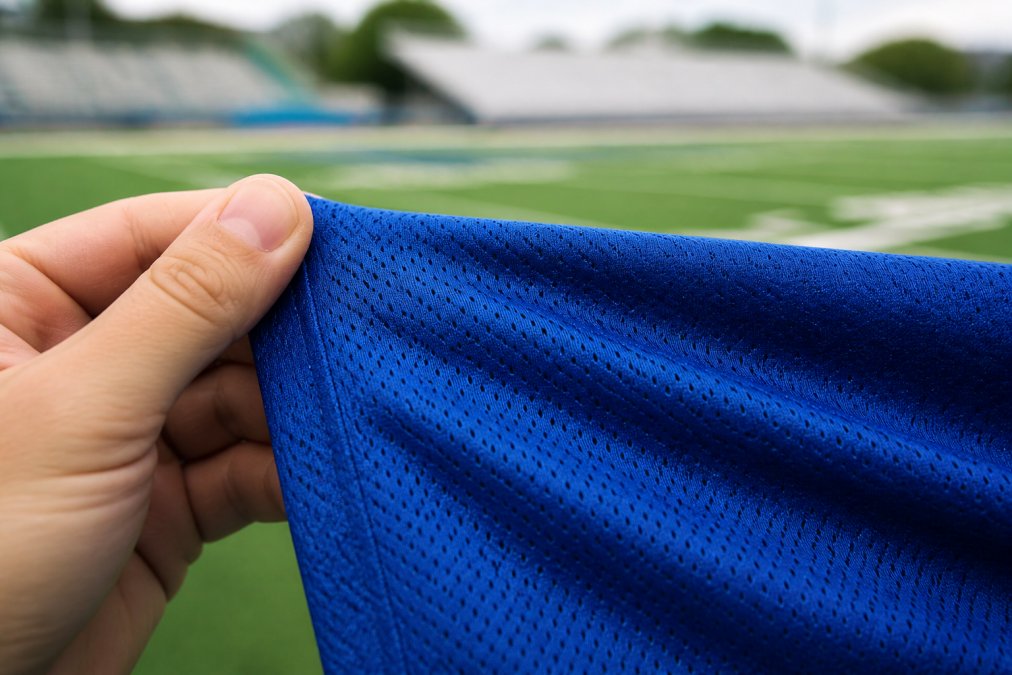
Fabric weight matters too. Lightweight mesh, around 3.5 to 4 ounces, suits basketball and soccer where breathability is critical (peer-reviewed research). Heavier knits, around 5 to 6 ounces, hold up better for baseball and football where players slide and dive. If you are unsure, ask to feel samples of both weights and consider your sport’s contact level before committing.
Custom Sports Apparel Turnaround Time: What to Expect
Realistic turnaround times for custom sports apparel range from one to four weeks, but that range hides significant variation depending on the decoration method, order size, and the shop’s production queue. Understanding where the time actually goes helps you plan your season and avoid last-minute panic.
Breaking Down the Production Timeline
A typical order moves through five stages, and each one can add days to your delivery date:
- Design approval (1-3 days): This is the most common bottleneck. If your logo is not vector-ready or needs redrawing, this stage stretches. A clean, production-ready file can move through in a single day.
- Screen or digitizing setup (2-5 days): Screen printing requires burning a mesh screen for each color in your design. Embroidery requires digitizing the logo into stitch patterns. Both are skilled tasks that shops batch into their production schedule.
- Garment printing or stitching (3-7 days): Actual production time depends on order size. A 15-piece youth order might take one day on the press; a 150-piece order with multiple colors can take several days.
- Quality inspection (1 day): Reputable shops check every piece for alignment, color accuracy, and defects before packaging.
- Packaging and pickup or shipping (1-2 days): Local pickup eliminates this stage entirely, which is a major advantage of working with a nearby provider.
Why Screen Printing Takes Longer Than You Think
Screen printing is not a single step. Each color in your design requires a separate screen, and each screen must be burned, aligned on the press, and tested. A three-color jersey takes roughly three times the setup time of a one-color design. Shops also run orders in batches to minimize setup waste, so your order waits for an opening in the production queue. This is why a shop that controls its own production in-house can compress timelines that national vendors stretch to 20-25 days.
The Six-Week Rule for Season Planning
A common pattern among experienced coaches is to place their order at least six weeks before the first scheduled game. This buffer covers design revisions, production delays, and sizing exchanges without jeopardizing the season. If you are ordering for a fall league that starts in early September, that means placing your order by late July, not mid-August.
Rush Orders: What They Really Cost
Most local shops can accommodate rush orders, but you are paying for the shop to disrupt its existing production queue. Expect a rush fee that scales with how much you are compressing the timeline. A two-week rush might add 15-20% to your total; a one-week rush can add more. The better strategy is to ask about the shop’s current queue before you commit to a date. A shop that is running at full capacity in peak season, typically March through May for spring sports and July through September for fall, will have less flexibility than one in a slower month.
Do not assume a quoted delivery date is guaranteed. Ask your provider what happens if production slips. A local shop that stands behind its work will offer a clear remedy, whether that is a partial refund or expedited reprint.
Budgeting for Bulk Orders and Team Seasons
Custom apparel pricing depends on order quantity, decoration complexity, and garment quality, so your per-piece cost drops as your order grows. Bulk ordering spreads the setup costs across more units, which is why teams that order uniforms plus warm-ups and fan gear together get better value than piecemeal orders.
For a youth league with 15 kids, confirm your provider has no minimum that forces you to over-order. Many local shops work with small teams and can adjust sizing mid-season as rosters change. When budgeting, also account for reorder fees if a player joins after your initial run. Ask upfront about the cost to add a few jerseys later, since matching the original dye lot matters for color consistency.
| Budget Factor | What It Affects | Planning Tip |
|---|---|---|
| Order quantity | Per-piece price | Combine team and fan orders |
| Color count | Screen setup fees | Limit to 2-3 colors |
| Garment quality | Durability and feel | Order one sample first |
| Rush production | Timeline and cost | Order 6 weeks ahead |
Eco-Friendly Inks and Sustainable Apparel Options
Sustainability is becoming a real consideration for teams and schools, and the good news is that eco-friendly options no longer sacrifice quality. Water-based inks, unlike traditional plastisol inks, soak into the fabric rather than sitting on top, producing a softer feel that many athletes prefer. These inks also eliminate the need for harsh chemicals in the production process.
On the garment side, look for recycled polyester fabrics made from plastic bottles. These materials perform identically to virgin polyester in moisture-wicking and durability while reducing landfill waste. Some providers also offer organic cotton for fan gear and sideline apparel. If sustainability matters to your organization, ask your apparel supplier which eco-friendly inks and fabrics they stock before you finalize your order.
Get Started with Your Custom Order
Bringing a team uniform to life takes planning, but the process is straightforward when you work with the right partner. Start by gathering your logo files, confirming your roster and sizing, and setting a deadline based on your season schedule. Then schedule a consultation to review fabric samples and decoration options.
Piercy Sports and Apparel specializes in high-resolution digital printing, premium embroidery, and screen printing. Our team builds tailored solutions around your exact vision, using top-grade products designed for longevity and performance. We deliver vibrant, durable designs with fast turnaround.
Frequently Asked Questions
What is the difference between screen printing and embroidery for sports uniforms?
Screen printing lays ink directly onto the fabric, which makes it ideal for large, bold designs like team names and numbers. Embroidery stitches thread into the garment, giving a raised, textured look that holds up well on hats, polos, and jackets. For jerseys, screen printing is usually the better choice because it is lighter, stretches with the athlete, and won’t add extra weight or friction. Use embroidery for sideline gear or coach apparel where a more polished, professional finish matters.
How long does it typically take to receive custom sports apparel?
Many shops quote 20-25 days for production alone, but a local provider can often turn orders around faster depending on the season and complexity. Your timeline depends on the decoration method, quantity, and whether the design is ready to print. For a youth league with a season starting in six weeks, you have room to handle design tweaks and delivery. Always ask for a production timeline before you commit, especially when you have a roster deadline.
What file formats are needed for custom team logo printing?
Vector graphics are the gold standard for apparel decoration. Send a .AI, .EPS, or .PDF file with your logo and text converted to outlines. If you only have a JPEG or PNG, a good shop can often trace or redraw it for you, but expect a small setup fee for that work. Low-resolution files from a website or social media will pixelate when scaled up to chest size. When in doubt, ask the shop before you send anything.
Can I order custom sports apparel for small teams or individual players?
Yes. Many local providers, including Piercy Sports and Apparel, work with smaller orders, so you are not forced to buy more than you need. This is especially helpful for youth leagues where rosters change mid-season. Ask about reorder policies before you place the first order, so you know what it costs to add a player or replace a damaged jersey later.
Ordering custom sports apparel for a team involves balancing quality, timeline, and budget. The teams that get it right treat the uniform as an investment in team identity, not just a purchase. Piercy Sports and Apparel makes that investment simple with a one-stop shop for uniforms, spirit wear, and promotional gear, backed by fast turnaround and craftsmanship built to last. Get started with Piercy Sports and Apparel and equip your team with gear that looks sharp all season.