Table of Contents
- Why Elevated Brand Identity Matters in Corporate Apparel
- Custom Business Apparel for Staff: Building Cohesive Visual Identity
- Corporate Apparel Design Best Practices: From Concept to Execution
- Embroidery vs Screen Printing for Business: Choosing the Right Technique
- Professionalism and Employee Morale: The Business Impact
- ROI and Budgeting Frameworks for Corporate Apparel
- Frequently Asked Questions
Last Updated: October 2, 2026
Why Elevated Brand Identity Matters in Corporate Apparel
An elevated brand identity corporate apparel transforms how teams present themselves to the world.
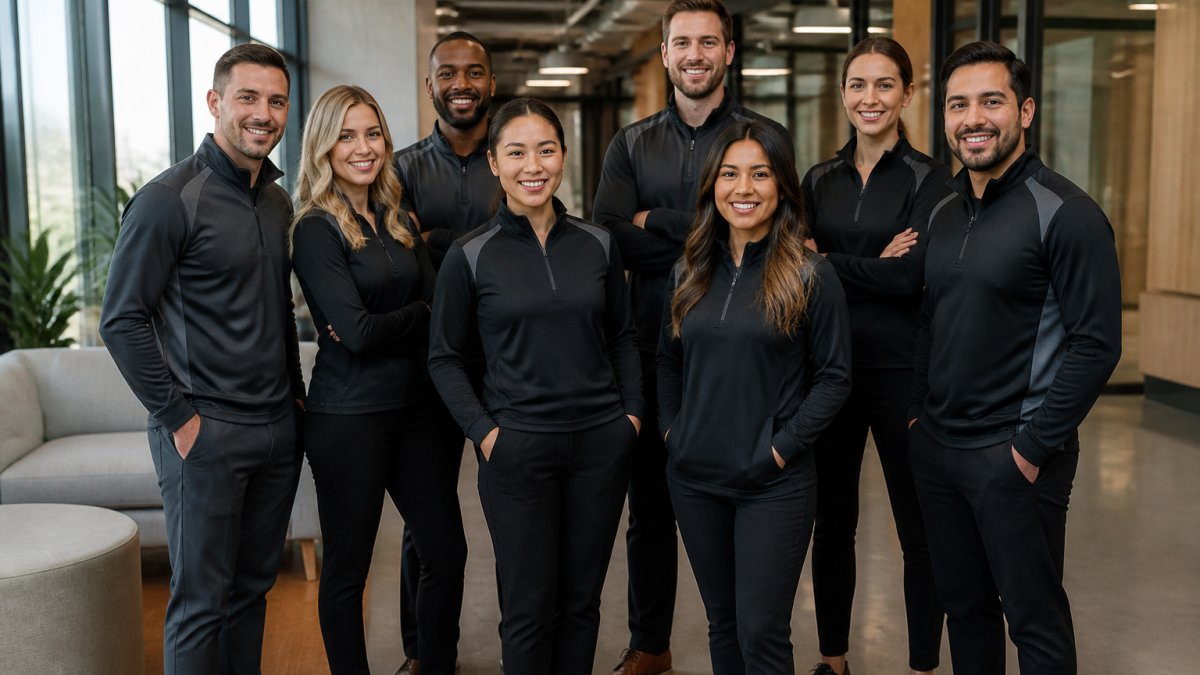
When employees wear branded apparel that reflects genuine quality and thoughtful design, something shifts. The apparel becomes a tangible expression of your company’s values and professionalism. Customers notice. Team members feel it.
The real power lies in how apparel anchors brand identity across every touchpoint.
The difference between generic off-the-shelf clothing and custom business apparel designed with intention is stark. One reinforces your brand identity; the other fades into the background.
Custom Business Apparel for Staff: Building Cohesive Visual Identity
Custom business apparel for staff creates the foundation for a unified corporate image. When everyone on your team wears apparel that reflects your brand identity, you eliminate visual chaos and establish immediate recognition.
The Role of Apparel in Brand Recognition
Your apparel is a mobile billboard. Every interaction your team has, whether in-person or at events, becomes an opportunity to reinforce brand recognition. Consistent logo placement, color schemes, and quality standards ensure that your brand identity registers with clients and customers.
The role of apparel extends beyond aesthetics. It communicates professionalism before a word is spoken. A technician arriving at a job site in branded gear signals that your organization takes itself seriously. A sales team in matching custom apparel projects confidence and cohesion.
Brand recognition builds through repetition and consistency. When your team wears apparel that consistently represents your brand identity, you’re creating thousands of micro-impressions daily. These impressions compound over time, strengthening how your market perceives your business.
Strengthening Corporate Culture Through Unified Appearance
A unified appearance does more than look polished, it strengthens the psychological connection your employees feel to the organization. When staff wear apparel that represents something bigger than themselves, team spirit and belonging increase.
Corporate culture thrives on shared symbols. Branded apparel becomes one of those symbols.
The unified appearance also creates psychological accountability. When you’re wearing your company’s name and logo, you’re conscious of how you represent it. This subtle shift in awareness often translates to improved customer interactions and professional behavior.
Corporate Apparel Design Best Practices: From Concept to Execution
Design simplicity is the foundation of effective corporate apparel. The most recognizable brands in the world use minimal, clean design, not because they lack creativity, but because simplicity ensures consistency and impact across different applications.
Design Simplicity and Logo Placement Strategy
Your logo placement strategy determines how effectively your brand identity communicates. The most effective placements are chest embroidery for visibility and shoulder placement for impact.
Design simplicity means choosing one primary logo placement and sticking with it. A single, well-executed logo on a quality garment outperforms multiple smaller logos scattered across the apparel.
Consider the context of how your apparel will be worn. Will team members wear jackets over their branded shirts? Will the apparel be visible during video calls?
Consistency in Visual Branding Across All Touchpoints
Consistency in visual branding means your apparel matches your other brand touchpoints, your website, business cards, signage, and marketing materials.
This consistency creates what designers call “brand coherence.” When someone encounters your apparel, then later sees your website or marketing materials, they should immediately recognize the connection.
Maintaining consistency requires clear brand guidelines. Document your approved logo versions, color specifications, and placement rules. Share these guidelines with your apparel vendor to ensure every order meets your standards.
Embroidery vs Screen Printing for Business: Choosing the Right Technique
The choice between embroidery and screen printing affects both how your apparel looks and how long it lasts. Each technique has distinct advantages depending on your use case and longevity expectations.
Embroidery creates texture and dimension. The thread sits on top of the garment, catching light and creating a premium appearance.
For elevated brand identity corporate apparel, embroidery generally conveys higher quality and professionalism. The tactile nature of embroidery suggests investment and care.
Durability and Longevity Comparison
Embroidery thread is engineered to withstand repeated washing, stretching, and friction. The stitching is locked into the fabric weave, making it resistant to peeling or cracking.
Screen printing durability depends heavily on ink quality and application technique. Lower-quality screen printing cracks and peels within months. High-quality screen printing, applied with proper curing, can last 2-3 years with regular washing.
The difference becomes apparent after the first dozen washes. Screen-printed logos begin showing wear at the edges. Embroidered designs maintain their integrity and appearance indefinitely.
Fabric Quality and Textile Performance Standards
Fabric quality determines how your apparel feels, wears, and ages. Premium corporate apparel uses 100% cotton or cotton-blend fabrics with tight weave construction.
Textile performance standards matter for durability. Look for fabrics with high thread count, this indicates tighter weaving and greater durability. Shrinkage rates should be minimal (under 3% for quality fabrics).
Weight matters too. Heavier fabrics (6+ ounces) feel more substantial and professional than lightweight alternatives. They drape better, hold their shape longer, and provide better durability for apparel that will be worn frequently.
Professionalism and Employee Morale: The Business Impact
Quality apparel directly impacts how employees perceive themselves and their role. When staff wear premium branded apparel, they unconsciously adopt more professional behavior.
The apparel signals that the organization invests in them.
The external impact is equally important. Clients and customers form immediate impressions based on appearance. Staff wearing premium branded apparel projects competence and reliability.
The correlation between apparel quality and perceived professionalism is not subtle. Professional appearance influences purchasing decisions, trust levels, and willingness to engage with a business.
ROI and Budgeting Frameworks for Corporate Apparel
Calculating ROI for corporate apparel requires moving beyond intuition to measurable outcomes. While many organizations invest in branded clothing, few establish clear metrics to track the return on that investment.
Establishing Baseline Metrics
Before calculating ROI, establish baseline metrics for the areas apparel will impact.
For brand recognition specifically, conduct a simple survey: ask new customers how they first heard about your business. Track mentions of “saw your team” or “professional appearance” separately.
Employee engagement metrics are equally important. Measure current turnover rates, internal satisfaction scores, and sick days taken. These psychological factors shift when employees feel invested in by their organization.
Cost Structure and Total Cost of Ownership
Corporate apparel budgeting must account for more than unit cost.
Calculate total cost of ownership (TCO) by dividing total program cost by expected lifespan in wears.
This calculation justifies higher upfront investment to finance and leadership teams.
Factor in replacement cycles. A typical corporate apparel program replaces 20-30% of inventory annually due to wear, loss, or employee turnover.
Quantifying Intangible Returns
The hardest part of ROI calculation is assigning value to intangibles. Use these frameworks:
Brand Recognition Value: Track customer acquisition source after launching apparel. If 5% of new customers cite “saw your team” as their discovery method, and your average customer lifetime value is $5,000, that’s $250,000 in attributed revenue from 50 customers. Divide by your annual apparel budget to calculate ROI.
Employee Retention Value: Calculate the cost of replacing one employee (typically 50-200% of annual salary when accounting for recruitment, training, and lost productivity). If quality apparel reduces turnover by even one employee annually, and that employee’s salary is $40,000, you’ve saved $20,000-$80,000.
Customer Trust Impact: Conduct brief post-interaction surveys asking customers to rate their confidence in your organization on a 1-10 scale. Segment responses by whether they interacted with uniformed vs. non-uniformed staff.
Budgeting Allocation Framework
A practical allocation model:
- Initial program launch: 2-3% of annual marketing budget, or $2,000-$10,000 depending on team size
- Annual maintenance and replacement: 0.5-1% of annual marketing budget
- Scaling or refresh cycles (every 3-4 years): 1.5-2% of annual marketing budget
For a company with $100,000 annual marketing budget and 25 employees, initial investment might be $2,000-$3,000 (roughly $80-$120 per employee for quality apparel). Annual replacement runs $500-$1,000.
Measuring Results Over Time
Track your baseline metrics monthly for the first 6 months after launching apparel, then quarterly. Look for:
- Customer acquisition: Percentage of new customers citing visual brand recognition
- Employee retention: Turnover rate compared to baseline
- Customer satisfaction: NPS or CSAT scores, particularly from customers who interacted with uniformed staff
- Brand consistency: Internal audits of apparel wear compliance and condition
- Cost per wear: Actual durability vs. expected lifespan
After 12 months, calculate your actual ROI. If results are below expectations, audit whether the issue is apparel quality, design consistency, or wear compliance, each requires different corrective action.
When sourcing custom business apparel for staff, work with vendors who can provide transparent cost breakdowns and realistic durability expectations. This data becomes essential for your ROI calculations and future budget justifications.
Frequently Asked Questions
How does custom business apparel for staff actually improve brand perception?
Consistent branded apparel creates multiple brand touchpoints throughout your workday. When employees wear unified corporate apparel, they become brand ambassadors both internally and in public interactions. This visual consistency reinforces brand values, increases recognition, and signals professionalism to clients and customers.
What’s the difference between embroidery vs screen printing for business apparel?
Embroidery creates raised, three-dimensional designs using thread, offering superior durability and a premium appearance ideal for long-term wear. Screen printing applies ink directly to fabric, providing vibrant colors and detailed graphics at lower costs for high-volume orders. Screen printing works better for complex multi-color logos and photographic designs. Choose embroidery for lasting professional impact; screen printing for cost-effective volume orders.
What are the key elements of corporate apparel design best practices?
Effective corporate apparel design starts with simplicity: limit logos to one primary placement (chest or sleeve), use 2-3 brand colors maximum, and ensure readability from a distance. Maintain consistency across all pieces using documented style guides that specify logo size, placement, and color specifications. Choose high-quality fabrics that represent your brand values and withstand frequent washing. Prioritize comfort and fit to encourage employee adoption. Balance brand visibility with professional aesthetics so apparel enhances rather than overwhelms the wearer’s appearance.
How can I ensure my custom apparel order meets quality standards?
Request samples before full production and inspect them for print clarity, embroidery thread consistency, and seam quality. Verify that printing or embroidery techniques match your durability requirements, embroidery lasts longer through repeated washing. Ask about fabric composition and care instructions to ensure longevity. Confirm turnaround times and minimum order quantities align with your needs. Work with providers who offer quality guarantees and can address issues like cracking or peeling designs. Request examples of previous work for similar projects to assess their craftsmanship.