Table of Contents
- Understanding the Custom Sports Gear Printing Process
- Sublimation Printing for Athletic Wear
- Best Embroidery vs Screen Printing for Sports Apparel
- Artwork Preparation and File Specifications
- Custom Jersey Printing Turnaround Time and Production
- Heat Transfer, Pressure, and Curing Requirements
- Ensuring Durability and Wash-Fastness
- Troubleshooting Common Printing Defects
- Frequently Asked Questions
Last Updated: September 24, 2026
Understanding the Custom Sports Gear Printing Process
The custom sports gear printing process combines multiple techniques to transform designs into durable, professional apparel. Temperature control, pressure settings, and curing time determine whether your custom sports gear looks professional on day one and holds up through an entire season.
Sublimation Printing for Athletic Wear
Sublimation printing converts solid dye into gas using heat, bonding permanently with polyester fibers to produce vibrant, full-color designs with no visible ink layer.
How sublimation works:
- Design is printed onto special transfer paper using sublimation ink
- Transfer paper is placed face-down on polyester fabric
- Heat press applies 350-400°F temperature for 30-60 seconds
- Dye converts to gas and penetrates the fabric at the molecular level
- Design becomes part of the fabric rather than sitting on top
The result won’t crack, peel, or fade. Sublimation works best on 100% polyester or high-polyester blend fabrics, including moisture-wicking performance apparel.
Best for:
- All-over designs covering large areas
- Photographic or gradient-heavy artwork
- Moisture-wicking jerseys and performance apparel
- High-volume orders where color vibrancy matters most
Limitation: sublimation cannot print on dark fabrics unless pre-treated, as dye requires a light base to show true colors.
Best Embroidery vs Screen Printing for Sports Apparel
Choosing between embroidery and screen printing depends on design, budget, and durability needs.
Embroidery for Durability and Premium Finishes
Embroidery stitches patterns directly into fabric, delivering a premium appearance and exceptional durability.
How embroidery works:
- Design is digitized into a machine-readable format
- Embroidery machine uses multiple needle colors to stitch the pattern
- Thread is locked into place by the fabric weave
- Finished design has raised texture and visible thread
Embroidered designs withstand hundreds of washes without degradation because thread is mechanically locked into fabric, making it ideal for logos, team names, and player numbers.
Best for:
- Team logos and wordmarks
- Premium uniforms requiring durability
- Small-to-medium designs (under 6 inches)
- Apparel that will see heavy use and frequent washing
Drawbacks: Cannot reproduce fine detail, slower for large orders, more expensive per unit than screen printing, and not ideal for full-coverage designs.
Screen Printing for Bold, High-Volume Orders
Screen printing pushes ink through a mesh screen onto fabric, delivering fast, cost-effective, bold results for volume orders.
How screen printing works:
- Design is separated into individual color layers
- A mesh screen is created for each color
- Ink is pushed through the screen onto the garment
- Each color requires a separate pass through the press
- Ink cures and bonds to the fabric surface
Screen printing delivers vibrant colors and sharp edges on any fabric color, handling large orders efficiently in single production runs.
Best for:
- High-volume orders (50+ units)
- Bold, simple designs with limited colors
- Budget-conscious projects
- Dark or light fabrics equally
Drawbacks: Limited to 4-6 colors per design, cannot reproduce fine detail or gradients, ink can crack with heavy stretching, and setup costs make small orders expensive.
Artwork Preparation and File Specifications
Proper file preparation prevents costly mistakes and ensures your custom sports gear printing process runs smoothly.
File format requirements:
- Vector files (AI, EPS, PDF) are preferred for screen printing and embroidery
- High-resolution raster files (300 DPI minimum) work for digital printing
- Color profile should be CMYK for print (not RGB)
- Avoid embedding fonts; convert text to outlines
Common mistakes: Low-resolution logos, RGB instead of CMYK color mode, gradients in screen printing designs.
Professional file prep prevents reprints and delays.
Custom Jersey Printing Turnaround Time and Production
Typical production schedules by method:
-
Screen printing: 7-14 days for standard orders (50+ units)
-
Embroidery: 10-21 days depending on stitch count and design complexity
-
Rush orders: Add 25-50% to standard pricing; availability depends on current queue
Lead time includes design approval, file preparation, setup, production, and quality inspection. Seasonal peaks can extend timelines by 5-10 business days.
Cost-per-unit breakdown for small orders:
Setup costs are the hidden factor that makes small orders expensive. Screen printing requires mesh screens for each color ($30-$75 per screen). Embroidery digitization costs $25-$100 per design. For a 12-unit order, setup costs distribute across fewer garments, raising per-unit price significantly.
- Screen printing (12 units, 2-color design): Setup $60-$150 + $8-$12 per shirt = $96-$294 total ($8-$24.50 per unit)
- Screen printing (100 units, same design): Setup $60-$150 + $4-$6 per shirt = $460-$750 total ($4.60-$7.50 per unit)
- Embroidery (12 units, small logo): Setup $50-$100 + $12-$18 per shirt = $194-$316 total ($16-$26 per unit)
- Embroidery (100 units, same design): Setup $50-$100 + $6-$10 per shirt = $650-$1,100 total ($6.50-$11 per unit)
Why volume matters: At 12 units, sublimation and DTG eliminate setup fees. At 50+ units, screen printing becomes most economical. At 100+ units, screen printing costs $3-$5 per shirt.
Planning ahead protects your budget: Early orders allow batching and reduce rush fees. Consolidating multiple small orders into one larger order reduces per-unit costs by 20-40%.
Seasonal timing: June orders for August delivery are faster and cheaper than July. Spring orders (February-March) avoid team registration rush. Winter orders often include promotional discounts.
Heat Transfer, Pressure, and Curing Requirements
Temperature, pressure, and dwell time determine whether prints last or fail prematurely. Equipment maintenance and calibration drift separate professional results from repeated failures.
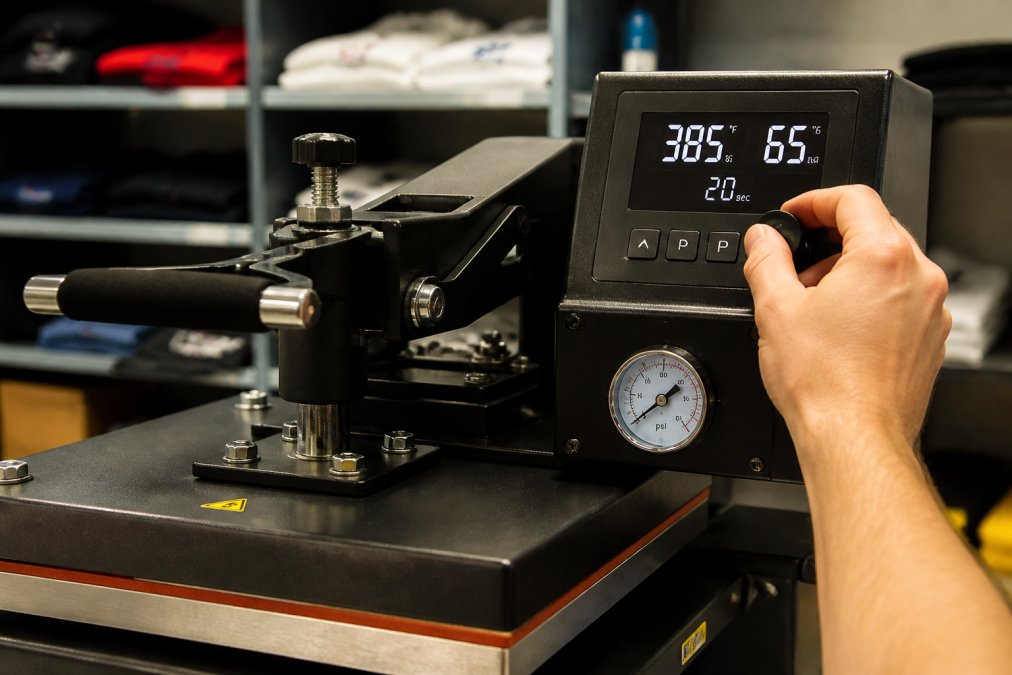
Temperature settings by method:
-
Screen printing: 300-320°F for 2-3 minutes (flash cure between colors at 280-300°F)
-
Embroidery: No heat required (thread bonds mechanically)
Temperature tolerance is tight: a 15°F variance causes visible defects.
Pressure: The overlooked variable:
Correct pressure (50-70 PSI for most applications) ensures even ink transfer. Too light (under 40 PSI): prints wash out within 5-10 cycles. Too heavy (over 80 PSI): fabric fibers crush and thread breaks.
Pressure must be uniform across the entire platen. Cheap heat presses cause spotty results with temperature gradients across garments.
Curing time and ink bonding:
Curing allows ink to fully bond with fabric fibers. Rushing this step is the most common cause of premature peeling and cracking.
- Undercured prints (dwell time too short): Ink sits on fabric surface; peels within 5-15 washes
- Properly cured prints: Ink penetrates fiber structure; survives 50-100+ washes depending on method
- Overcured prints (rare): Excessive heat can degrade ink color or scorch fabric
Dwell time varies by fabric type. Thick, dense fabrics (heavy cotton, performance blends) require longer dwell times than lightweight synthetics.
Equipment maintenance and calibration drift:
Calibration checks:
- Use a digital thermometer or infrared gun to verify actual platen temperature monthly
- Check pressure consistency by placing a pressure-sensitive film under the platen and inspecting color uniformity
- Replace heating elements if temperature fluctuates more than ±10°F during a production run
- Inspect platens for warping; a warped platen creates uneven pressure across the design
Long-term maintenance costs:
A commercial heat press costs $1,500-$5,000 upfront. Maintenance adds $200-$500 annually:
- Replacement heating elements: $150-$300
- Platen resurfacing or replacement: $200-$400
- Thermostat recalibration or replacement: $100-$200
Diagnosing pressure-related failures:
- Uneven ink coverage (spotty or faded areas): Platen is warped or pressure is uneven. Check with pressure-sensitive film.
- Ink bleeding into adjacent areas: Pressure is too high, forcing ink through fabric weave. Reduce PSI by 5-10.
- Designs peeling at edges first: Pressure is too light at the perimeter. Verify platen flatness and increase overall pressure.
- Fabric texture flattening (shiny spots): Pressure is too high or dwell time is too long. Reduce both by 10-15%.
Professional equipment maintains consistency:
Ensuring Durability and Wash-Fastness
Durability determines whether your custom sports gear investment lasts one season or five. Wash-fastness refers to how well colors and designs survive repeated laundering.
Factors affecting longevity:
- Ink quality and proper curing
- Fabric type (polyester outlasts cotton for most methods)
- Wash temperature (cold water extends print life)
- Detergent type (gentle formulas reduce fading)
- Dryer heat (air drying is gentler than machine drying)
Troubleshooting Common Printing Defects
Even with proper technique, defects happen. Identifying the cause prevents repeat problems and saves money on reprints.
Cracking and peeling:
- Cause: Insufficient heat, pressure, or curing time
- Fix: Increase temperature by 10-15°F or extend dwell time
- Prevention: Use calibrated equipment and test settings before production
Color fading or dullness:
- Cause: Incorrect color profile (RGB instead of CMYK) or low ink saturation
- Fix: Convert files to CMYK and increase ink density settings
- Prevention: Verify color profile before sending files to production
Pixelation or blurry edges:
- Cause: Low-resolution artwork or improper file scaling
- Fix: Require vector files or minimum 300 DPI raster images
- Prevention: Request artwork in correct format from the start
Uneven coverage or spotty printing:
- Cause: Dirty screens, worn equipment, or inconsistent pressure
- Fix: Clean screens thoroughly and check press calibration
- Prevention: Maintain equipment regularly and replace worn parts
Ink bleeding or color separation:
- Cause: Mesh screen too coarse or ink too thin
- Fix: Use finer mesh for detail work and proper ink viscosity
- Prevention: Match mesh count to design complexity
Frequently Asked Questions
What is the difference between sublimation printing and screen printing for sports gear?
Screen printing applies ink through mesh screens, providing bold, opaque coverage and is ideal for high-volume team orders. Choose screen printing for solid colors and logos on traditional team uniforms.
How long does the custom jersey printing turnaround time typically take?
Custom jersey printing turnaround time depends on the printing method and order volume. Screen printing may take 10-14 days due to setup and curing time. Rush options are available for urgent orders. Factors affecting turnaround include design complexity, quantity, fabric availability, and whether artwork requires revision. Contact Piercy Sports and Apparel for current production schedules and rush pricing options tailored to your deadline.
What file formats and resolution do I need for artwork preparation?
Submit artwork as vector files (AI, EPS, or PDF) for logos and text, which scale without pixelation. For full-color designs, provide high-resolution raster files at 300 DPI minimum. Use CMYK color profile for print accuracy, not RGB. Ensure artwork is sized to final garment specifications. If your design is low quality, professional designers can redraw or enhance it before printing. Provide clear specifications on placement, size, and any special color requirements to ensure your design matches your vision.
How do I ensure custom printed sports gear will hold up after washing?
Durability depends on printing method and proper care. Screen printing requires proper curing time and ink saturation to prevent cracking. Embroidery provides the longest-lasting results, resisting fading and wear. Recommend customers wash in cold water, use mild detergent, and air-dry to maximize garment longevity. Quality inks and proper pressure settings during production are critical, professional printing services test wash-fastness standards to guarantee durability.