Table of Contents
- What Makes Moisture-Wicking Fabrics Essential for Softball
- How Moisture-Wicking Technology Works in Performance Apparel
- Custom Softball Jersey Fabric Types: Polyester, Nylon, and Blends
- Benefits of Polyester vs Cotton for Sports Uniforms
- Fabric Weight and Construction for Softball Performance
- How to Care for Moisture-Wicking Uniforms
- Selecting the Right Fabric for Your Team’s Needs
- Conclusion
- Frequently Asked Questions
Last Updated: September 27, 2026
What Makes Moisture-Wicking Fabrics Essential for Softball
The best moisture wicking fabrics for summer softball uniforms are textiles engineered to pull sweat away from the skin and move it to the fabric’s outer surface, where it evaporates quickly. For softball players, this capability matters more than most realize, the difference between a jersey that clings to your body after the first inning and one that stays dry can affect your comfort, performance, and focus on the field.
The problem with traditional cotton uniforms is straightforward: cotton absorbs moisture rather than wicking it. Once saturated, it stays wet against your skin, creating chafing, discomfort, and that heavy, clammy feeling that distracts you during critical plays. Moisture-wicking fabrics solve this by using synthetic fibers with hydrophobic properties, they repel water and move it outward through capillary action, the same mechanism that allows plants to pull water up through their roots.
At Piercy Sports and Apparel, we understand what fabric performance actually means on the diamond. It’s not just about staying dry, it’s about maintaining breathability, durability through sliding and diving, and the ability to hold custom embroidery and sublimation printing without degradation. Below, we’ll walk you through the specific fabrics that deliver these qualities and how to select the right choice for your team’s needs.
How Moisture-Wicking Technology Works in Performance Apparel
Moisture-wicking operates through a two-stage process: first, the fabric’s hydrophobic fibers repel water molecules, preventing absorption. Second, capillary action, the natural tendency of liquids to move through narrow spaces, pulls moisture from the inner layer of fabric to the outer surface. Once there, the moisture evaporates into the air, leaving the fabric dry and your skin comfortable.
The key to effective wicking is fiber selection and construction. Synthetic fibers like polyester and nylon have a natural resistance to water absorption. When these fibers are knitted into a tight weave with a textured inner surface, they create pathways for sweat to travel outward while the outer surface remains hydrophobic. This is why performance apparel feels different from casual cotton, the engineering is intentional.
Thermal regulation plays a role too. As sweat evaporates from the fabric surface, it carries heat away from your body, naturally cooling you during intense activity. This is why moisture-wicking jerseys feel cooler than cotton even when both are wet, one is actively shedding moisture while the other is holding it.
The effectiveness of wicking depends on three factors: fiber type, knit construction, and finish treatments. A polyester jersey with a loose weave won’t wick as effectively as one with a tight, engineered knit. Similarly, finish treatments, special coatings applied after manufacturing, can enhance or diminish wicking performance. Understanding these variables helps you choose fabric that will actually perform when your team needs it.
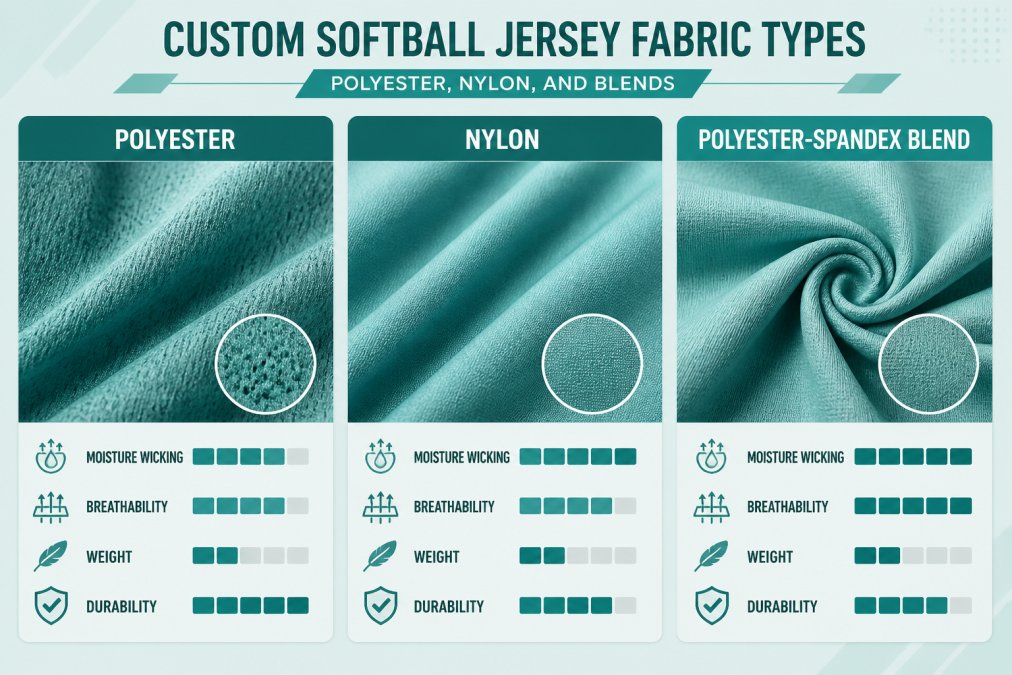
Custom Softball Jersey Fabric Types: Polyester, Nylon, and Blends
Polyester: The Industry Standard
Polyester dominates custom softball uniforms for good reason. It’s durable, affordable, and performs reliably across a range of conditions. Polyester fibers are inherently hydrophobic, meaning they naturally repel moisture. When woven into a performance knit, polyester delivers consistent wicking with minimal degradation over time.
The real advantage of polyester emerges in durability. Softball involves sliding, diving, and contact with dirt and grass. Polyester resists pilling (those small balls of fiber that form on fabric surfaces) better than most alternatives, and it holds its shape through repeated washing. For teams ordering custom jerseys that need to last a full season or longer, polyester is the dependable choice.
Polyester also accepts sublimation printing exceptionally well. Sublimation, the process of printing designs directly into the fabric using heat and special inks, requires a synthetic fiber base. Polyester’s structure allows dyes to bond at the molecular level, creating vibrant, durable designs that won’t crack or peel. If your team wants custom graphics that withstand repeated washing and sweat exposure, polyester is the foundation you need.
One limitation: polyester alone can feel slightly less breathable than blended fabrics, particularly in very hot conditions. This is why many manufacturers blend it with other fibers to optimize performance.
Nylon: Durability and Stretch
Nylon offers something polyester doesn’t: natural elasticity. Nylon fibers have inherent stretch, which means a nylon jersey moves with your body rather than constraining it. For players who value freedom of movement during batting and fielding, this matters.
Nylon also excels in durability. It’s more abrasion-resistant than polyester, making it the better choice if your team regularly slides or plays on rough fields. The fiber won’t pill as easily, and it resists tearing under stress. For youth leagues where uniforms take a beating, nylon can extend the lifespan of your gear.
The trade-off is cost. Nylon is more expensive than polyester, and the price difference adds up across a full roster. Additionally, nylon’s moisture-wicking performance, while adequate, doesn’t match polyester’s efficiency. Nylon absorbs slightly more moisture before releasing it, which means you’ll feel a bit wetter during intense activity.
Nylon is also less ideal for sublimation printing. While it accepts dyes, the results aren’t as vibrant or long-lasting as on polyester. If custom graphics are important to your team’s identity, nylon requires a secondary printing method like screen printing or embroidery.
Polyester-Spandex Blends: Optimal Performance
Polyester-spandex blends represent the sweet spot for most softball teams. This combination pairs polyester’s wicking efficiency and durability with spandex’s stretch and comfort. A typical blend runs 88% polyester and 12% spandex, enough spandex to provide meaningful stretch without compromising the fabric’s structural integrity.
The result is a jersey that moves with you, wicks sweat effectively, and maintains its shape through a full season. Spandex adds dimensional stability, meaning the fabric resists shrinking and warping in the wash. For teams that need uniforms to fit consistently across multiple washings, this is valuable.
Polyester-spandex blends also work beautifully with sublimation printing. The polyester base accepts the dyes while the spandex ensures the design stretches without cracking. This combination is why most professional and semi-professional teams use polyester-spandex for custom jerseys.
The only consideration is cost, blends are more expensive than pure polyester. However, for a team ordering custom uniforms, the performance and longevity justify the investment.
When comparing fabric quotes, ask specifically about the polyester-to-spandex ratio.
Benefits of Polyester vs Cotton for Sports Uniforms
Cotton and polyester represent fundamentally different approaches to fabric design. Cotton is natural, breathable, and comfortable for casual wear. But for sports uniforms, polyester outperforms cotton in nearly every measurable way.
Cotton absorbs moisture, it can hold up to 27% of its weight in water before feeling wet. Once saturated, it stays wet against your skin, creating chafing and discomfort. It also dries slowly, which means your uniform stays damp long after you leave the field. For a sport like softball, where you’re active for two to three hours in warm weather, this is a significant problem.
Polyester, by contrast, absorbs less than 1% of its weight in water.
Fabric Weight and Construction for Softball Performance
Fabric weight, measured in grams per square meter (GSM), directly impacts how a uniform feels and performs. Lighter weights (around 140-160 GSM) create a more breathable, flexible jersey. Heavier weights (180-220 GSM) offer more durability and structure but can feel slightly warmer and less flexible.
How to Care for Moisture-Wicking Uniforms
Proper care extends the life of your team’s uniforms and maintains their performance. Moisture-wicking fabrics require different handling than casual cotton clothing.
Never dry-clean moisture-wicking uniforms. The harsh chemicals used in dry cleaning damage synthetic fibers and strip away performance finishes. Dry cleaning is appropriate for formal wear, not for athletic apparel.
Selecting the Right Fabric for Your Team’s Needs
Choosing the best moisture wicking fabrics for summer softball uniforms comes down to balancing performance, durability, budget, and aesthetics. Start by identifying your team’s priorities.
| Fabric Type | Moisture-Wicking | Durability | Stretch | Cost | Best For |
|---|---|---|---|---|---|
| Polyester | Excellent | Very Good | Minimal | Low | Budget-conscious teams, vibrant sublimation |
| Nylon | Good | Excellent | Natural | High | Rough playing conditions, maximum durability |
| Polyester-Spandex | Excellent | Very Good | Excellent | Medium | Most teams, balanced performance and comfort |
Conclusion
Choosing the right moisture-wicking fabric for your summer softball uniforms affects comfort, performance, and durability. Polyester-spandex blends deliver the best combination of wicking efficiency, stretch, and longevity for most teams. At Piercy Sports and Apparel, we specialize in custom jerseys engineered for athletic performance, featuring high-resolution digital printing, premium embroidery, and durable construction that withstands a full season of play.
Frequently Asked Questions
What fabric is most moisture-wicking for sports uniforms?
Polyester-spandex blends are the most effective moisture-wicking fabrics for sports uniforms. Polyester moves sweat away from skin through capillary action, while spandex (typically 5-10% of the blend) adds stretch and recovery. Pure polyester performs well but lacks the flexibility athletes need. Nylon blends also work effectively for high-durability applications. Cotton absorbs moisture rather than wicking it, making it unsuitable for intense athletic activity.
Why is polyester the industry standard for softball jerseys?
Polyester dominates softball uniform production because it excels at moisture transport, dries quickly, resists wrinkles, and maintains dimensional stability through repeated washing and sliding. Its hydrophobic fiber structure actively moves sweat away from the body rather than absorbing it. Polyester also accepts sublimation printing beautifully, allowing vibrant, durable custom designs that withstand the friction of sliding and diving. The fabric’s durability and affordability make it the practical choice for team uniforms.
What’s the difference between polyester and cotton for athletic wear?
Polyester actively wicks moisture away from skin through its hydrophobic fiber structure, while cotton absorbs moisture and retains it, keeping players wet and uncomfortable. Polyester dries in minutes; cotton takes hours. Polyester resists wrinkles and maintains shape through repeated wear and washing, while cotton wrinkles easily and can shrink. For softball, where players sweat heavily and slide frequently, polyester’s quick-dry and durability advantages make cotton impractical despite its comfort in casual wear.
How should teams care for moisture-wicking uniforms to maintain performance?
Wash uniforms in cold water with mild detergent and avoid fabric softeners, which coat fibers and reduce moisture-wicking ability. Dry on low heat or air-dry to preserve elastic fibers and prevent shrinkage. Turn jerseys inside out before washing to protect sublimated designs and reduce pilling. Avoid bleach, which degrades synthetic fibers. Proper care preserves the fabric’s capillary action and extends the life of custom embroidery and printing, ensuring uniforms perform season after season.