Last Updated: October 31, 2026
Quick Summary
Choose professional staff uniforms by first listing the daily tasks and working conditions for each role, then matching fabric, fit, style, and branding to that work. Group roles into two or three basic uniform types, test fabric by washing samples, and compare suppliers on total cost rather than the lowest quote.
- List each role’s tasks and conditions, such as bending, heat, or customer contact, before choosing any garment.
- Most businesses can cover their staff with two or three basic uniform types.
- Wash a fabric sample several times before committing, since store feel can mislead.
- Measure every employee with the same method and compare against each supplier’s size chart.
- Build a budget that includes garments, decoration, alterations, and replacement stock, then divide by garment lifespan.
Table of Contents
Piercy Sports and Apparel, based in Whiteland, Indiana, works with businesses that need professional staff uniforms built for real jobs. The best uniform decisions begin with a plain look at the daily tasks, the environment, and the people wearing the clothes.
A uniform is simply a set of garments that identifies employees and suits their work. Good uniforms do both jobs well: they look professional and they hold up to the demands of the role.
Start by listing the tasks each role performs. Then note the conditions around them. Ask these questions:
- Do staff bend, lift, climb, or kneel?
- Are they exposed to heat, cold, moisture, or dust?
- Do they interact with customers face to face?
- Do they need visibility for safety, such as on a loading dock or near traffic?
- Do they need pockets, tool loops, or badge space?
Write the answers down for each job title. Many businesses find that two or three basic uniform types cover most roles. A front-of-house team might share one look, while maintenance or shipping staff need something more rugged.
Watch out: Do not assume every department needs the same garment. Choosing one style for the whole company often leaves some staff overdressed for their work and others underprepared.
Check your state and federal workplace safety rules before you finalize choices for hazardous roles. The Occupational Safety and Health Administration (OSHA) publishes requirements for high-visibility clothing and personal protective equipment that may apply to your staff.
Once you know the work, the fabric choice gets much easier. That is the next step.
Pick Fabrics That Match the Job and Last Through Laundering
Fabric decides how professional staff uniforms feel, how they wear, and how long they stay presentable. The wrong material can wrinkle, pill, fade, or trap heat within a few weeks.
Match the fabric to the work:
- Cotton blends feel comfortable and breathe well, but they can shrink and wrinkle.
- Polyester blends resist wrinkles and hold their color, which suits daily wear and frequent washing.
- Performance knits wick moisture and allow stretch, which helps active staff.
- Heavier twills and canvas handle abrasion and rough use.
Laundering matters as much as the fiber. Ask each supplier for care instructions and shrinkage information. Then test a sample by washing it several times at the temperature your business will use. Check the seams, collars, and printed or embroidered areas after each wash.
Consider how often uniforms will be washed. A uniform worn daily by a restaurant server needs a different fabric than a jacket worn once a week in an office. Plan for replacement garments so staff always have clean options.
A common mistake is judging fabric by how it feels in the store. Wash a sample before you commit.
Run a Sizing and Fitting Process Your Whole Team Can Follow
Sizing causes more uniform complaints than almost anything else. A repeatable process saves time, reduces returns, and keeps everyone looking consistent.
Follow these steps:
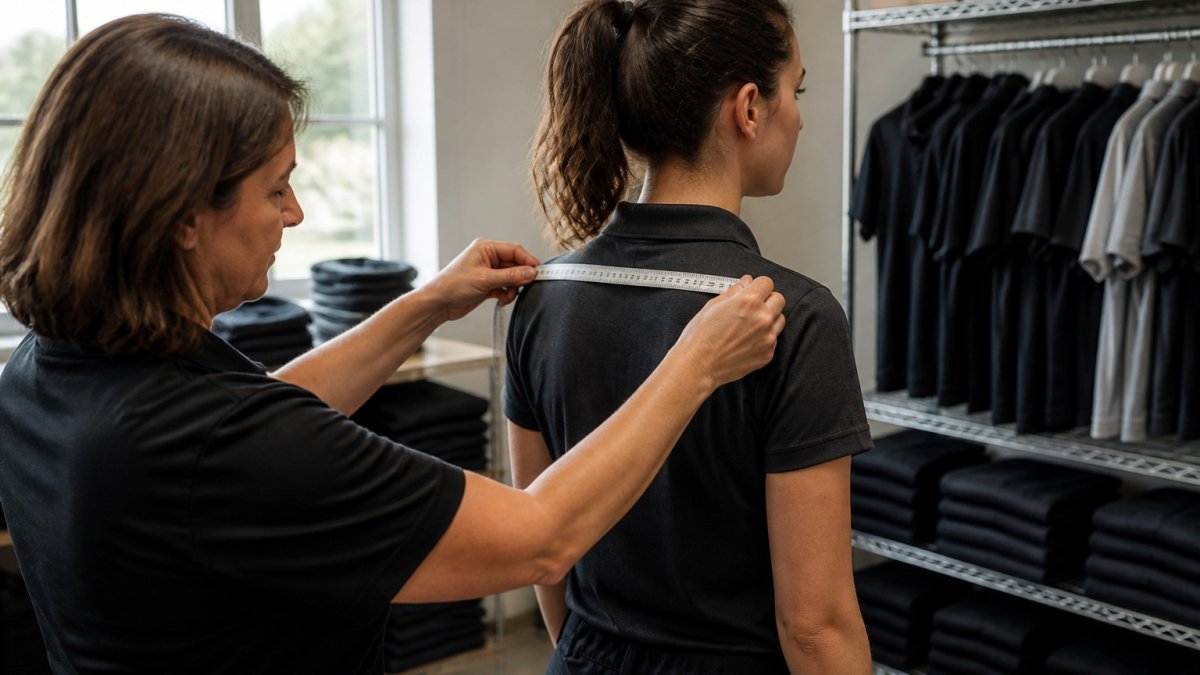
- Collect measurements for every employee using the same tape and method.
- Record chest, waist, hip, and inseam, along with height and any fit notes.
- Compare measurements against each supplier’s size chart, since sizes vary between brands.
- Have staff try on a sample garment before the full order is placed.
- Keep a fit record so future hires and reorders go smoother.
Ease of movement matters too. Ask staff to reach, bend, and lift during the fitting. A shirt that pulls at the shoulders or a pant that restricts the knees will cause problems within a day.
Respect privacy during measuring. Use a private space and let each person choose who helps them.
Choose Styles and Business Uniform Ideas That Fit Each Role
Style choices should support both the job and the brand. Business uniform ideas range from simple polos and button-ups to jackets, vests, and work pants. Pick a few core pieces and let each role build its look from them.
Good starting combinations include:
- Polo shirts with a fitted pant for retail or hospitality
- Button-down shirts with a blazer for client-facing office roles
- Zip-up jackets with cargo pants for field and maintenance crews
- Lightweight pullovers with embroidered logos for hybrid teams
Keep the color palette tight. Two or three colors across the whole team looks more polished than a rainbow of options. Your brand colors can anchor the look.
Balancing Comfort, Inclusion and Accommodations
Comfort affects performance and retention. Uniforms should suit different body types, genders, religious needs, and medical conditions. Offer a range of cuts and sizes, and allow reasonable changes for employees who need them.
A written uniform policy helps. Explain what is required, what is optional, and how staff can request accommodations. Review the policy when roles change or new hires join.
Decide How to Brand Uniforms and Compare Custom Embroidered Staff Shirts
Branding turns a uniform into a message. The two most common methods are embroidery and screen printing.
- Embroidery stitches the logo into the fabric. It looks professional, resists fading, and suits polos and jackets.
- Screen printing applies ink to the surface. It works well for large logos and bold designs on cotton tees.
Pricing depends on quantity, design size, stitch count, number of colors, and delivery date, so request a written quote from Piercy Sports and Apparel for current figures.
Logo files need to be clean. Ask for vector artwork when possible.
Evaluate a Uniform Supplier for Small Businesses and Budget the Total Cost
The cheapest quote is rarely the lowest total cost. Consider these factors when you compare suppliers:
- Minimum order quantities, especially if your team is small
- Turnaround time for production and delivery
- Quality of garments, decoration, and stitching
- Support for logo cleanup and digitizing
- Reorder terms and how quickly replacements arrive
- Return and replacement policies for sizing errors
Build a simple budget. Add the garment cost, decoration cost, sizing and alteration costs, replacement stock, and any setup fees. Divide the total by the expected lifespan of each garment to estimate the yearly cost.
Ask for examples of past work similar to your business. Browse our custom business apparel for staff buying guide for buying steps and pricing context.
Set Up a Reordering Plan Before Your First Order Ships
Uniforms wear out and staff change. A reordering plan keeps your team covered without emergency orders.
Track these items:
- Current inventory by size and role
- Garments reaching the end of their useful life
- New hires who need sizes
- Lead time from order to delivery
Order replacements before stock runs low. Keep a small reserve of popular sizes. Review the plan each quarter, and update your sizing records as staff join or leave.
Piercy Sports and Apparel can help you plan reorders so your team stays consistent. Visit our website to request a quote and talk through your staffing needs.
Frequently Asked Questions
How do I choose the right uniforms for my staff?
Start with the tasks each role performs, the environment they work in, and the image you want to project. Match fabric and style to those needs first, then choose branding. Ask a few staff members to wear sample garments for a shift before you commit to a full order. This keeps you from buying styles that look right on paper but restrict movement or overheat in practice. Document your choices so future hires receive the same standard.
What fabrics are best for staff uniforms?
Polyester blends are a common choice for durability and wrinkle resistance, while cotton blends offer more breathability for workers who are active or on their feet all day. Check the fabric weight and the stitching at seams and stress points, since those determine how long a garment lasts. Ask any supplier how the fabric holds color and shape after repeated washing, and request care instructions so your laundering routine does not shorten the garment’s life.
Should staff uniforms include a logo?
A logo helps customers recognize your staff and reinforces team identity, but placement and method matter. Keep logos on the chest or sleeve for visibility and avoid placing them where they interfere with safety equipment or name tags.
How do I choose a uniform supplier for a small business?
Look for a supplier that explains its production timeline in writing. Confirm how they handle logo files, and compare total cost, including setup fees and reorder charges, rather than unit price alone. Compare total cost, including setup fees and reorder charges, rather than unit price alone. Request a quote from Piercy Sports and Apparel for current pricing, which depends on quantity, timing and delivery.