Table of Contents
- What Screen Printing and Embroidery Are
- Screen Printing vs Embroidery: Key Differences
- Screen Printing Cost Per Shirt Explained
- Screen Printing vs Digital Printing: When Each Wins
- Screen Printing vs DTF: What You Need to Know
- How to Choose the Right Method for Your Order
- Frequently Asked Questions
Last Updated: October 8, 2026
What Screen Printing and Embroidery Are
Screen printing pushes ink through a fine mesh screen onto fabric. The mesh is coated with photo-emulsion and exposed to form a stencil; a squeegee pulls ink through the open areas onto the garment.
Embroidery stitches thread directly into fabric. A computerized machine reads your design file and builds the image layer by layer, producing a three-dimensional, textured design.
Both methods have been industry standards for decades, and at Piercy Sports and Apparel we use each depending on the project. The choice between screen printing and embroidery shapes durability, cost, speed, and finished look.
Screen Printing vs Embroidery: Key Differences
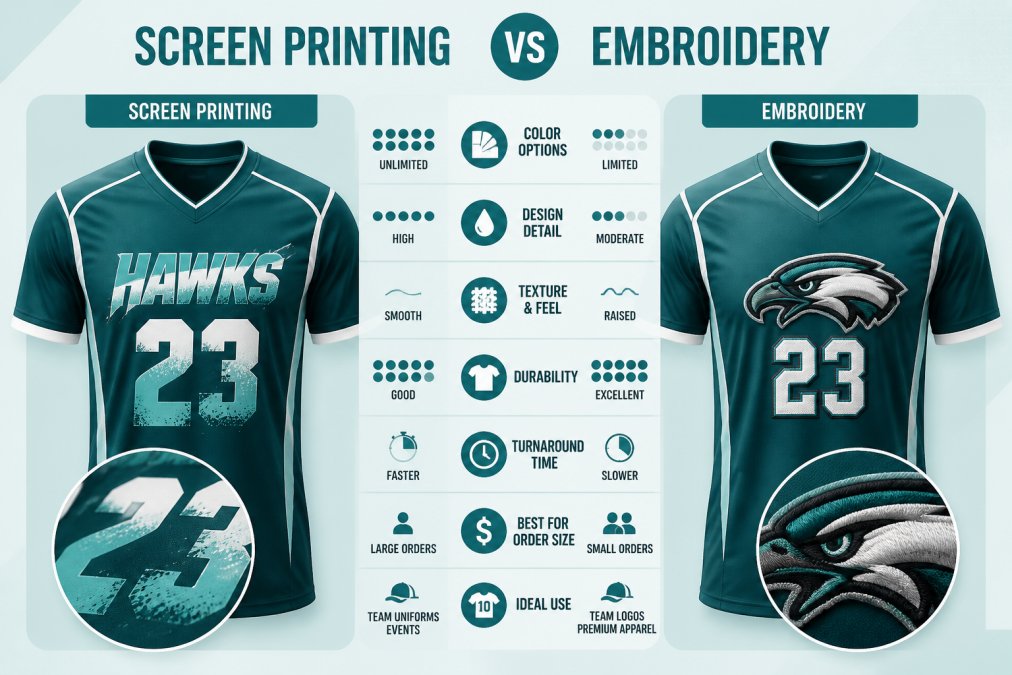
The two methods apply designs to fabric in fundamentally different ways.
Design Complexity and Color Options
Screen printing excels with complex artwork and unlimited colors. Each color needs its own screen, a five-color design needs five, but photographic images, gradients, and fine detail translate beautifully.
Embroidery works best with bold, simplified designs. Intricate details get muddled at small sizes, and switching thread colors adds cost, most embroidered logos use two to four colors.
Durability and Wash Performance
Embroidery wins on longevity. The thread bonds mechanically into the fabric, so stitched designs survive hundreds of washes without fading or cracking.
Screen printing durability depends on ink quality and curing. Properly cured plastisol lasts 50+ washes before noticeable fading; water-based inks fade faster. Because the print sits on top of the fabric, bleach or high heat eventually break it down.
For athletic uniforms that see heavy use and frequent washing, embroidery is the safer choice. For promotional products or seasonal apparel, screen printing holds up perfectly well.
Production Speed and Turnaround
Screen printing moves faster for large orders. Setup takes time, but once screens are made you can produce dozens of shirts per hour.
Embroidery is slower, each garment is stitched individually, taking several minutes per design.
If you need 500 shirts in two weeks, screen printing gets you there. If you need 20 custom polos by next week, embroidery might struggle with turnaround time.
Screen Printing Cost Per Shirt Explained
Screen printing pricing is a formula, not a single number. Understand the four inputs and you can get a quote.
The Four Inputs That Set Your Price
1. Screen setup (per color, per location). Every color in your design needs its own mesh screen burned with a stencil.
2. Garment cost. The blank shirt is often the largest line item.
3. Print cost (per unit, per color, per location). This is where quantity breaks live: ink, labor, and press time spread across your run, so more pieces means a lower per-impression cost.
4. Add-ons. Oversized prints, specialty inks (metallic, puff, discharge, glow), underbase for printing on dark garments, individual folding and bagging, and rush turnaround all add cost.
How Quantity Breaks Actually Work
Most screen printers use a tiered price sheet where per-unit print cost drops at thresholds, often 24, 48, 72, 144, 288, and 500 pieces. Setup is fixed, so the more units you spread it across, the smaller its contribution per shirt.
Minimum Order Quantities and Why They Exist
Most shops set a minimum because the press must be set up, registered, and torn down regardless of run length. Common minimums are 12-24 pieces for small-team shops and 24-144 for higher-volume operations; below that, shops add a surcharge or decline.
If your order is under the minimum, you have three options: pay the surcharge, combine your order with another design to hit the threshold, or switch to a method with no minimum (see the digital printing and DTF sections below).
What Pushes a Quote Up
- More colors. Each color adds a screen, a setup charge, and a print station pass.
- More locations. Front, back, sleeve, and neck label are four separate setups.
- Dark garments. Printing light ink on dark fabric usually requires a white underbase, an extra screen and an extra pass.
- Specialty inks. Metallic, puff, and discharge inks cost more and often run slower.
- Tight deadlines. Rush fees are common when you compress the normal turnaround.
- Small runs. Setup amortization is worse, so per-unit cost rises.
What Keeps a Quote Down
- One or two colors, one location. The simplest possible job.
- Light garments. No underbase needed.
- Standard plastisol on cotton. The most economical ink and fabric combination.
- Larger runs. Setup spreads thin and press time per shirt drops.
- Reorders. Screens already exist, so setup is often waived.
Ask any printer for a written quote that itemizes setup, garment, print, and add-ons separately. A single lump-sum number hides where your money is going and makes it impossible to compare two providers fairly.
Embroidery and Digital Pricing in Contrast
Embroidery pricing works differently: a one-time digitizing fee plus a per-unit stitch charge. With no screen, minimums are often lower and per-unit cost stays flat.
Digital printing (DTG) has no setup fee and no minimum, but per-unit cost is higher than screen printing at volume and durability is shorter. DTF sits between the two: low setup, flexible minimums, moderate per-unit cost.
For a quote built around your exact artwork, garment, and quantity, contact Piercy Sports and Apparel, we itemize every line so you can see precisely what you are paying for.
Screen Printing vs Digital Printing: When Each Wins
Digital printing works like a fabric printer, applying ink directly to garment material without screens or stitching.
Digital printing excels with photorealistic images, complex gradients, and one-off orders.
But the ink sits on top of fabric rather than bonding in, so durability lags behind screen printing and embroidery and colors can fade after 20 to 30 washes.
Screen printing outperforms digital printing for durability and color vibrancy on dark garments. If you’re ordering 50+ pieces and durability matters, screen printing is the stronger choice.
Screen Printing vs DTF: What You Need to Know
Direct-to-film (DTF) prints your design onto a special film, then transfers it to the garment with heat and pressure.
DTF works well for small to medium orders (12 to 100 pieces) where you want design complexity and reasonable durability without high setup fees.
For established, high-volume operations, traditional screen printing remains the industry standard. For small businesses and custom orders, DTF offers a middle ground worth exploring.
How to Choose the Right Method for Your Order
Most guides stop at “it depends on your order,” which is useless when you’re trying to place one. Here is a decision framework, an artwork-readiness checklist, and a provider-selection checklist you can use with any shop, including ours.
A Decision Framework You Can Apply in Five Minutes
Answer these four questions in order. The first one that clearly applies usually settles the method.
1. Is your design photorealistic, gradient-heavy, or more than six colors?
If yes, screen printing or digital printing.
2. Is your order under 24 pieces?
If yes, embroidery or digital printing.
3. Will the garment be washed frequently and worn hard (uniforms, workwear, athletic gear)?
If yes, embroidery is the most durable choice.
**4.
If your answers point in different directions, the tiebreaker is almost always budget versus durability. Cheap and short-lived favors digital.
Artwork Requirements: What to Send Before You Order
Most delays and surprise charges trace back to artwork that was not print-ready. Here is what shops typically need.
File format. Vector files (AI, EPS, PDF, SVG) are ideal for screen printing and embroidery because they scale without losing quality.
Resolution. For raster artwork, aim for 300 DPI at the final print size.
Color separation. Screen printing requires each color separated onto its own screen.
Color matching. Provide Pantone (PMS) numbers if brand color accuracy matters.
Embroidery-specific. Embroidery needs a digitized stitch file (common formats: DST, PES, EXP), not a vector.
Do not send a screenshot, a photo of a printed logo, or a low-resolution web image and expect a clean print. Redrawing artwork is a billable service at most shops, and it adds days to your turnaround.
A Provider-Selection Checklist
Use these questions with any printer you are considering. The answers tell you more than a price quote does.
-
Can they show samples? Ask for physical samples of comparable work, same garment type, similar complexity. Photos hide registration and ink coverage problems.
-
Do they provide a digital proof before production? A proof catches layout, color, and sizing errors before screens are burned. Skipping it is how expensive mistakes happen.
-
What is their stated turnaround, and what does rush cost? Get it in writing, including the ship date, not just the production start date.
-
What are their minimums and setup fees, itemized? A shop that won’t break out setup from per-unit cost is hard to compare against another.
-
What is their reorder policy? If they keep your screens or digitized file on file, reorders should be faster and cheaper. Confirm this before your first order.
-
What happens if the print is wrong? Ask about their written policy on misprints, misaligned prints, and short shipments.
-
Do they handle garment sourcing, or do you supply blanks? Both models are fine, just know which one you’re in.
-
Can they handle the full method mix? A shop offering screen printing, embroidery, digital, and DTF can recommend the right method for each part of your order instead of forcing everything through one process.
The best provider is not the cheapest quote. It is the one that gives you an itemized quote, a proof before production, a written turnaround, and a clear policy on errors. Those four things prevent almost every bad outcome.
Matching Method to Use Case
- Youth league and school team gear: screen printing for jerseys and spirit wear at volume; embroidery for hats, polos, and coach apparel.
- Corporate uniforms and workwear: embroidery for durability and a professional finish; screen printing for large back prints and event shirts.
- Promotional giveaways: screen printing for cost efficiency at volume; digital or DTF for small, personalized runs.
- One-off or sample orders: digital printing or DTF, no setup, no minimum.
- Reorders of an existing design: screen printing, since screens are already on file.
At Piercy Sports and Apparel, we offer screen printing, embroidery, digital printing, and DTF under one roof, so we recommend the method that fits your order rather than the one we happen to run. Send your artwork, quantity, garment preference, and deadline, and we’ll return an itemized quote with a recommended method and a proof before anything goes to press.
Frequently Asked Questions
Is screen printing or embroidery better for custom apparel?
Neither is universally better, it depends on your needs. Screen printing excels for photographic designs, gradients, and large orders where cost per shirt drops significantly. Embroidery works best for logos, text, and professional looks that need durability and a premium feel. Screen printing typically handles unlimited colors on a design; embroidery is limited by thread colors and thread count. For sports uniforms that endure frequent washing, embroidery often outlasts screen printing, while screen printing delivers sharper detail on complex graphics.
How much does screen printing cost per shirt?
Screen printing cost per shirt depends on order quantity, design complexity, and the number of colors. Setup fees (creating screens) mean small orders spread this cost across fewer shirts, raising the per-unit price. Large orders reduce per-unit costs significantly because the setup is shared. Pricing also varies by garment type and ink. Contact Piercy Sports and Apparel for a quote tailored to your specific order size and design to get accurate pricing.
What is cheaper, DTF or screen printing?
Screen printing is usually cheaper for large orders because setup costs are amortized across many units. DTF (direct-to-film) printing is more cost-effective for small orders and one-offs because it has no screen setup fees. DTF also handles full-color, photorealistic designs without color surcharges, while screen printing charges per color. For mid-size orders, the cost advantage shifts based on design complexity. Get quotes from your provider for your specific order to compare accurately.
Which apparel decoration method lasts the longest?
Embroidery typically lasts the longest because thread is stitched directly into the fabric, surviving hundreds of washes without fading or cracking. Screen printing durability depends on ink quality, curing, and wash care; high-quality screen printing can last 50+ washes, but cheaper inks may crack or peel sooner. DTF prints sit on top of the fabric and can crack with heavy wear, though premium DTF inks perform better. For uniforms and gear that endure frequent washing, embroidery and high-quality screen printing are the most durable choices.