Table of Contents
- Why Custom Business Apparel for Staff Matters
- Top Custom Apparel Options for Your Team
- Embroidery vs Screen Printing for Business Gear
- Low Minimum Custom Apparel for Small Business
- Best Practices for Employee Uniform Branding
- Sustainability and Ethical Sourcing in Custom Business Apparel
- How to Place a Custom Apparel Order Without the Headaches
- Conclusion
Last Updated: August 29, 2026
Custom business apparel is one of the most direct investments a company can make in how its team looks, feels, and represents the brand every day. At Piercy Sports and Apparel, we work with businesses of every size to turn logo files and brand colors into professional gear that holds up through real-world use. This guide covers every major apparel category, the key customization decisions you’ll face, and the practical steps that separate a smooth order from a frustrating one.
Custom business apparel is professionally decorated clothing items, including shirts, outerwear, and accessories, that carry a company’s logo, colors, or branding to create a unified, recognizable team identity. According to the Advertising Specialty Institute’s annual State of the Industry report, branded apparel is consistently the most recalled category of promotional products, with recipients keeping wearable items far longer than other promotional goods.
The fabric weight, decoration method, garment fit, and care instructions all determine whether your staff looks sharp in month one or month twelve.
Why Custom Business Apparel for Staff Matters
Professional, unified staff appearance signals organizational credibility to customers, builds team cohesion internally, and reduces daily friction around dress code decisions. Businesses in customer-facing industries consistently report that uniformed staff are perceived as more knowledgeable and trustworthy by customers.
Staff who receive quality branded gear often describe it as a tangible sign that the company invests in them. A cheap, ill-fitting shirt with a cracked print sends the opposite message. Custom apparel also eliminates ambiguity: customers know who works there, staff know what to wear, and management doesn’t field daily dress code questions.
Top Custom Apparel Options for Your Team
The best starting point for any custom apparel program is knowing which garment categories serve your team’s daily environment.
1. Embroidered Polos and Button-Downs
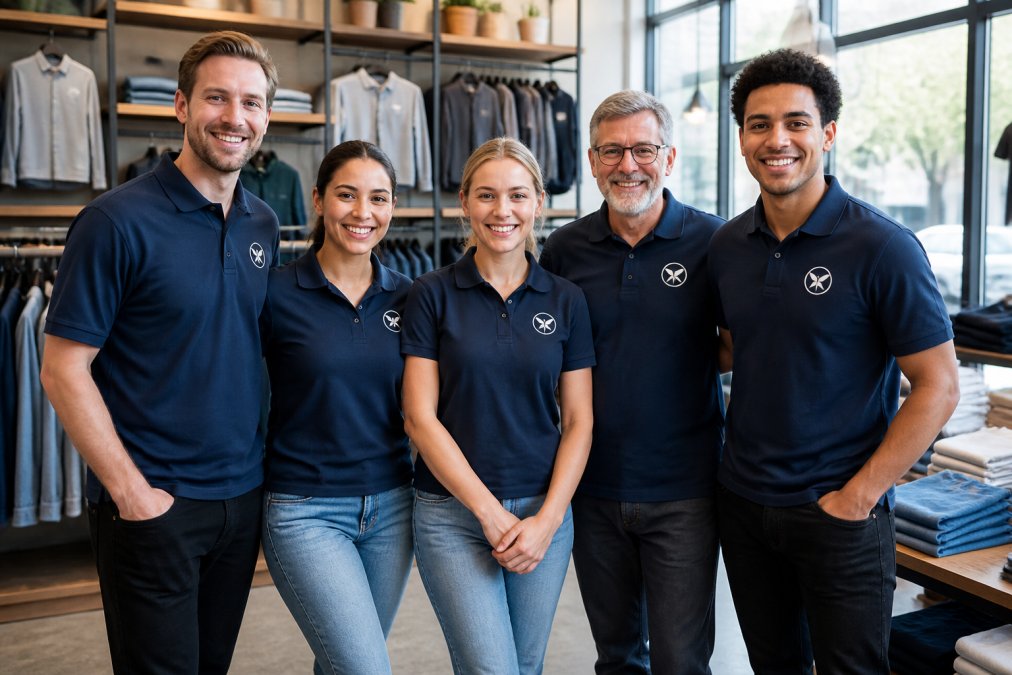
Embroidered polos are the workhouse of corporate identity programs. They read as business casual, hold up through commercial laundering, and the embroidery does not fade or crack with repeated washing, unlike screen printing.
Polos work across hospitality, healthcare reception, retail management, financial services, and any customer-facing environment. Button-down shirts carry a more formal register and suit sales teams and trade show staff. The left chest is the standard logo placement. Embroidery files require digitizing, so vector artwork is strongly preferred when submitting files.
2. Screen-Printed T-Shirts and Sweatshirts
Screen printing delivers bold, high-impact visuals at scale, making it the right choice for larger orders where cost per unit matters. T-shirts and sweatshirts suit warehouse teams, event staff, volunteer crews, and roles where comfort and mobility take priority over formality.
Sweatshirts extend uniform programs into colder months without requiring a separate outerwear budget. The main trade-off is that plastisol inks can crack over time if garments are washed incorrectly. Water-based inks offer better long-term durability, particularly on performance fabrics.
3. Branded Outerwear and Workwear
Outerwear earns its highest visibility, a branded fleece or jacket gets worn far beyond the workplace, turning every commute into brand exposure. Workwear, including reinforced pants and high-visibility vests, serves industries where garment performance is non-negotiable: construction, landscaping, logistics, and manufacturing.
Embroidery is the preferred decoration method for outerwear because it withstands outdoor conditions and repeated washing. For high-visibility workwear, confirm that decoration placement does not interfere with reflective striping.
4. Headwear and Accessories
Branded caps and beanies extend a uniform program at low per-unit cost and high wear frequency. Structured caps with embroidered logos are standard for professional settings. Laser engraving is an option for leather patch hats, which offer a premium aesthetic without high cost.
Accessories, including branded bags and aprons, round out a complete staff identity program.
5. Promotional Merchandise and Corporate Gifts
Promotional merchandise serves dual purposes: it equips staff with branded items for daily use and functions as corporate gifting for clients and partners. The distinction matters for budgeting. Uniform programs prioritize durability and volume. Corporate gifting prioritizes perceived value and presentation.
Embroidery vs Screen Printing for Business Gear
Choosing between embroidery and screen printing comes down to three factors: garment type, artwork complexity, and order volume.
Embroidery is best for structured garments like polos, caps, and outerwear. It produces a textured, dimensional finish that reads as premium and holds up through commercial laundering. The limitation is artwork complexity: fine lines, small text under roughly 0.25 inches, and photographic images do not translate well to embroidery.
Screen printing excels on flat, soft garments like t-shirts and sweatshirts. It handles large artwork, gradient colors, and photographic elements that embroidery cannot replicate. Per-unit cost drops significantly at higher quantities.
|
Factor |
Embroidery |
Screen Printing |
|---|---|---|
|
Best garment type |
Polos, caps, outerwear |
T-shirts, sweatshirts, bags |
|
Artwork complexity |
Simple logos, text |
Complex designs, photos |
|
Durability |
Excellent, no cracking |
Good; depends on ink type |
|
Minimum order impact |
Lower minimums viable |
Cost-effective at volume |
|
Finish |
Textured, dimensional |
Flat, vibrant |
An embroidered polo that lasts three years costs less per wear than a screen-printed shirt that cracks after six months.
Low Minimum Custom Apparel for Small Business
Small businesses and youth organizations often assume custom apparel requires large minimum orders. That assumption is increasingly outdated. Many quality decorators now offer low minimum or no-minimum ordering, particularly for embroidered items where setup costs are lower than screen printing.
According to the Small Business Administration’s guidance on branded marketing materials, consistent visual branding is one of the highest-return investments a small business can make in its early years.
Practical considerations for small orders:
- Proof approval: Always request a digital proof before production begins to catch color and placement errors.
- Turnaround time: Small orders often move faster through production queues, but confirm the timeline in writing.
- Artwork preparation: Low-quality logo files are one of the most common causes of poor results. A reputable decorator will tell you upfront if your file needs work.
- Reorder flexibility: Confirm whether your decorator can process small reorders without requiring a full minimum quantity restart.
Piercy Sports and Apparel works with organizations of all sizes with tailored solutions that fit the actual order size.
Best Practices for Employee Uniform Branding
Employee uniform branding works best when treated as a system, not a one-time purchase.
Logo Placement and Color Matching
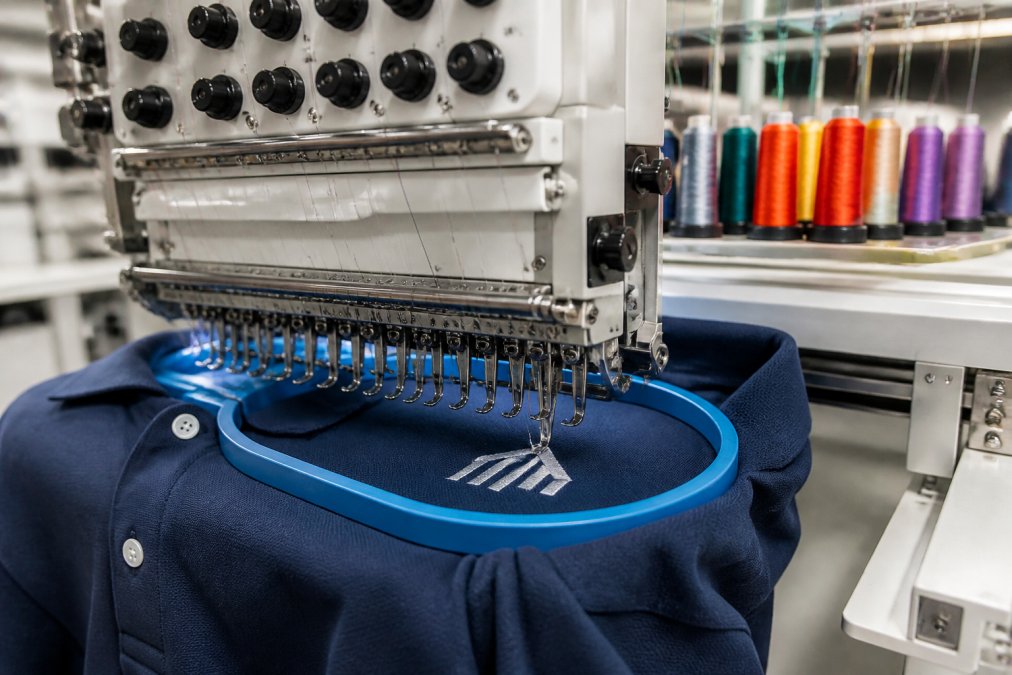
The left chest is the default for polos and button-downs because it aligns with natural eye contact during face-to-face interactions. Full-back placement works for outerwear and roles where staff are seen from behind.
Screen-printed colors are matched using the Pantone Matching System, a standardized color reference that ensures consistency across print runs. Embroidery thread colors follow a separate matching system, and thread texture means colors appear slightly different than flat ink. Always review an embroidery proof on the actual garment color before approving a full run.
Sizing, Fit, and Inclusivity
Standard sizing charts vary between garment manufacturers, and a size large from one brand may fit very differently from another. Requesting a size run sample before committing to a full order is standard practice.
Inclusive sizing matters practically and culturally. Staff who cannot find a garment that fit well either wear it uncomfortably or don’t wear it at all. Confirm that your chosen garment style is available across the full size range your team requires before finalizing the design.
Care and Maintenance to Extend Garment Life
The most durable decoration fails early if garments are washed incorrectly. General guidelines that apply across most decorated garments:
- Wash inside-out to protect decoration from abrasion
- Use cold water to prevent shrinkage and preserve print adhesion
- Avoid high-heat drying, which degrades both screen-printed inks and embroidery thread
- Do not iron directly over embroidered areas or screen-printed graphics
- For commercial laundering, confirm with your decorator which inks and thread types are rated for industrial wash cycles
Providing staff with written care instructions at uniform distribution significantly extends garment life.
Sustainability and Ethical Sourcing in Custom Business Apparel
Sustainability in custom business apparel is no longer a niche concern. Many businesses now include ethical sourcing criteria in vendor selection, and staff increasingly care about the provenance of what they’re asked to wear.
The Fair Labor Association’s apparel sourcing standards provide a reference point for evaluating whether a garment manufacturer meets baseline labor and environmental standards.
Key sustainability considerations:
- Fabric composition: Recycled polyester, organic cotton, and blended performance fabrics have different environmental profiles. Recycled polyester has gained significant traction in branded outerwear.
- Decoration chemistry: Water-based inks have lower environmental impact than plastisol inks and produce a softer hand feel.
- Garment longevity: The most sustainable garment is one that doesn’t need replacing. Investing in higher-quality blanks and decoration methods reduces total garment consumption.
- Supplier transparency: A reputable decorator should tell you where blank garments are manufactured and whether those facilities meet recognized labor standards.
Backing sustainability claims with verifiable sourcing information is more credible than generic “eco-friendly” language.
How to Place a Custom Apparel Order Without the Headaches
A structured approach prevents the most common delays and errors.
Step 1: Define your requirements before contacting a decorator. Know your garment types, approximate quantities, required sizes, and target delivery date before starting the conversation.
Step 2: Prepare your artwork in the right format. Vector files, typically in .AI, .EPS, or .SVG format, are the standard for apparel decoration. If your logo exists only as a low-resolution JPEG, ask whether your decorator offers artwork cleanup services.
Step 3: Request a digital proof before approving production. A proof shows exact placement, size, and color before any garment is committed. Approving production without a proof is the fastest way to end up with an order you can’t use.
Step 4: Confirm turnaround time in writing. Standard production timelines vary by decoration method and order volume. If you have a hard deadline, communicate it clearly and get written confirmation that it’s achievable.
Step 5: Plan for reorders from the start. Ask whether your artwork and order specifications will be saved for future runs. A decorator who retains your digitized embroidery file saves you setup costs on subsequent orders.
Step 6: Review your order confirmation carefully. Check garment style, color, sizes, decoration placement, and quantity before confirming. Errors caught at confirmation cost nothing to fix. Errors caught after production are expensive.
According to PPAI’s industry guidelines for promotional product ordering, the majority of order errors trace back to incomplete or unclear specifications provided at order placement.
|
Step |
Action |
Common Mistake to Avoid |
|---|---|---|
|
1. Define requirements |
Set quantities, sizes, deadline |
Starting without a firm delivery date |
|
2. Prepare artwork |
Submit vector files |
Sending low-resolution JPEGs |
|
3. Request proof |
Review before approving |
Skipping proof to save time |
|
4. Confirm timeline |
Get written delivery commitment |
Assuming standard timelines apply |
|
5. Plan reorders |
Confirm file retention |
Losing artwork between orders |
|
6. Review confirmation |
Check every detail |
Approving without reading |
Custom business apparel for staff is a decision with a long tail. The garments your team wears today will represent your brand for the next one to three years. Getting the fabric, decoration method, sizing, and care instructions right from the start is far less expensive than replacing a poorly executed program halfway through the season. Piercy Sports and Apparel combines high-resolution digital printing, premium embroidery, and screen printing with fast, reliable turnaround times and tailored solutions built around your exact requirements. Get started with Piercy Sports and Apparel and outfit your team with branded apparel that stays sharp from day one through year two.
Frequently Asked Questions
Q: What are the benefits of providing custom apparel to employees?
A: Custom business apparel for staff creates a consistent professional appearance that reinforces brand identity every time an employee interacts with a customer. Beyond brand visibility, uniforms reduce the daily decision burden on staff and signal team cohesion. Branded workwear also doubles as free advertising whenever staff are in public, extending your logo's reach without additional marketing spend.
Q: How do I choose between embroidery and screen printing for staff uniforms?
A: Embroidery is the better choice for structured garments like polos, outerwear, and headwear where a premium, three-dimensional look matters. It holds up through repeated commercial laundering without cracking or fading. Screen printing suits high-volume orders of t-shirts and sweatshirts where large, multi-color artwork needs to cover a broad chest area. If your logo is intricate or very small, embroidery after digitizing typically produces a cleaner result than screen printing at that scale.
Q: Can small businesses order custom apparel without meeting large minimums?
A: Yes. Many decorators, including Piercy Sports and Apparel, offer low minimum or no-minimum ordering so small teams and youth leagues can get professional custom apparel without overordering. Pricing per piece does decrease as quantity rises, but you are not forced to buy 144 shirts when you only need 15. Confirm minimum quantities and any setup fees before placing your order, and ask whether reorders for roster changes carry additional charges.
Q: How much does it cost to get custom staff apparel made?
A: Pricing for custom business apparel depends on garment type, decoration method, number of colors, order quantity, and turnaround time. Embroidered polos typically cost more per piece than screen-printed t-shirts because digitizing and machine time add to production costs. Bulk orders lower the per-unit price significantly. For an accurate quote specific to your logo, garment choice, and quantity, contact Piercy Sports and Apparel directly rather than relying on generic estimates.
Q: How can I create a custom work uniform if my logo file is low quality?
A: A low-resolution logo does not have to mean pixelated results. Reputable decorators can redraw or vectorize artwork before production. For embroidery, the digitizing process converts your design into stitch instructions, so the decorator works from a rebuilt vector file rather than your original image. Share the highest-resolution version you have, describe the colors precisely using Pantone references if possible, and request a digital proof before production begins to confirm the result matches your brand.
This article was written using GrandRanker